What Could Have Been

What do you regret? As a believer it is already forgiven.

“Many of us crucify ourselves between two thieves – regret for the past and fear of the future.”  

~Fulton Oursler

Regret is something that can really damage our lives. My dictionary defines regret as, “to feel remorse for, or to feel sorrow over something.” It’s often a difficult emotion for us, resulting in a paralysis of sorts. It is the personal sorrow about one’s behavior in a certain situation, that can be overwhelming.

There will always be a deep sense of loss for “what could have been.”

I regret many things, it seems my mind works as an active recorder. Future life continues its relentless advance, and there is from the past a constant awareness of darkness, failure and sin. Because the future comes at me so fast, I never really have time to reflect on the past.

There are some who have no idea what I’m talking about.

I might as well be speaking Chinese. But there are others who will “spark” on what I have just stated. Regret for many of us, is savage and bitter.

Not a day goes by when the voice of darkness doesn’t speak to us. My thinking is that it may be more reasonable to take a baseball bat across your femurs, and dealing with broken legs, than handling regret that has gone vicious and viral.

We think “about what could have been.” We imagine life without regret, of things we might have done not having this dark burden. However, these possible choices are things we can never be sure of.

In my younger days I dreamed of attending college, and then going to seminary. I really thought that I wanted to be a pastor, in some small Lutheran church in the Midwest. But this would never happen. It was just an aspiration, a dream. And it wasn’t reality (even though I wish it had been).

I assure you there are far more nastier and blacker regrets, there are things of which I am profoundly ashamed. But my point is this, they exist, they do unsettle us, and the present moment is corrupted by my past behavior.

I once read an interview with a prominent psychiatrist. He said something that connected with me. “Over 80% of mentally ill patients could be released from treatment if they only understand that they were forgiven.”

Regrets can be so strong, and so crippling that we will sometimes try to destroy ourselves.

You are not unique or alone. There are millions of sincere Christian believers who face what you are facing.

“The temptations in your life are no different from what others experience. And God is faithful. He will not allow the temptation to be more than you can stand. When you are tempted, he will show you a way out so that you can endure.”

1 Cor. 10:13, NLT

I must tell you that there is a spiritual war. Satan is the enemy of our souls. He will bring to your mind fear and confusion. In scripture, he is called “the accuser of the brethren.” He has a diabolical ministry to bring you down. He operates out of pure hatred.

He will never show you any mercy.

We must develop a more scriptural method of wrapping up our minds in God’s Word. It stops and deadens the spiritual radiation from the enemy. The Word has tremendous power to halt the enemies attack. The only way to survive all of this is to dress up yourself in spiritual armor.

“Therefore take up the whole armor of God, that you may be able to withstand in the evil day, and having done all, to stand firm.”

Ephesian 6:13

cropped-christiangraffiti1-2

Tears Do Things

I’ve been thinking a lot about tears lately—in part because Pastor Bryan pointed out to me how many hits my post titled God Keeps Your Tears in a Bottle has had, in part because I’ve cried more than a few tears this year, and in part because I’ve been listening to Johnny Cash’s Cry, Cry, Cry in my car all week—and I thought I’d share my thoughts with you all here.

First of all, people cry for a lot of reasons.

Earlier this year my sister died of breast cancer at only 61 years old. I cried, a lot. It’s normal and even helpful to shed tears over the death of a loved one even if we know where they are going when they die, because it allows us to express the grief we feel over not having them in our lives any more here on earth.

I remember a time I had a previous boss say some very cruel things to me in front of other people. She accused me of having done things I had not based on motives I did not have. I was very angry, hurt, and frustrated. And I cried, a lot. I didn’t cry in front of her, mind you, but afterwards I did. And it was good to express that anger to others.

Just yesterday I experienced unexpected tears.

I was reciting the prayers of the people in church, which I’ve done many times. Our church has many prayer concerns for members, family, and friends with health concerns and more. Towards the end of the prayer I began to lift up prayers for a church member’s brother-in-law who is a pastor back in New York because he is faced with conducting the funerals of two teens who had been killed in an accident last week.

I recently wrote this poem.

Tears

Tears of sorrow, anger
drench my soul
course without end
eroding pain, anguish

Where once only aching
occupied my heart
now is a deep empty ravine
carved by a river of tears

Tears of forgiveness
water my soul’s riverbed
allowing flowers of love
to flourish and grow

Peace arises in my heart
held aloft by God’s promises
the fragrance of sweet alyssum
blossoms of my soul

I think the saddest tears of all, though, are the tears of major clinical depression. These tears are so sad because the one who cries them doesn’t know what purpose they serve.

I remember when I was suffering from depression sitting in a chair and just crying. When someone asked me why I was crying all I could say was, “I don’t know.” And I truly didn’t. The tears didn’t wash away pain; they only seemed to make it all the worse.

In the midst of such tears, there is One who knows their purpose.

Romans 8:26 says: “In the same way, the Spirit helps us in our weakness. We do not know what we ought to pray for, but the Spirit himself intercedes for us through wordless groans.” Through prayer God can sometimes lead us to an understanding of the purpose of the tears of depression, and ultimately to healing.

That makes your tears a good thing.

Henry Ward Beecher

Check out Linda’s site.

I’m More or Less Oblivious

Inspector Clouseau, (Upon discovering stolen artifacts) in The Pink Panther 2

“Ah yes, the Shroud of Turin! We will have to dry clean it before we return it.”

______________________

I honestly think that our bumbling attempts to follow Jesus are entertaining angels who watch our efforts and shake their heads in astonishment. “Did you see what Bryan just did?”

I’m the “Inspector Clouseau” of the spiritual realm.   😁  

Maybe you can relate?

Clumsy and very much oblivious, I bungle my way down the path of discipleship, without a clue. It seems when something right happens, I still end up butchering it. The Holy Spirit has His hands full. Scripture tells me He has no regrets.

We have experienced so much, and been given so much light.

And yet we consistently choose to trade it for a lie. For the most part, I don’t sin automatically, I sometimes choose it deliberately.  People don’t sin because they feel they have to. We sin because we like the pleasure it brings. We sin because it feels nice. It’s often a mask to cover the pain.

It’s a patch for the pain of my twisted up life.

We sin because it brings a thrill to our bodies, and excitement to the boredom of our everyday lives.  We sin because we believe the lie that the pleasure it brings, though passing (Heb. 11:25).

Sin happens when I look at anything or anyone other than God.

The issues I have are both spiritual and medical.  I survived a brain tumor and I need to walk with a cane. I have constant vertigo. My right arm is paralyzed. I struggle hard sometimes. I have some struggles with social anxiety. But God gives me buckets of His grace.  I know first-hand his agape love for me.

But He will not bless my disobedience and rebellion. 

When we announce to the world that “Jesus is Lord” we can expect God will hold our feet to the fire over this.  The Holy Spirit will not negotiate when we suddenly decide we are hungry for sin.  Apprehended by grace, we must fully surrender all claims we have to sample sin’s delights.

Who do we find joy in? It really does matter.

In the middle of my battles to be a believer, I must remember joy.  I cannot imagine being without it.  I’ve been clinically depressed pushed to the point of suicide.  But God gives me joy in my darkness.

“The joy of the Lord is your strength.”

Nehemiah 8:10

“For the Lord takes pleasure in his people; he adorns the humble with salvation.”

Psalm 149:4

1brobry-sig4 (2)

Rembrandt’s Prodigal Son

Rembrandt-The_return_of_the_prodigal_son
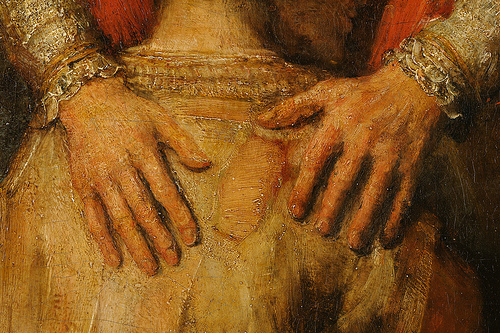
Rembrandt, “The Return of the Prodigal Son,” c. 1661

17 “But when he came to himself, he said, ‘How many of my father’s hired servants have more than enough bread, but I perish here with hunger! 18 I will arise and go to my father, and I will say to him, “Father, I have sinned against heaven and before you. 19 I am no longer worthy to be called your son. Treat me as one of your hired servants.”’ 20 And he arose and came to his father. But while he was still a long way off, his father saw him and felt compassion, and ran and embraced him and kissed him. 21 And the son said to him, ‘Father, I have sinned against heaven and before you. I am no longer worthy to be called your son.’ 22 But the father said to his servants, ‘Bring quickly the best robe, and put it on him, and put a ring on his hand, and shoes on his feet. 23 And bring the fattened calf and kill it, and let us eat and celebrate. 24 For this my son was dead, and is alive again; he was lost, and is found.’ And they began to celebrate.

Luke 15:17-24, ESV

Two hundred and eighty-nine words– these describe the life of every man, woman, and child who has ever lived. These 289 words reveal to us a God who loves far too much, way too easy. Perhaps we sort of expect that he will ‘appropriately’ punish his son– at least put him on probation at least. It only makes sense. But we find that is legalism talking.

“Every saint has a past, and every sinner has a future.” 

Many of us have lived as prodigals, and we have spent our inheritance like ‘drunken sailors.’ We really have nothing at all to show for it. The prodigal, completely destitute, takes the only work he can find. (Imagine a good Jewish boy feeding hogs.)

He is so far gone that he starts inspecting the filthy slop buckets for something to eat.

Many of us will understand his despair. Often there comes to us a crystalline moment of simple awareness. The prodigal, sin-crusted and impoverished, still has a lingering memory of the Father’s house.

The servants there had far more than him right now. Sometimes I wonder if in our captivity, we instinctively want to go home, if only in our minds, to be a servant there.

The Father has dreamed of this precise moment.

The parable says, “He saw him–felt compassion–ran out to him–embraced him–and kissed him.” The Father is a whirlwind of agape love. I’ve read the Parable of the Prodigal Son a hundred times or more. It never loses its punch. I simply want to bring some observations: 

  • We see that his father receives him with a tender gesture. His hands seem to suggest mothering and fathering at once; the left appears larger and more masculine, set on the son’s shoulder, while the right is softer and more receptive in gesture.
  • The son’s head is downy, almost like a newborn’s. We must enter the kingdom like little children. 
  • The Prodigal Son seems to be protected by his father. He snuggles near the Father’s breast. It’s love that holds him there.
  • Consider his sandals. It has taken a long time for him to come home. 
  • Standing at the right is the prodigal son’s older brother, who crosses his hands in stoic judgment; we read in the parable that he objects to the father’s compassion for his brother.
  • We see his mother in the background in the painting, and a seated steward or counselor. One stands in profound joy, the other in sits in stunned perplexity.

But Rembrandt had painted the Prodigal once before, when he was considerably younger. And it is a very good painting. The prodigal is happy and gay; there is absolutely no indication of the consequences of sin.

The Prodigal Son in the Brothel, 1635

He’s a charming young man at the height of his popularity, and we see him at a happy party. He is spending the inheritance of his father.

But Rembrandt chooses at the very end of his life to re-paint it to reflect reality.

This is one of the last paintings he will do, and it is the Prodigal Son–destitute and repenting. I can only imagine; the years have taken a toll and he doesn’t really feel his first painting is enough. He wants to paint what is true.

He now is painting our spiritual condition.

We are given a work that some critics call as the greatest painting ever completed. The painting is now in St. Petersburg, Russia. It is seldom seen by visitors. It is a clear echo of the grace of God for fallen men and women. Like the father in the painting, He’s ready to forgive every sin saturated son and daughter.

The Father’s Prodigal

bry-signat (1)