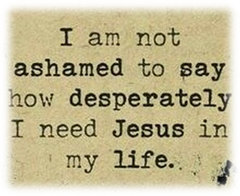
You Are Simply His Servant

“Which one of you having a servant tending sheep or plowing will say to him when he comes in from the field, ‘Come at once and sit down to eat’? Instead, will he not tell him, ‘Prepare something for me to eat, get ready, and serve me while I eat and drink; later you can eat and drink’?” 

“Does he thank that servant because he did what was commanded? 10 In the same way, when you have done all that you were commanded, you should say, ‘We are unworthy servants; we’ve only done our duty.’”

Luke 17:7-10

“The will of God for your life is simply that you submit yourself to Him each day and say, “Father, Your will for today is mine. Your pleasure for today is mine. Your work for today is mine. I trust You to be God. You lead me today and I will follow.”

    Kay Arthur

Really now. What little we give Jesus determines so much, since we owe him so much. The service that we can give to our Master Jesus is just a miniscule repayment for everything. Settle that now and God will use you.

Let’s think about this parable.

Question: Is the master unfair? Does he lord his authority over the servant? Is he taking advantage of him? Why is the servant so compliant? Every time I read this passage, questions like this always come up.

But even reading this, I still don’t grasp being a real servant. At least not consistently.

A couple of observations–

#1, the Holy Spirit really hasn’t taught me about being a total servant yet. Until he does, I don’t understand the deep meaning of this parable. (And it always goes deeper than I want it to.)

#2, I’m a product of my country, no such things like slaves, we’re a democracy. We have equal rights– to be a slave isn’t something I really understand. (It doesn’t really compute.)

#3, It’s purposefully constructed to create issues in my mind and heart. Something that “irritates” me–but in a good way. (Perhaps it’s the grain of sand that eventually becomes a pearl?)

And maybe all three are somewhat true. But no matter how I handle this parable, I always hit this spiritual speed bump. I really don’t grasp real servanthood. But yet, I still like this parable; I love reading it, no matter what it does to me.

We owe everything to him. Plain and simple.

I understand that I’m weak and shaky, but still, Jesus wants to be my Master. I’m his servant–at least I want to be–and He commands me to serve. Reading this parable puts this idea into a real perspective. OK, let’s now consider this verse:

1 Corinthians 6:20, ESV

A transaction has been made for your soul. God has intervened, and he’s given you salvation. We have a life now that will give us life, eternally. Since he is our master, we can no longer direct our own lives. Like the “unworthy servant” in verse 10, we now walk forgiven and very much redeemed.

Interesting. The parable isn’t really talking to us on how to be saved, that’s given to us by faith. Rather it points out the service we give Him after our salvation. We are simply His servants now.

And we owe it all to him, He’s our Savior, and now our Master.

   John MacArthur

Love Jesus First

Art by Eugène Burnand

Delusions of the First Person Variety

I need to briefly share what delusions are like.  I’m going to flip the switch and flood the room with light, and watch the “critters” scuttle to find a hiding place. 
I’m doing this to help heal myself, and for you to understand this awful state of mind.
First of all, let’s define things. 

Delusion n.
A false belief held despite strong evidence against it; self-deception. Delusions are common in some forms of psychosis. 

Delusion de·lu·sion n.
A false belief strongly held in spite of invalidating evidence, especially as a symptom of mental illness.

Typically, my delusions have a common core of pride or self-centered thinking. For instance, I have experienced all of these to a degree:

  1. A woman loves me and she is secretly trying to be with me. This is very flattering and egocentric.  This  one can really mess with your thought-life. (Ego.)
  2. I’m the center of the universe, people really do not exist, except when they come into my life or influence.  [This one is a bit metaphysical.] See #7.
  3. I have special powers that ‘know” a person’s motives, plans and heart.  I am hyper-discerning.  The opposite can be true at times, where I become exposed to people, which necessitates me never leaving my room. I feel “naked” and of course, very uncomfortable.
  4. I get paranoid, thinking people are plotting with each other behind my back, working to destroy me.  Chat rooms, and Facebook are focal points for me with this one, but not always.  With this one I get really verbal, and I start zapping people.  I guess because it’s the internet I can do this with impunity.
  5. Clocks are always at the top of the hour, like- 7:00 am.  Or they are at the bottom of the hour, like 11:30 pm.  I call this “chronosynchronism.” I believe this is evidence that my life is orchestrated, purposeful, and this is evidence I am very significant.  This is my latest.  And it really isn’t super disruptive.
  6. I can read secret messages in books meant for me.  I also line up spaces in what I’m reading to form an unbroken line.  I compulsively do this.
  7. The big one is this, I am in my form of “The Truman Show”.  The universe is just a set and I am the only living thing out there.  Everything is focused on me (of course).
  8. I hear voices sometimes, but mostly a radio or sometimes the “dot-dash-dot” of a telegraph.  I think its trying to warn me in some code.  It can be persistent. And it can be disruptive. Paranoid because my giftedness is the primary reason for the NSA to control me.
  9. My wife intends to poison me.
  10. Personal hygiene issues. Afraid of being murdered in the shower creates a super-phobia. I once went 6 weeks without showering. (I made my own eyes ‘water’, lol).
I guess all of these have one thing in common. 

They are self-centered.  They are unreasonable and illogical.  They are compulsive. And yes, meds do work.  And the above list?  The delusions are only mild-to-moderate issues of delusional paranoia.  There are so many Christians and non-Christians who have worse. I once met a man who seriously believed he was Jesus. (And no, I didn’t worship him).

As a believer working out his discipleship, I’ve discovered that humility and openness is always the way of keeping one tethered to reality.  However, I have a fear that I will break loose and never come out again.  I MUST live in “brokenness”.  (So in a strange way, following Jesus Christ is easier.)

Also, I must be open to things that will invalidate my delusion.  Even if I’m 99% convinced, that 1% will cause me to consider thinking through a scenario.  Truth is your best friend when you are challenging a delusional paranoid.  But it has to be gently applied. Life doesn’t have be lived this way. Also, delusions will often ‘morph’ and change and take on modified characteristics. This seems to be part of the mental illness, but can also indicate demonic oppression (or both even).

A psychiatrist should be informed in most cases. Very often meds will be necessary to get you through this time, but not always. But sometimes.

Praying for delusional behavior

People have prayed for me, more then I have prayed for myself.  Your intercession bridges a gap over this illness.  When you pray, you power up the energy cells and get instructions.  It may mean wait, or proceed.  Every person and situation is different.

“Do not believe that he who seeks to comfort you lives untroubled among the simple and quiet words that sometimes do you good. His life has much difficulty and remains far behind yours. Were it not otherwise he would never been able to find these words.”
Rainer Maria Rilke
Prayer is always the best approach.

So many delusions and so little time. They will vary from person-to-person. An active prayer may help, “Lord, may it be the real me who touches the real You.” Remember, Jesus stands at the right hand of his Father praying for you [which can’t be all bad].

 
 “Who is to condemn? Christ Jesus is the one who died—more than that, who was raised—who is at the right hand of God, who indeed is interceding for us.”

Romans 8:34

bry-signat (1)

Admitting I Need Jesus

When I was in the sixth grade, a friend invited me to her church. My parents didn’t go to church, but said I could go with Clarissa if I wanted to. Before long, I was spending at least three days a week with my church friends. I learned who Jesus was and that if I believed in Him I would be saved.

I believed, though I didn’t fully understand my need for a Savior.

It would be many years and much wayward living later before I would realize the importance of the Apostle Paul’s words to the church in Rome. “For I am not ashamed of the gospel, for it is the power of God for salvation to everyone who believes, to the Jew first and also to the Greek. For in it the righteousness of God is revealed from faith to faith; as it is written, ‘But the righteous man shall live by faith.’” (Romans 1:16–17 NASB).

It’s easy to think “of course I’m not ashamed of the gospel.” Why would anyone be ashamed of the good news that Jesus died for our sins so that we might be reconciled to Him?

But at its core, faith in the gospel requires the believer to say “I can’t do this myself.”

Well, let me tell you a little secret that believers and nonbelievers often forget. We humans, with all our self-importance, like to think we’re the kings and queens of the universe. We strut around like peacocks, patting ourselves on the back for our so-called brilliance. And you know what? We even pass that audacity onto our poor children, encouraging them to be little independent dynamos. But hey, who needs divine intervention when we’ve got our fabulous human ego, right? wink

I remember a time when my son was in high school and because of a snow day his class schedule was changed. As a result, he took the wrong books. He called to ask me to bring the right books to the school office on my way to work, which I happily agreed to do. When I got to the office to drop them off, the school secretary chided me for bailing him out. “These kids need to learn to be responsible or suffer the consequences,” she said.

I’ve thought of that encounter often, being thankful that Jesus didn’t say the same to the Father when the plan of salvation was put into place. What if Jesus had said, “You know Dad, these humans need to be more responsible or suffer the consequences.” We’d all be doomed.

And so, although it requires me to admit I can’t do it alone, I choose to live by faith in the One who gives me His righteousness.

For the broken believer (which is all of us, if we’re honest), it is all the more important to be okay with something less than full independence. We were created to be dependent on God and on one another. We were created to live in community and relationship with others.

Note: A version of this article was originally published in the January 2020 issue of The Christian Journal, a publication I highly recommend, and not just because they publish some of my writing.

I am Jonah

1 “But Jonah was greatly displeased and became angry. 2 He prayed to the LORD, “O LORD, is this not what I said when I was still at home? That is why I was so quick to flee to Tarshish. I knew that you are a gracious and compassionate God, slow to anger and abounding in love, a God who relents from sending calamity. 3 Now, O LORD, take away my life, for it is better for me to die than to live.”

 4 But the LORD replied, “Have you any right to be angry?”

Jonah 4:1-4, NIV 

Jonah is the very essence of the modern Christian who prefers God to be just like them (only more so.)  Just like Jonah we can be:

  1. unbelieving,
  2. unaccepting and
  3. unforgiving.

When you mix the three, (in a kind of “Jonah smoothie”) you will have something quite religious– but very toxic.  A toxicity that normally should require protective clothing and a quarantine.

Jonah has a sense of who God really is.  But, he disagrees.  In his eyes, God is way too excessive, way too elaborate in His love.  He makes way too many possibilities for forgiveness.  It drives him nuts, to serve a God that is way too liberal with His love.  It seems to push Jonah to try to readjust the love of God on his own.

In the eyes of Mr. Jonah, he simply must modify the “way of salvation.”  In his way of thinking, he can’t let God, be wholly God.  Jonah simply must step in, and dial back the real tendency of God to venture into His excessive and foolish love.  He must be thinking that what God is doing is way too outrageous, and far too far for human reasoning.

Amazingly, Jonah knows God deeply.  He knows, and he is afflicted by the grace that God has for these Ninevites.  Jonah doesn’t get vague, rather he gets specific.  He becomes more aware.  Verse 2 states Jonah’s deep awareness that God is simply too good for people, He is far too rich and generous with the behavior of people who live way too loose.

Since God seems so excessive we feel we must adjust Him.

It seems we must work to make Him more acceptable, and to redefine Him into a more focused kind of religious faith.  Something that makes sense to us His followers.  Something in the way the World perceives Him.  It so seems that this is a job that almost every believer jumps at. (I vote to send God to “rehab.”) :-)

But the LORD replied, “Have you any right to be angry?”  The Lord speaks specifically to Jonah.  He asks a question, which is a very good idea, when confronting foolish thinking.  “Have you any right?”  This question reverberates and echos through the corridors inside our hearts.  It seems our right doesn’t extend that far.  Being “angry” with God (and the way He does things,) is never an acceptable way of thinking.

Simply put, you have no right.  You have nothing.  There isn’t any allowance or prerogative given, that allows you to alter and adjust the way God wants His reputation and character to be made public.  Sorry, you can’t “airbrush” Him to meet the perceived ideas of the mass population.  He will not allow you to “photoshop” His face or presence, to make His love more presentable.