“Go and Learn” [Discipleship]


“When Jesus heard this, he said, “Healthy people don’t need a doctor—sick people do.” 13 Then he added, “Now go and learn the meaning of this Scripture: ‘I want you to show mercy, not offer sacrifices.’ 

“For I have come to call not those who think they are righteous, but those who know they are sinners.”

Matthew 9:12-13

This passage can be a bit of a challenge. But these two verses fit together like an old watch mechanism, small gears and wheels in precise motion, keeping time in a treasured grace.  My father had an old one, used once by a train conductor.  It was made of gold, and had been used for almost 100 years.

The complexity of these verses were never meant to confuse the disciples.  But for them it is simple, to go and learn.”  Certainly, there are times we will be ‘schooled’ in what we learn.  And really the only way to approach this is in humility.  Trying to extract the truth will take patience and a broken heart.

Jesus states the truth of being a doctor, and there is a singular work that a doctor does.  It is serving all who come to him with sickness or injury.  Jesus clarifies a truth that has to be in place.

“Go and learn what the Scriptures mean when they say, `Instead of offering sacrifices to me, I want you to be merciful to others.’ I didn’t come to invite good people to be my followers. I came to invite sinners.” v.13, CEV

“Go and learn!” This implies that there are lessons for us, classes that we need to take in order to grow-up, how to touch sick and desperate people.  Funny, but it’s all about mercy, and nothing to do with “sacrifices.”  Mercy is what matters. I want you to be merciful to others.”

I admit that I’d rather be right than to be merciful. (It’s good to be both.)  But mercy– and gentleness should be our driving impulse.  These attitudes assist us to move us forward. “Go and learn.”

The last verse reveals the thinking that Jesus has.  He has come to help those of us in trouble.  The good people don’t understand, after all, isn’t their ‘sparkly goodness’ enough?  As his disciples, we share our faith to all; but maybe we should consider the weak, poor and the sick already prepared for the words of Jesus? “Go and learn.”

“Discipleship is a lifelong process and journey rooted in a relationship with Jesus, whereby we become more like Christ.”

Greg Atkinson

1brobry-sig4


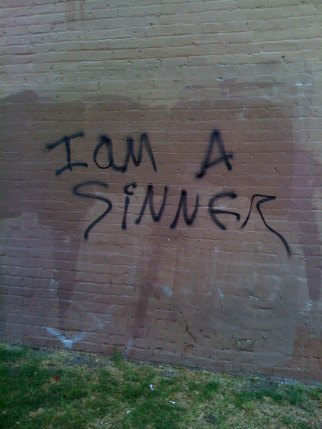
cropped-christiangraffiti1 (1)

(

Mary Magdalene

“Dear woman, why are you crying?” Jesus asked her. “Who are you looking for?”

She thought he was the gardener. “Sir,” she said, “if you have taken him away, tell me where you have put him, and I will go and get him.”

16 “Mary!” Jesus said.

She turned to him and cried out, “Rabboni!” (which is Hebrew for “Teacher”).

John 20:15-16, NLT

 A word, a name– and when He speaks it, it crackles.  “Mary!”  His recognition and affection saturates His greeting.  

And instantly Mary ignites.  Her love for Jesus is instantly awakened. Her heart bounds to Him, and she can see no one else.  Simply, “Mary”, and her routine universe is changed forever.

The Lord does not see masses, or crowds. 

He sees people, individuals that have names.  He simply doesn’t accept the idea of mass communications to make disciples.  His heart is for individuals.   He does not make styrofoam cups, He makes individual people. And that is exactly how He responds.

Her immediate response is just as forthcoming.  “Rabboni”.  The simple Hebrew word for “teacher”.  Obviously her relationship with Jesus has infused this word with much more than meets the eye.  As we trace her history with Jesus we develop a deep understanding into her walk.

You might say that Mary was well acquainted with spiritual things— for her it was almost exclusively evil. Mark 16 tells us of seven demons that had tortured her. Jesus had cast these dark powers out of her. She understood the dark torment Satan once had over her.

Mary speaks just one profound word. 

Rabboni.’ That word has deep and strong connotations.  Primarily, it has the concept of someone superior and yet exercising that gift in a quality way.  Mary has been given a quite exceptional gift–an opportunity to be a student who sits at Jesus’ feet.  Teacher.

Her ‘turning’ to Jesus is remarkable, but she is still not quite there yet.  However she turns to look at Him who now has risen out of death.  She already has evaluated all of this and she decides to commit.  Mary has arrived at the very place Jesus has chosen for her.

Jesus fully intends to make us His disciples. 

Embracing Him as God is a serious and brave step.  Actually, it is a ‘reality shifting’ concept that will change us.  That does not mean we will stop struggling.  But what it does mean is that certain things are now established.  

Can you trust Him that far?
“Christ will always accept the faith that puts its trust in Him.”

     Andrew Murray


The Weakest Link is Us

power-and-weakness

“Now when they saw the boldness of Peter and John, and perceived that they were uneducated, common men, they were astonished. And they recognized that they had been with Jesus.”

Acts 4:13

“God created the world out of nothing, and so long as we are nothing, He can make something out of us.”  

Martin Luther

Consider this: the jawbone of a donkey, a sling shot. and barley loaves, a woman’s tears, a young boy’s lunch, a young colt, and a talking donkey, they all suggest that God touches the common and the insignificant. He uses what we consider of minor importance.

We often turn to the talented and gifted far too readily.

Peter and John are being seen by the Sanhedrin (the Jewish “Supreme Court”). They are to give account of themselves before the highest court of the land. There had been a healing, and there was the matter of preaching as well. Both Peter and John exude a confidence that these religious leaders couldn’t deny. Their perception was that they were ignorant men. Uneducated and common. But, they also knew they had been with Jesus.

However, in the minds of the leadership, they were nothing more than religious white trash.

God loves to use what we consider common. His revealed history has been to take anything at His disposal and utilize it to redeem lost souls. A staff or a sling-shot are used with an adroitness that seems extraordinary among men. The things we think are simple and common are used to further God’s work among mankind.

But the message always returns back to the preachers. The Sanhedrin knew of the disciples preaching. They had absorbed the fact of a miracle; a crippled man had just been healed. (This they couldn’t deny.) But they were troubled. And they didn’t really know what to do.

What more could this be, but a direct intervention of God? And yet, God is working through extremely “common people.” Then let’s look…

“…if we are being examined today concerning a good deed done to a crippled man, by what means this man has been healed,”

Acts 4:9

Within this preaching was woven this healing. The Holy Spirit was ‘rocking their  world.’ The people who came in contact with these disciples would never be the same. Paul tells the Corinthian church that:

“Instead, God chose things the world considers foolish in order to shame those who think they are wise. And he chose things that are powerless to shame those who are powerful.”

1 Corinthians 1:27, NLT

If God has a specialty it would be this. He desires all the glory. He goes out of the way to use the broken and weak. He shows His strength through insignificant and minor things and people. This is His heart given to nobodies.

“We are all wounded. But wounds are necessary for his healing light to enter into our beings. Without wounds and failure and frustrations and defeats, there will be no opening for his brilliance to trickle in and invade our lives.”
“Failures in life are courses with very high tuition fees, so I don’t cut classes and miss my lessons: on humility, on patience, on hope, on asking others for help, on listening to God, on trying again and again and again.”

Bo Sanchez


The Bipolar Believer

BipolarArt4

“Unstable as water, you shall not have preeminence.”

Genesis 49:4

“And for those who live in the land where death casts its shadow, a light has shined”

Matthew 4:16

I’ve been down this road before. I’m not surprised by anything.

I guess this is my big issue with Bipolar Disorder (BP);  its unpredictability, and the way you fluctuate.  You get up in the morning and you immediately have to start analyzing your mood. 

“Am I more depressed than I was yesterday, or I am speeding up?” Am I acting appropriately, or am I stepping out of line again?”

For  B.P. people, we can never be totally sure about anything. 

We are always in a state of flux or movement.  As BPs who are believers in Jesus, it seems like we have broken every rule in the book, twice. This disorder almost always demands certain hypocrisy– which instills a lot of guilt and shame.

Almost 40 years ago, a visiting pastor to our church came up to me and told me that he had a word from God, especially for me. This was long before I was diagnosed with Bipolar. I can’t remember much, but I do recall him saying, “You are as unstable as water”. 

But I can also see now that my instability has made me a deeper, more tolerant person. 

I now give a lot of latitude to others’ shortcomings.  I know how difficult it is to process life and face issues.  Because I do this “yo-yo” thing, I can accept inconsistency as a normal part of life.  I realize that I’m not perfect, nor is anyone else I know. I’m learning to make allowances for it. 

Sometimes, just being aware is half the battle. And I’m starting to understand how God’s grace is given to others.

I’m learning to be gracious. I’m learning how to love, I think. Maybe this weakness is becoming a strength for me. I hope so.

“And He has said to me, “My grace is sufficient for you, for power is perfected in weakness.” Most gladly, therefore, I will rather boast about my weaknesses, so that the power of Christ may dwell in me.”

2 Corinthians 12:9, NASB


bry-signat (1)