Esteeming His Word

Quite often, we’re intimidated by the Bible.  We all can take on a verse or two.  But that is pretty much it.

The Bible isn’t made up of singular verses, but of whole books.  I intend to go on record, to encourage you to ingest the Word.  It’s as if we went to a Chinese restaurant buffet.  There is so many delicious choices.  But we load up exclusively on the “Kung Pao Chicken.”  We make many trips, but that is all we take.  Only the Kung Pao, and that’s it.

Have we really experienced this restaurant?  Or just the chicken?  The Word is extensively diverse.  There are recipes, and there are heaping and steaming platters of things we will never personally experience, and that is a shame.  So much is there, but we pick out just one thing.

I have been reading the first few chapters of the prophet Jeremiah.  It really humbles me, and I sense I’ve been sliced open and my innards have been drug out into the streets.  It has spiritually eviscerated me. It has opened me up, with a spiritual power.  (I’m sorry, but “Moby Dick” or “Great Expectations” or other works of classical literature does nothing comparable for me.)

God’s Word has a peculiar dimension to it.  What it does is spiritually forceful.  It eagerly waits for us–this leather backed book.  At random we pick it up and start to read.  Quite quickly, it slips through our issues, and it directly ministers to us.  It has such power that it enters our thinking, and detonates, when the time is right. And we are left to pick-up the pieces. (This is good.)

You see, His presence has throughly saturated His Word.  He comes and infuses His books.  They have been dipped in His very personality and brought out for us to read and handle.  The things we discover there develop an awareness of truth and what is real.  If you study, you will hear the voice of God.

You have not arrived.  There is still a substantial work to be done.  You desperately need God’s words.  And you don’t need to become proficient or educated.  Perhaps we should just strive to be holy and kind.  Even an unorthodox approach is better than none.  Please–put down the remote, take up your heart, and apply it to your Bible.  It won’t take long, but the work is eternal.

“The Bible is alive; it speaks to me. It has feet; it runs after me. It has hands; it lays hold of me!”

 — Martin Luther

bry-signat (1)

cropped-christiangraffiti1.jpg


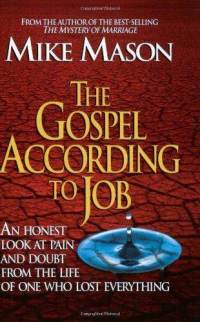
The Gospel According to Job

Today, I want to bring out this book, out into the spotlight.  It is a tremendous devotional that makes its way through the book of Job.  I have leaned on it, and it has held me nicely.  I challlenge you to get a copy of this, and to let it work in the confines of your spirit and mind. ––Bryan

A

Excerpt from “The Gospel According to Job,” by Mike Mason


“An Honest Look at Pain and Doubt from the Life of One who Lost Everything”

_______________________

A“Once I met a man who, like Abraham, had moved his entire household halfway around the world on the strength of a vision from God. When I asked him to tell me the story, he answered that there were three versions of that story, and which one did I want to hear? First, there was the version of the story that he told to Christians. Then there was the version he told to non-Christians. Finally, there was the truth. Job is a book that tells things from the third point of view. Probably, along with Ecclesiastes, it does this better than any other book in the Bible.

Not that the other Scriptures do not tell the truth. But Job tells the truth in a way that makes it almost impossible to pervert the truth into pious pabulum. A few years ago I went through a difficult time. Never mind what the problem was. It was nothing compared to the trials of Job. In fact, it was nothing at all compared to the sufferings of many of my neighbors right there on the quiet street where I lived.

But pain is pain, and suffice it to say that my pain was enough to drive me to my knees, totally defeated, half-crazy at times, and crying out for relief. Month after month the battles raged on, thick, dark, agonizing. I prayed, but somehow prayer did not ‘work.’ Usually nothing at all worked, except lying low and gritting my teeth until, for reasons entirely obscure to me, the straightjacket of oppression began to loosen a little––at least enough for me to get on with my life for another day or so before the screws tightened again. What else could I do? How was I to fight this?

In retrospect I can see that a large part of my anguish was rooted in the fact that there really was nothing I could do to control what was happening to me. I was absolutely helpless, and it is this, perhaps, that is the soul of suffering, this terrifying impotence. It is a little taste of the final and most terrifying impotence of all, which is death.

We Christians do not like to think about being absolutely helpless in the hands of our God. With all of our faith, and with all of His grace, we still prefer to maintain some semblance of control over our lives. When difficulties arise, we like to think that there are certain steps we can take, or attitudes we can adopt, to alleviate our anguish and be happy. Sometimes there are. But anyone who has truly suffered will know that when it comes to the real thing there is no help for it, no human help whatsoever.

Simply put, when we are in a deep dark hole we cannot think our way out; neither can we hope, sing, pray, or even love our way out. In fact there is absolutely nothing either we or anyone else can do to better our situation. We can have faith, yes; but in itself faith will not change anything. Neither faith, nor any other good thing that a person might have or do, can actually lift the cloud, move the mountain, or bring about an end to the problem.

Only the Lord Himself can do that, and when He does, as Exodus 6:6 puts it, “Then you will know that I am the Lord your God, who brought you out from under the yoke.” How will we know? Simply because nothing and no one else could possibly have done it. In this kind of crucible, therefore, we come to a new understanding of what it means to be saved, what it means to be snatched away from the brink of destruction.

Here we get down to the bedrock of the gospel. During my night of anguish, I turned to the book of Job, and there I began to make contact with the gospel in a way that somehow I never had in studying the New Testament. Reading Job, I found myself experiencing in new and astonishing depth the reality of Jesus’ promise in John 8:32,

 “You will know the truth, and the truth will set you free.”


cropped-christiangraffiti1.jpg

Yield to God

 I read a story about a radio exchange that took place some time ago between a U.S. Navy ship and Canadian authorities off the coast of Newfoundland. The Canadians warned the Americans and the conversation went something like this: “Please divert your course 15 degrees to the south to avoid a collision.”

The Americans responded, “Recommend you divert your course 15 degrees to the north to avoid a collision.”

The Canadians said, “Negative. You will have to divert your course 15 degrees to the south to avoid a collision.”

The Americans: “This is the captain of a U.S. Navy Ship. I say again, divert your course.”

“No. I say again, you divert your course.”

“This is the aircraft carrier USS Lincoln, the second largest ship in the United States Atlantic fleet. We are accompanied by three destroyers, three cruisers, and numerous support vessels. I demand that you change your course 15 degrees north. I say again, that is 15 degrees north or countermeasures will be undertaken to assure the safety of our ship.”

After brief moment of silence, the Canadians responded: “This is a lighthouse. It is your call.”

Sometimes we don’t like what God wants us to do, and we want Him to change course when, in reality, it is us who ought to change course.

We need to understand that God’s plans are better than ours. Having said that, it does not mean that they are always the easiest or even the most appealing at the moment. There are times when we are going through life that we might not like the plan of God. But God’s plans are always better for us in the long run.

“My thoughts are nothing like your thoughts,” says the Lord.
    “And my ways are far beyond anything you could imagine.

Isaiah 55:8, NLT

Can you say, “Yes, Lord. I am Your servant. Take me, use me, spend me. Fulfill all Your holy, eternal purposes in and through my life, whatever the cost”?

That area you have insisted on controlling, that part of you you’ve just stubbornly refused to yield, where you have insisted on things being your way – it’s time to drop your sword and raise your white flag. It’s time to surrender.

Those of us with a chronic illness can find many of their issues can be resolved by this simple act of yielding to God. There will be aspects that linger, but much peace of heart and mind will can come through a quiet release of your will to Him.

 bry-signat (2)
flourish31

Righteousness: His, Yours? (or Ours?)

“All of us are dirty with sin.
All the right things we have done are like filthy pieces of cloth.
All of us are like dead leaves,
and our sins, like the wind, have carried us away. “ 

Isaiah 64:6, NCV

________________

I have this reoccurring nightmare. I jump out of a plane.  I deploy my parachute, and it opens.  But it is completely full of holes!  Yikes!  I wake up before I splat. And then I think in a spiritual sense— what a relief it is to have a holiness that is given, or imputed.  If somehow you could turn off the spigot of the holiness he gives, and then run on your own merits; how far would you go?

Among good Christian people, there is an occupational hazard of sorts, and that is to “advance” in our thinking to that place where we are doing fine on our own.  We very much appreciated Jesus’ help– but now, at this moment, I must figure it out by myself.  This line of thinking, is called “self-righteousness.”

“Many have passed the rocks of gross sins – who have suffered shipwreck upon the sands of self-righteousness.” 

William Secker:’The Consistent Christian,’ 1660

We begin to travel in our sense of ourselves, away from a desperate, clinging to a trust in his mercy that is moving to a place of a confident, strutting awareness of having put ourselves back together again.  This is the ‘evil ones’ work– to steer you into self-righteousness.  Once you get there, he can just release you and let you ‘stew in your own juices,’ while he rules over your soul.

Becoming self-righteous should scare us to death.  It will damn our souls just as quick as adultery, or murder.  It is evil, and it sedates us to the place where it can work, unhindered and unchallenged.  I’ve read that some predators inject first an anesthetic to soothe their prey. This enables them to take their time, as they slaughter them.

I have had several bouts with self-righteousness.  (And I bet I’ll have several more.)  It is sin that will give you a wonderful back massage, just before it reaches for the knife that will cut your throat.  Somehow, we are lulled into this and my! I’m such a good person (even after such a dark and evil start.)

“Self-righteousness is the largest idol of the human heart – the idol which man loves most and God hates most. Dearly beloved, you will always be going back to this idol. You are always trying to be something in yourself, to gain God’s favour by thinking little of your sin, or by looking to your repentance, tears, prayers ; or by looking to your religious exercises, your frames, etc; or by looking to your graces, the Spirit’s work in your heart.”  

–Robert Murray McCheyne

 Jesus was, and is, and will be all my “righteousness.” 

We must cling to these hand-holds of grace.  The waves are substantial, and we most certainly would be swept out to sea.  But we grab and hold on to him.  And he holds on to us!  The fantasy of having enough of my own created righteousness to please God is simply a crock.  Jesus was, and is, and will be all my “righteousness.”  I have nothing– nothing else.

 bry-signat (1)

cropped-christiangraffiti1.jpg