Broken Dreams, On a Friend’s Suicide

This is a guest post from TheNorEaster, hope it blesses!

A TheNorEaster Post.

An old buddy of mine from high school recently committed suicide.

I cried myself to sleep the night I got the news, praying passionately and begging God to have mercy upon him.

John was the last person I would ever expect to take his own life. He always was quick with a joke, and his laughter was contagious.

When I got the news, I was fortunate enough to be with my best friend, who eventually asked, “How many is that?”

“Exposures?”

“And the people you were especially close to.”

“Mike shot himself, Ken’s two neighbors had some kind of ritual, Adrian stabbed his social worker to death to get shot by a cop, Judy’s killer hung herself in prison after beating her to death with a sledgehammer, Neal’s father-in-law shot himself, I don’t know how Kim did it, and then there was Britany, Terry, Nancy.

“And now, John. That’s ten, I think. It wouldn’t be so bad if there weren’t so many.”

Each new loss compounds the previous ones. And I kept wondering when it all would end, when my grief would finally pass — when I could, at long last, get on with my life.

As I write these words now, I realize these trials are my life. And that the only way anyone can ever avoid grief is pure apathy.

I grieve because I care. And I mourn because I have loved.

If there ever was a way to love somebody without ever getting hurt, or burned, even betrayed — Well, I sure wish somebody would put it in The Suggestion Box.

I’d be lying if I said that I am not angry at John. He left behind a wife. Two children. But, I also know, from what I know, that John covered his own wounds very well.

Until the blood of his wounds soaked through the bandage.

It has been said that America is “The Land of Opportunity.” And we are taught to pursue our dreams with ferocious tenacity — be it writing a book or making music or simply starting a family.

In the midst of it all, we sometimes forget that life is not, at all, fair. That those who live good and respectable lives come upon atrocious times. And that those who do achieve their dreams — even one as seemingly simple as starting a family, like John — do indeed have their own wounds with which to contend.

As I consider this, I cannot help but wonder — What is the purpose of a dream?

To achieve? To inspire? To be rich? Or famous?

“Not so with you. Instead, whoever wants to become great among you must be your servant, and whoever wants to be first must be your slave — just as the Son of Man did not come to be served, but to serve, and to give his life as a ransom for many.”
~Matthew 20:26-28

God sure does everything backwards, doesn’t He?

So, is it just possible that the relentless pursuit of a dream is a symptom of our spiritual poverty? Doesn’t Scripture tell us to be content? And yet, how can we possibly be content if we always want to be where we are not?

I am very much aware that those questions do sound discouraging. And, in fact, they are discouraging — until we consider the truth behind Psalm 37:4:

“Take delight in the LORD,
and he will give you the desires of your heart.”

For the longest time, I thought that passage was some sort of trade off, that if I took “delight in the LORD” then my dreams certainly would come true.

But, I realize now that what I have wanted — and even what I still do want — is so very rarely what God wants.

And that is why, to be sure, that delighting in the Lord does not mean getting what we want, but instead means that God gives us desires in our hearts to serve Him — in humility, with gratitude, and, above all, out of love.

“Whoever wants to become great among you must be your servant.”

And if my dreams must die that I may yet have a measure of greatness in the eyes of God, if I still must endure the terrible loss of my old buddy, if I need struggle with depression to run the race, if I must face my own foolishness in my fourth suicide attempt last year, if being broken is the cross I must carry in this life to see my precious Father face to Face…

…I’d say a few broken dreams cannot possibly compare to such heavenly glory.

“Sunset is Morning.”

Please check out TheNorEaster’s terrific blog at: http://thenoreaster.wordpress.com/

Two O’ Clock in the Morning Poetry, #6


Max Ehrmann (1872-1945)
Max Ehrmann
(1872-1945)

Go placidly amid the noise and haste, and remember what peace there may be in silence. As far as possible, without surrender, be on good terms with all persons. Speak your truth quietly and clearly; and listen to others, even to the dull and ignorant; they too have their story. Avoid loud and aggressive persons; they are vexations to the spirit. If you compare yourself with others, you may become vain or bitter, for always there will be greater and lesser persons than yourself.

Enjoy your achievements as well as your plans. Keep interested in your own career, however humble, it’s a real possession in the changing fortunes of time. Exercise caution in your business affairs, for the world is full of trickery. But let this not blind you to what virtue there is; many persons strive for high ideals, and everywhere life is full of heroism. Be yourself. Especially do not feign affection. Neither be cynical about love; for in the face of all aridity and disenchantment, it is as perennial as the shamgrass. Take kindly the counsel of the years, gracefully surrendering the things of youth. Nurture strength of spirit to shield you in sudden misfortune.

But do not distress yourself with dark imaginings. Many fears are born of fatigue and loneliness. Beyond a wholesome discipline, be gentle with yourself. You are a child of the universe no less than the trees and the stars; you have a right to be here. And whether or not it is clear to you, no doubt the universe is unfolding as it should. Therefore be at peace with God, whatever you conceive him to be. And whatever your labors and aspirations, in the noisy confusion of life, keep peace in your soul. With all its sham, drudgery and broken dreams, it is still a beautiful world. Be cheerful. Strive to be happy.

–Desiderata, Max Ehrmann 1927 
n
Max Ehrmann (September 26, 1872 – September 9, 1945) was an American writer, poet, and attorney from Terre Haute, Indiana, widely known for his 1927 prose poem “Desiderata” (Latin: “things desired”). He often wrote on spiritual themes.

Ehrmann was awarded Doctor of Letters honorary degree from DePauw University in about 1937.[6] He was also elected to the Delta Tau Delta Distinguished Service Chapter, the fraternity’s highest alumni award.[3]

Max_Ehrmann_statueEhrmann died in 1945. He is buried in Highland Lawn Cemetery in Terre Haute, Indiana. In 2010 the city honored Ehrmann with a life-size bronze statue by sculptor Bill Wolfe. He is depicted sitting on a downtown bench, pen in hand, with a notebook in his lap. “Desiderata” is engraved on a plaque that resides next to the statue and lines from the poem are embedded in the walkway. The sculpture is in the collection of Art Spaces, Inc. – Wabash Valley Outdoor Sculpture Collection.[7]

Ehrmann returned to his hometown of Terre Haute, Indiana in 1898 to practice law. He was a deputy state’s attorney in Vigo County, Indiana for two years. Subsequently, he worked in his family’s meatpacking business and in the overalls manufacturing industry. At age 40, Ehrmann left the business to write. At age 54, he wrote Desiderata, which achieved fame only after his death. –from Wikipedia
n
be-gentle-with-yourself

Two O’ Clock in the Morning Poetry, #3

Collector_Trench

Middle Parts of Fortune, by Frederic Manning

“The air was alive with the rush and flutter of wings; it was ripped by screaming shells, hissing like tons of molten metal plunging suddenly into water, there was the blast and concussion of their explosion, men smashed, obliterated in sudden eruptions of earth, rent and strewn in bloody fragments, shells that were like hell-cats humped and spitting, little sounds, unpleasantly close, lie the plucking of tense strings, and something tangling his feet, tearing at his trousers and puttees as he stumbled over it, and then a face suddenly, an inconceivably distorted face, which raved and sobbed at him as he fell with it into a shell-hole.”

(Accounts of The Great War) 
R
FredricmanningManning was an Australian aspiring intellectual, already in his mid-30s when he enlisted as a private soldier in 1915. His prewar existence in England was dogged by unfulfilled literary hopes and emotional confusions. He served for only a few months in France, and his military career ended in alcoholism and disgrace. But in 1929 he composed a novel, obviously autobiographical, about three soldiers’ experience of the trench nightmare, which is outstanding. Almost certainly the finest work of its kind to emerge from the war. (Penguin)
&

Manning continued to write. In 1917 he published a collection of poems under the title Ediola. This was a mixture of verse predominantly in his former style alongside war poems heavily influenced by the imagism of Pound, which deal introspectively with personal aims and ideals tempered in the crucible of battle. He contributed to anthologies, for example, The Monthly Chapbook which appeared in July 1919 edited by Harold Monro, containing twenty-three poems by writers including John Alford, Herbert Read, Walter De La Mare, Osbert Sitwell, Siegfried Sassoon, D. H. Lawrence, Edith Sitwell, Robert Nichols, Rose Macaulay and W. H. Davies alongside Manning and Aldington. He wrote for periodicals, including The Criterion, which was produced by T. S. Eliot.

&&&

Poetry did not pay, and so in 1923 Manning took a commission from his publisher John Murray to write The Life of Sir William White, a biography of the man who, as Director of Naval Construction, led the build-up of the Royal Navy in the last years of the nineteenth century. Galton had died in 1921, which not only left Manning effectively homeless, but also lacking a forceful directing influence in his life. He lived for much of the time at the Bull Hotel in Bourne, apart from a short spell when he owned a farmhouse in Surrey. At this time he was friendly with T. E. Lawrence, then serving in the Royal Air Force at RAF Cranwell, some twenty miles (a motorcycle ride) from where Manning was living. In 1926 he contributed the introduction to an edition of Epicurus’s Morals: Collected and faithfully Englished by Walter Charleton, originally published in 1656, published in a limited edition by Peter Davies. — from Wikipedia and Penguin

&

Bonus–

wwi13
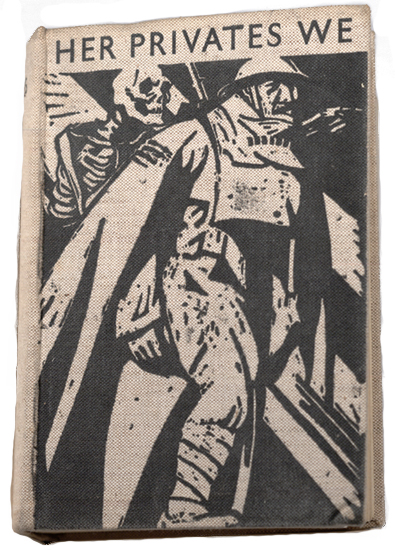
“Her Privates We” 1930, Cover art

The Man Called Cash

Johnny Cash
1932-2003

My favorite musical artist of all time is Johnny Cash. You will find frequent mention of him on my blog, Linda Kruschke’s Blog.

There are only a handful of his songs that I don’t like. Of course, I love all the gospel music he recorded. But I also love everything from Cry, Cry, Cry to Cocaine to T for Texas to Hung My Head to his rendition of Nine Inch Nails’ Hurt and Depeche Mode’s Personal Jesus. His music covers the whole spectrum of real human existence. Many of his songs bring tears to my eyes every time I hear them.

But as great as his music is, the reason I love Johnny Cash has just as much to do with his life and his witness to the grace and redemptive power of Christ. I have read two of his biographies and several essays about him in a book of collected essays. I also have a graphic novel about his life that I recently purchased (though I haven’t read it yet), and have read the introduction to his novel The Man in White. He lived a fascinating and tumultuous life.

For anyone interested in the life of a legend who is nonetheless an incredibly “real” person with struggles and trials just like the rest of us, I recommend The Man Called Cash: The Life, Love, and Faith of an American Legend by Steve Turner. This book is a meticulously researched and well-written account from which even those who knew Johnny well would likely learn something about him that they didn’t know before. Starting almost at the end, with the death of June Carter, and then winding his way through the early years, the middle years, and everything in between, Turner reveals a man who knew God as only a sinner can.

This book includes two awesome sections of black and white photos from Johnny’s life, as well as the unedited text of an interview Turner conducted with Johnny in 1988, a chronology of June and Johnny’s lives, a complete discography, and an index. But these are all just icing on the cake of a story that will bring tears to your eyes and a smile to your heart.

One of my favorite stories of redemption is about the time Johnny crawled into Nickajack Cave, thirty miles from Chattanooga, with the plan to never come out.

He believed that if he crawled in far enough, he’d be unable to find his way out. When he starved to death it would look like a tragic accident.”

In 1995 he [Johnny] told the writer Nick Tosches:

“It just felt like I was at the end of the line. I was down there by myself and I got to feelin’ that I’d taken so many pills that I’d done it, that I was gonna blow up or something. I hadn’t eaten in days, I hadn’t slept in days, and my mind wasn’t workin’ too good anyway. I couldn’t stand myself anymore. I wanted to get away from me. And if that meant dyin’, then okay, I’m ready. I just had to get away from myself. I couldn’t stand it anymore, and I didn’t think there was any other way. I took a flashlight with me, and I said, I’m goin’ to walk and crawl and climb into this cave until the light goes out, and then I’m gonna lie down. So I crawled in there with that flashlight until it burned out and I lay down to die. I was a mile in that cave. At least a mile. But I felt this great comfortin’ presence sayin’, “No, you’re not dyin’.” I got things for you to do. So I got up, found my way out. Cliffs, ledges, drop-offs. I don’t know how I got out, ‘cept God got me out.

Turner, pg. 119.

And God did have things for Johnny to do. He had to show the world how even someone as strung out on drugs as he was could be redeemed by the grace of God. He had to show that despite our faults and weaknesses – or maybe because of them – God loves each and every one of us. He may have been a music legend, but he was never afraid to use his talent to glorify God and to share the gospel. His was a life of redemption and grace well worth reading about. If you think your life isn’t worth living or that God can’t possibly love you or redeem you, read about the life of one who was chief among sinners but who was saved by grace.

As a bonus to go along with this book review of his biography I want to share this video of the song “Singer of Songs” by Johnny Cash. It is a great synopsis of the purpose God had for his life and how he fulfilled it. He truly was a singer of songs about life, love, death, birth, God, and more. I suspect he’s still singing today at the throne of the King.

Love you, Linda K.