
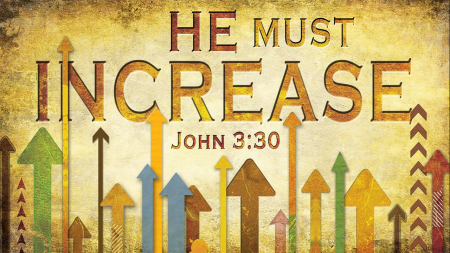
The Equation of Discipleship

He must become greater and greater, and I must become less and less.

John 3:30, NLT

Before our Lord appeared, John the Baptist had incredible popularity.  Thousands and thousands came to him as he preached in the wilderness of Judea.  However, when Jesus initiated His own ministry, people left in droves to follow Him.  Imagine having a wildly successful thing going, and the next day having it fizzle.

I have discovered that it is one thing to be the center of attention, and quite another to be a minor player.  John the Baptist was the MVP, but overnight he was sent to the farm team (baseball metaphor).  Men and women reach for center stage, to be in the limelight.  But very few can move in the other direction gracefully.

A conductor was asked what the hardest instrument to play.  The interviewer expected that it would be a saxophone or trombone or some other.  The conductor just smiled,  and said, “The hardest is the second violin”.

“How great victory was that which Jonathan must have gained over himself, when he rejoiced to see David raised above him! He discerned the mind of God in David, and had so learned to delight in God, that he did not see in David one who was to outshine him, but another faithful man raised up for God and Israel.”   

 
–Robert C. Chapman
 
Jonathan understood who David really was.  He had a sense of who was to be the new king. He had a conviction that understood David’s destiny and giftings.  Jonathan turned his back decisively on being made king.  Ambition was not in his vocabulary.  He could rejoice with David. Knowing this, Jonathan became a free man.

We must not aspire to being a leader as much as learning to become a true follower.

The need at the moment isn’t so much better leaders, but stronger followers. Often we struggle with this, somehow we believe, we’ll become “second class” disciples if we submit to another’s vision or giftings. The way of true servanthood is difficult for many. But to be a real follower will often mean not to strive or assert, but to surrender. That’s the way of Jesus.
 
Thomas a Kempis counseled,

“Be desirous, my son, to do the will of another rather than thine own.”

  
That is an interesting place to find yourself.  But that is the need of the moment.  He must increase, become greater, and I must decrease, become lesser.  There can be no room for personal aggrandizement. 

We need people who know how to play second fiddle.


The Strange Ramblings of a Broken Believer

Related image

“My grace is all you need. My power works best in weakness.”

2 Corinthians 12:9, NLT

“If we find ourselves with a desire that nothing in this world can satisfy, the most probable explanation is that we were made for another world.”   

— C.S. Lewis

I think I am often a creature of habit, far more than I’d like to admit. I rather think we choose our habits and inclinations.  They, in turn, decide our paths.  But I suppose we give ourselves too much credit, to decide and direct.  Simply put, we are not that big. I honestly don’t think we have the power to steer our lives the way we like. That is what I’m thinking about today anyway.

Somebody once told me, “The purpose of life is not to find your freedom, but to find your master.” 

I don’t live that way, at least my inner propensity does not include God.  Did you ever think something like this?  “I wish God did not exist.  I want to be in charge, and I want to do, how I want to do, when I want to do it!”

Living it all with no rules and no accountability! Somehow I still seem to find myself sitting on my throne. I like this!

But as we get older, our hair goes gray and we look in the mirror and see bags and wrinkles, we realize how vulnerable and how tenuous life really is.  If we are honest and sufficiently self-aware, we understand that we will never be able to seize control of the known universe.

“Life is what happens while you are making other plans,” John Lennon observed. 

It seems that reality springs on you, and you have this bolt out of the blue that shocks you to the core.  Life has happened, and you didn’t even realize it.

I sometimes look at myself in the mirror, not in vanity, but in steady amazement.  The ugly tattoos, and the ‘track marks’ are from another life. I have scars on my wrists from a couple of suicide attempts.  I have an amazing surgical zipper scar from a brain tumor.  I have severe ataxia that makes me walk with a cane. I have lost the use of my right hand in an accident. But I am also learning how to be broken.  And everything that has happened has happened for a reason.

C.S. Lewis once said, “Experience is a brutal teacher, but you learn. My God, do you learn.”  

I sense that he did learn, otherwise he couldn’t have said that.

Re-reading this I decided that I ramble a lot.  Forgive me.  Maybe there is scrap or two in it for someone.

“I came to you in weakness—timid and trembling.”

1 Corinthians 2:3

bry-signat-1 (1)

Do Not Judge Too Hard

“Judge not, and you will not be judged; condemn not, and you will not be condemned; forgive, and you will be forgiven;”

Luke 6:37
 

“Pray don’t find fault with the man who limps
Or stumbles along the road
Unless you have worn the shoes that hurt
Or struggled beneath his load
There may be tacks in his shoes that hurt,
Though hidden away from view
Or the burden he bears, placed on your back,
Might cause you to stumble, too.”

“Don’t sneer at the man who’s down today
Unless you have felt the blow
That caused his fall, or felt the same
That only the fallen know.
You may be strong, but still the blows
That were his, if dealt to you
In the self same way at the self same time,
Might cause you to stagger, too.”

“Don’t be too harsh with the man who sins
Or pelt him with words or stones,
Unless you are sure, yea, doubly sure,
That you have no sins of your own.
For you know perhaps, if the tempters voice
Should whisper as soft to you
As it did to him when he went astray,
‘Twould cause you to falter, too.”

By St.Georgy

“Judging others and being quick to criticize just pollutes your life. Learning how to open your hand is the best thing you can possibly learn.”

Paul Stanley


Please, Don’t Find Fault

“Here Comes the Judge!”

“You may think you can condemn such people, but you are just as bad, and you have no excuse! When you say they are wicked and should be punished, you are condemning yourself, for you who judge others do these very same things.”

Romans 2:1, NLT

One of the spiritual diseases endemic to the Christian believer is “fault finding”. For some reason, (and I’m still trying to figure out why), is we have a strong inclination to pass a judgement on people (those whom Christ died for!)  We don’t throw stones (far be it from me)– however, we certainly do and will point fingers. And perhaps we feel that its our religious duty, or maybe even our ministry (!).

Almost always, there a sense of certain and attainable righteousness. or our generated holiness involved. This should not be dismissed or overlooked. Because I believe I am right, and have religious grounds, I put all of the “evil sinners” on trial, and then I pronounce my verdict. (And they certainly deserve whatever I decide.)

Much of the same type of thinking was used in Romans 2.  Paul castigates those who were judging others. He goes on a scathing and sizzling rebuke directly at those who were destroying others by their overly-righteous attitude.

” And we know that God, in his justice, will punish anyone who does such things. 3 Since you judge others for doing these things, why do you think you can avoid God’s judgment when you do the same things? 4 Don’t you see how wonderfully kind, tolerant, and patient God is with you? Does this mean nothing to you? Can’t you see that his kindness is intended to turn you from your sin?.”

Romans 2:3-4

Without a doubt this whole subject is highly complex and nuanced. Hundreds of verses should be worked through. But this blog is not that place. However, I will advance this– I read this written by the Desert Fathers.

“Correct and judge justly those who are subject to you, but judge no one else. For truly it is written: ‘Is not those inside the church whom are you to judge? God judges those who are outside’.

Macarius of Alexandria, 296-393 AD


A Simple Poem of a Quiet Wisdom

Pray, don’t find fault with the man who limps
Or stumbles along the road
Unless you have worn the shoes that hurt
Or struggled beneath his load
There may be tacks in his shoes that hurt,
Though hidden away from view
Or the burden he bears, placed on your back,
Might cause you to stumble, too.
Don’t sneer at the man who’s down today
Unless you have felt the blow
That caused his fall, or felt the same
That only the fallen know.
You may be strong, but still the blows
That were his, if dealt to you
In the self same way at the self same time,
Might cause you to stagger, too.
Don’t be too harsh with the man who sins
Or pelt him with words or stones,
Unless you are sure, yea, doubly sure,
That you have no sins of your own.
For you know perhaps, if the tempters voice
Should whisper as soft to you
As it did to him when he went astray,
‘Twould cause you to falter, too.


r