Straining at Your Oars

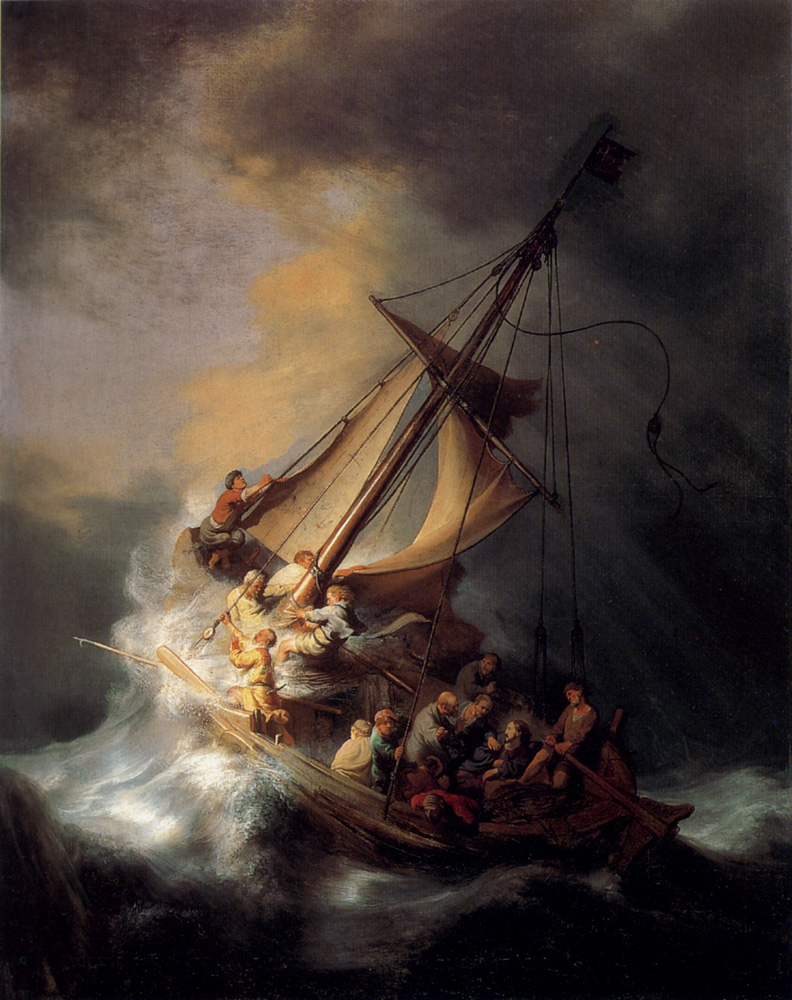
“He saw the disciples straining at the oars because the wind was against them.”

Mark 6:48

It’s good to know that Jesus sees our labor.  He truly understands all that concerns us, and he understands every issue that concerns us.  Attentive and keenly aware He comes to our boat.  It’s quite common for us to think that he isn’t aware, and we may feel that He’ll pass us by without a word.

Jesus watches over us all the time. 

He knows all about our battles, the fight we have with our flesh, the difficulty we have with the challenging people in our lives. I often struggle to steer my boat. Jesus knows when and why I labor like I do.  And He doesn’t condemn me.

The disciples were straining hard to keep the boat afloat. 

Every oar was being used and every man had his seat.  They must work together.  Some were frantically bailing, and a couple gripped the tiller. A lot of effort was being expended but nothing was working.  The wind continued to push harder against them. 

This is really quite perplexing.  If you remember, they’re simply trying to obey the command of Jesus to cross the sea. They were being obedient, and yet they were starting to sink.

Why do things have to be so difficult?

I’m intrigued by believers who expect sunshine, blue sky, and red roses just because they are doing God’s will.  They don’t seem to think through the issues of conflict and challenge, weakness and humility. That’s not how it’s suppose to work.

“It is necessary to go through many hardships to enter the kingdom of God.”

Acts 14:22

Doing the will of God will often mean that there will be a headwind directly at us.
 

The seas will become impossible, and we may even be driven back.  But special comfort comes when we realize we’re being watched.  Jesus is doing constant surveillance on us, and He sees our toil on the oars. And then He comes to us, walking on the water.

Even in our storm, our hearts should trust and rejoice.

“Lo, I am with you always, even to the end of the age”

Matthew 28:20

Jesus Wept

When I was a kid I learned no one wanted to hear me cry.

When I was little, I had a temper like a small hurricane. I didn’t like to be teased and would become angry and cry if anyone teased me. I was always told, “Go to your room and cry. No one wants to hear you crying.” So I did.

But my temper tantrum just didn’t end there.

You see, the way our house was designed, my bedroom was, I think, supposed to be a family room. It had two doors opposite one another so that it functioned as a hallway between the dining room and the back hallway where the bathroom and other bedrooms were. When I was sent to my room, I would run into the room and slam one of these two doors.

Because of some principle of physics that I don’t even remotely understand, the door would not completely close and the slamming would cause the other door to fly open and hit the closet. So then I would run over and slam that door, with the same result, until my mom yelled, “Quit slamming those G** damned doors!”

The belief that no one wanted to hear me cry or witness my temper tantrums stuck with me for a long time. The way I always interpreted that statement was that no one cares how I feel. When bad things happened to me later in life, I told no one because I didn’t think they would care. When I was the most depressed, I kept it a secret because I was ashamed of feeling so bad and didn’t want to waste anyone’s time.

It turns out that many of the things we learn as kids just aren’t true.

This is one of those things. Okay, so maybe there are people who don’t care. A lot of them. But there are also people who do care. People, like me, who when they ask “How are you?” they really want to know, even if how you are is horrible. The world is full of loving, compassionate people who have struggled just like you and me, and want to help us find a way through the temper tantrum of the day.

And even if you can’t find anyone in your life who cares, Jesus cares.

John 11:35 records that “Jesus wept.” Why was He weeping? Not because Lazarus was dead, for He knew death was not the end of Lazarus. Jesus wept out of compassion for those who mourned the death of Lazarus.

In 1 Peter 5:7, the apostle wrote, “Cast all your anxiety on him because he cares for you.” He really does, you know. And so do His followers, though sometimes they don’t know how to show it.


Under Quarantine

quarantine

Quarantines are a real possibility, even to this day. A quarantine is imposed when a disease is contagious enough that it would harm a society: Measles, Smallpox, and the recent COVID-19 are just a few physical diseases where isolation must be imposed.

It can be severe— an epidemic, with desperate consequences if not adhered to; in some rare cases, the use of deadly force has been authorized to maintain a quarantine until the disease is no longer communicable.

This may surprise you, but there are examples of ‘quarantines’ in the Bible.

The term ‘unclean’ was used for ‘leprosy.’ Those afflicted had to isolate themselves; they had to ‘announce’ their presence when in contact with society. Lepers lived in groups away from the general populace, as a result of their disease.

In Paul’s epistle to the Corinthians, he addresses another kind of ‘quarantine.’ The situation was dire; the church had advocated a Christian living with his father’s wife.

“I have already passed judgment on this man in the name of the Lord Jesus. You must call a meeting of the church. I will be present with you in spirit, and so will the power of our Lord Jesus. Then you must throw this man out and hand him over to Satan so that his sinful nature will be destroyed and he himself will be saved on the day the Lord returns.”

1 Corinthians 5:3-5, NLT

Understanding the Principle of Usefulness

Now in a large house, there are not only gold and silver vessels, but also vessels of wood and of earthenware, and some to honor and some to dishonor.”

2 Timothy 2:20, NASB

Found in God’s pantry are lots of pots and pans of various uses.  Paul writes Timothy about the ‘large house’ which is the Church inclusive. Look around Timothy, there are gold ones, and there are silver ones. They have a noble purpose fitting for such a great house. These are the ones the guests will use; they befit the significance of the Lord himself. These vessels have great value for they are made of precious metals.

There are vessels of different categories. These are the ones made of wood, and of clay. These are part of the household, make no mistake about it. But their use is one of function, they’re utilized in common and ignoble ways. (A clay ‘bed-pan’ perhaps?!)

21 “Therefore, if anyone cleanses himself from these things, he will be a vessel for honor, sanctified, useful to the Master, prepared for every good work.”

2 Timothy 2:21

Paul, the author of the New Testament doctrine of grace emphasizes the place of personal holiness. We are to ‘cleanse’ ourselves to become a vessel of honor. There is good news here:

  • All are vessels in the Father’s house. Each of us belongs to Him. He alone determines their use.
  • Things are not yet in their final state. Changes in status can be experienced. In God’s economy, clay pots can become ‘golden.’ Silver can become ‘wood.’

Some sin is contagious.

It affects believers, and the Church becomes compromised by what we’ve done. And then sometimes we are quarantined by the Holy Spirit–until the contagion passes. This spiritual disease must not be permitted.

I have experienced this several times in my own discipleship. These are not pleasant times, but there is no condemnation. I’m still His servant, His love for me stays outrageously constant. He has never turned away a sinning child who repents of their sin.

“Yes, I am His servant, but I must wait out in the hall. I haven’t been faithful. So I sit in His waiting room, waiting for His call. This is for my good. And my Father knows what is best.” 

The Blessings of an Illness

The Bible is a book of miraculous healing.

Jesus Christ performed many of them. He taught His disciples, and those who would follow, to heal the sick and afflicted. This is a real part of the Gospel, and it’s the definite work of his Kingdom.

I’ve personally seen legs lengthened and fevers ‘broken’ on several occasions. Obviously it changes life for the sick person, certainly! But it can also boost the faith of those who witness these miracles. I truly believe the Holy Spirit still works these wonders today. We must let him do these things. That isn’t an option.

Somehow though, there is the ‘understanding’ that in order to be healed you must have sufficient faith. Those who are not healed are the people who have a weak faith, they’re missing out somehow on a miracle because their faith didn’t measure up. I wonder though, how much faith was needed to wash in the pool of Siloam in John 5? But really, all that is needed is a mustard seed (Matthew 17:20).

Faith is an active component to many who were healed in Scripture. Jesus said to the blind man, “Receive your sight; your faith has healed you” (Luke 18:42). It happened!

Yet we read of many believers in Hebrews 11 who endured sickness and ill-treatment. We read of vicious brutality and persecution of these “people with faith.”

Not everyone who is sick will receive a physical healing.

For believers today who suffer physically or mentally, we may question our faith. (Especially when the healing evangelist comes to town). After 2-3 tries we settle back on our “deficient’ faith feeling a bit miserable. I honestly don’t think that’s what the Lord wants.

It seems to me that the real issue is not so much a weak faith, but holding on to your faith when you are not healed.

I hear talk about having faith to be healed–but what about the faith that’s needed to be sick?

Why do we suffer from illness? I suspect that for many believers sickness is really there to bring glory to God. Holding onto faith in the midst of pain often encourages those who witness it. I believe that was Paul’s experience (2 Cor. 12:7-10).

Oh dear one, continue to seek healing, (James 5:14).

The Spirit does these things today. But if you’re left in your illness, trust in Him still. All your ways end up in His nail-scarred hands of our Lord Jesus. But remember, when he greets you in heaven, you will know him by the scars.

“The moment an ill can be patiently handled, it is disarmed of its poison, though not of its pain.”

–Henry Ward Beecher