The Father is Running!

“So he returned home to his father. And while he was still a long way off, his father saw him coming. Filled with love and compassion, he ran to his son, embraced him, and kissed him.”

Luke 15:20, NLT

There comes a time when the prodigal stands up–looks around, and then decides he can’t live this way anymore, it’s now time to return home.  But he is no longer a ‘rich man’s son’, the pig-pen completely crushed that idea.  He returns home, thinking that at least he can be a slave.

The devastated prodigal now understands.

And it’s that which gives him the propulsion to leave the pigs behind, and begin to somehow be received by his father. The trip is a long one, lots of walking, and yes, it’s hard–he’s far from where he’s supposed to be. He is tired, ragged and worn.

But please dear one, you must understand this about Jesus’ parable–the story isn’t so much about the prodigal son, rather I think that the focus should really be on the father. Jesus is teaching us that the love of God is a searching/seeking kind of love, and it cannot be shut down, or go away over time. Not ever.

You see, it is a 24/7/365 day kind of love.

Think of it like high intensity radar that sweeps over extreme distances, it is always looking, seeking, and it won’t be denied.  The Father is seeking for His sons and daughters.  He intends to find them. If we refuse we will continue to feed pigs, over and over, and we will starve.

The running love of the Father is strenuous and reaching

The Father never sits on His backside, calmly watching from His throne. He reaches out and runs to us. God doesn’t sit. He is far from passive, rather He intensely yearns for His son. And God is fully into reclaiming His missing sons and daughters, just like in Jesus’ story.

He continues to search, even in when things get really bad.

Sin disfigures
Sin disfigures, a meth addict’s mug shots over time

The Father recognizes His prodigal son.  It’s funny, but gross sin often has a way that disfigures a person’s countenance. Look at the wino or meth addict on the street.

The boy who abruptly left home is not the son who returns.  There has been damage done.  His face has changed.  The Father understands this, and yes, it has been terribly hard and brutal. But that hardly matters.

I believe that this parable is the greatest of them all. 

Jesus is explaining the deep love the Father has for prodigals like us. This story is so revealing, in it we see that the Father who is running. We must know this about Him. We must internalize it and understand the compassion He has. If we stall in our discipleship it’s because we don’t grip the awesome depth of His love.

There seems to be very few people who understand a running God.

The prodigal son is a timeless parable that transcends generations, holds within it a profound message of forgiveness, redemption, and unending love. As we delve deeper into the intricate layers of this tale, we discover a powerful metaphor that illuminates the human experience and the unwavering compassion of the Father.

As the prodigal hits bottom he realizes the futility of his choices and yearns to return to the forgiving embrace of his father. Overwhelmed by guilt and shame, he makes the long journey back to the home he once took for granted. Little does he know it, behind the scenes, his father has been watching, waiting, and hoping for his return.

And then, in a moment that encapsulates the beauty of unconditional love, the father catches sight of his boy from afar. Without a second thought, the father runs towards him with outstretched arms, his love insisting on forgiveness.

We see a love that surpasses human understanding.

The parable teaches us about the power of redemption and forgiveness, reminding us that no sin is too great to be forgiven, and no distance is too far for reconciliation. It emphasizes the importance of humbly seeking forgiveness and shows that love is always within reach.

Jesus teaches us a different kind of love. It’s not based on achievements or what society says. This love is given to everyone, regardless of their flaws, but in order to have it, they must leave the pigs behind. Sometimes that isn’t always easy.

This profound depth of His love often leaves us feeling totally doubtful or skeptical.

Our logical minds struggle to grasp how such boundless love can exist, especially when we witness the failings and flaws of human love. Yet, it is precisely because love transcends logic that it is so powerful. It operates on a different plane, bypassing our human limitations and revealing a deeper truth about the nature of God’s infinite compassion.

So, let us tell others about this love that Jesus spoke of.

Let’s begin to see that this compassion will transform lives, heal wounds, and bridge divides. For when we approach Jesus’ parable with humility and faith, we may just catch a glimpse of its power and appreciate its profound beauty in a new way.

If the Church can just keep up with our running God, we will finally understand who He really is. And if we only accept the love of the Father towards prodigals—no matter what the sin—it’s then we will finally understand the white-hot love of the Kingdom of Jesus.

And the Church will finally be doing His will in the world.

Finally.

1brobry-sig4

The Throne of Mega Grace

“Let us then with confidence draw near to the throne of grace, that we may receive mercy and find grace to help in time of need.”

Hebrews 4:16, ESV

As verses go, this is one of the more significant. There are plenty of promises to be found in the scriptures but Hebrews 4:16 has a meaningful spot in my walk. When I think about it, and consider its implications, I have very little to say but “hallelujah!”

Jesus is our great High Priest. That word “great” clearly underscores His value to us. It shouldn’t really surprise us: the word in Greek is “megas” which means preeminent, all intensive and all abundant. (The idea can also mean ‘weight.’)

Some versions of the Bible use “boldness” instead of confidence. I like boldness but confidence is good too. Both words are wonderful. (One version uses “bravely!”).

His absolute power as a Priest is forever and ever.

He is now our precious mediator. Jesus is now our go-between of our ugly sin and His incredible holiness. He has created a spiritual super-highway for those who chose to come to Him through a saving faith. He has done this all by Himself. It was what He wanted.

The throne He sits on is now known as our “throne of grace.”

“Ancient Jewish Rabbis taught that God had two thrones, one of mercy and one of judgment. They said this because they knew that God was both merciful and just, but they could not reconcile these two attributes of God. They thought that perhaps God had two thrones to display the two aspects of His character. On one throne He showed judgment and on the other throne mercy. But here, in light of the finished work of Jesus, we see mercy and judgment reconciled into one throne of grace.”

David Guzik

Mercy and grace. Help in our time of need. If you’re anything like me, my neediness is perpetual. I need Jesus all the time, and He has made it clear through His Word that He’s always available to us. His throne room is never off-limits. He has given us the keys!

“The greatest privilege God gives to you is the freedom to approach Him at any time.”

    Wesley L. Duewel

I have a new site and I hope you visit: alaskabibleteacher.com

The Smiles of God

sun-1443875842olr

“Heaven is where the unveiled glories of the Deity shall beat full upon us, and we forever sun ourselves in the smiles of God.”

Ezekiel Hopkins, “A Puritan Golden Treasury”


Jesus said to them, “The wedding guests cannot fast while the groom is with them, can they? As long as they have the groom with them, they cannot fast. (Mark 2:19)

This was Jesus’ idea.  He was bringing correction to the lives of those who were very serious, and especially those who felt the most religious.  Often, our native tendency is asceticism.  We evaluate ourselves religiously by our prayers and our fasts.

For serious people, we have a serious religion, and we focus on doing a serious religious activity, for that is what our serious faith demands.

Jesus pointed out that mournful faces are not indicators of a pious life.  How can His disciples mourn when Jesus the bridegroom is nearby? His disciples are going to a wedding, not a funeral!

Without question, the New Testament believers are to know repentance and self-examination.  We should grieve over our sins, but that grief is to be based on hope and joy.  Jesus changed everything.

If you are saddened by sin, that sadness must be tethered to joy and not to despair.  

The disciples could not mourn and fast while Jesus was present.   He does not wish His disciples to go mourning and fasting when they have no occasion for such exercises. His words are a defense of Christian joyfulness. Christ wants His friends to be glad. There is an utter incongruity in a sad and mournful Christian life.  It does not make sense in light of what Jesus has done.

Our sins have been forgiven–erased, cleansed, and washed away.  We have been dipped into the righteousness of the Son of God.  The fierce enemies of our souls have been eradicated by Jesus.  All of this is to bring out a song from a grateful heart.  We revel in the smile of Jesus and walk under the banner of beautiful love.  We have His forgiveness and have been given His favor.  We should be radiant!

 I pray that you will rejoice in this wonderful day He has made.


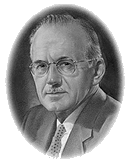
A.W. Tozer, on Having a Personal Revival

How to Have a Personal Revival,
Serious Repentance and Restitution, and
Steps to Spiritual Growth.

by A.W. Tozer

1) Put yourself in the way of the blessing. 

It is a mistake to look for grace to visit us as a kind of benign magic, or to expect God’s help to come as a windfall apart from conditions known and met. There are plainly marked paths that lead straight to the green pastures; let us walk in them.  To desire revival, for instance, and at the same time to neglect prayer and devotion is to wish one way and walk another.

2) Do a thorough job of repenting. 

Do not hurry to get it over with.  Hasty repentance means shallow spiritual experience and lack of certainty in the whole life.  Let godly sorrow do her healing work. Until we allow the consciousness of sin to wound us, we will never develop a fear of evil. It is our wretched habit of tolerating sin that keeps us in our half-dead condition.

3) Make restitution whenever possible. 

If you owe a debt, pay it, or at least have a frank understanding with your creditor about your intention to pay, so your honesty will be above question. If you have quarreled with anyone, go as far as you can in an effort to achieve reconciliation. As fully as possible make that crooked things straight.

*****

Thought 

Repentance and restitution result when we seriously reflect on what God shows us in His Word. What is it of which we need to repent and is there restitution to be made?


Scripture

“Bring forth fruit that is consistent with repentance [let your lives prove your change of heart];”

Matthew 3:8 (Amplified Bible)

Prayer

My tendency, Lord, is not to take seriously my sin that hurts other people and to leave unrepaired the damage I have left in the lives of others. Make me sensitive, Lord!


tozer
Aiden Wilson Tozer was born on April 21, 1897, on a small farm in Western Pennsylvania, the third of six children. And although he would inspire millions with his preaching and writing, he was given very little education during his childhood.

A. W. Tozer was 66 when he died of a heart attack on May 12, 1963. Buried in a small cemetery in Akron, his tombstone simply and appropriately reads, “A Man of God.” He left behind many books that continue to give Christians encouragement and guidance. His writings are as fresh today as when he was alive. His honest and colloquial humor has been known to sweep up congregations in gales of laughter. And his wisdom has left them silent and stunned. For almost 50 years Tozer walked with God, and even though he is gone, he continues to minister to those who are eager to experience God.