Mentally Ill Christians Can Do Ministry


“Religious people love to hide behind religion. They love the rules of religion more than they love Jesus. With practice, Condemners let rules become more important than spiritual life.”

Mike Yaconelli

“We are told that Christ was killed for us, that His death has washed out our sins, and that by dying He disabled death itself. … That is Christianity. That is what has to be believed.” 

                                                                C.S. Lewis, Mere Christianity 

People with mental illnesses, for the most part, have been diverted underground.  We have been pushed into hiding our true identity;  we can come out into the open, but only if we agree to play according to the rules—their rules. 

We are expected to censor ourselves and say appropriate things at the right time.  Pharisees [who are alive and well] insist on a level of purity that all must maintain. [I am not picking on anyone, just a generality.]

If I say that I am depressed, paranoid, manic, or desperate I will upset the apple cart and muddle up everything.  “Truth?  You can’t handle the truth?”, [a line from some movie.]  But if we use our shortcomings as credentials, we have the ability to speak about grace, love, and of self-acceptance, with real authority. 

Christians with mental illnesses have been given a gift that we are to share with the Church.  The Holy Spirit has sprinkled us into each fellowship of believers.  He places us as we are suffering in strategic places. Our “gifts” are to speak to the Body, spiritually about a lot of things, but especially grace. 

If our fellowships become religious, it is usually because of our weaknesses, we have allowed ourselves to be silenced into submission by the “interpreters” of scripture.  If we don’t like the rules, we are told to go elsewhere.  We are not welcome. 

But don’t you see, that is our moment to shine! 

Our “unsightly” presence shouts out to the “wonderful” people, proclaiming grace in weakness.  Those who receive us, receive Him.  Those who turn from us, muffling us, are doing that to Jesus. Frightening, isn’t it?  It’s interesting to note that those who do not believe yet have often used “legalism” as the touchstone for their evaluation.

I would strongly suggest that we take our illnesses into the open.  That we become transparent toward others.  As we do this, we can oh-so-gently guide our fellowships into true grace and love.  They look at me and they see Jesus. 

And that is our ministry as mentally ill people to the Church. 

9 But He said to me, “My grace is sufficient for you, for power  is perfected in weakness.”  Therefore, I will most gladly boast all the more about my weaknesses, so that Christ’s power may reside in me.”

10 “So because of Christ,  I am pleased in weaknesses, in insults, in catastrophes, in persecutions, and in pressures. For when I am weak, then I am strong.” 

                               2 Corinthians 12:9-11 (HCSB)

Dear friend, the gospel is either radical, or it is nothing.

 

Are There Benefits to Being Bipolar?

Bipolar people can be really different.

Originally Published on July 20, 2010 in “Psychology Today”

Let me start by acknowledging what is well known: Manic Depression or Bipolar disorder can be a devastating illness. Affecting at least 1% of the population, it can, untreated, result in suicide, ruined careers and devastated families. Bipolar disorder is often accompanied by alcohol and drug abuse and addiction, criminal and even violent behavior. I acknowledge this because I do not want to make light of the burden this illness places on people’s lives, families, and communities.

On the other hand, the history of the world has been influenced very significantly by people with manic depression (see website www.wholepsychiatry.com for details). They include:

“It seems clear that for at least some people with Bipolar disorder, there is an increased sense of spirituality, creativity, and accomplishment. It may be that having bipolar disorder holds great potential, if one is able to master or effectively channel the energies, which are periodically available, to some higher task. This would of course presume the ability to abstain from harmful drugs and alcohol, to have good character, and at least some supportive relationships and community networks.”

Y
It might be helpful to consider a reconceptualization. Perhaps instead of it being a disorder, we can think of people with bipolarity as having access to unusual potency. This potency will find a way to be outstanding-either in a destructive way, or in a constructive way. If such a choice is presented to the person, perhaps it can open some doors.
——————————————–
 

“And we know that God causes everything to work together for the good of those who love God and are called according to his purpose for them”

Romans 8:28

Source of this article: Psychology Today 

Bryan’s note: A great book, a favorite of mine, that works a lot of this out is Exuberance: The Passion for Life,” by Kay Redfield Jamison.


Jumpstarting a Prayer Life

We must (MUST!) pray as believers in Jesus. Prayer is the oxygen of our spiritual life. We must breathe, or else. When I go to my doctor she puts an 0ximeter on my finger so she can assess how my lungs are using oxygen. I suppose if we would put it on our “spiritual finger,” might it reveal something?

We don’t know exactly how to pray, I think communicating with God isn’t natural. We must be taught. The disciples wanted desperately how to pray–they didn’t know how, (Luke 11:1-2). So, we too must have Jesus teach us.

We can only learn how if the Spirit teaches us.

Also, we must practice praying. We may do it terribly rotten, but we should never give up–it’s not natural–it’s supernatural. But we learn by doing. We may get discouraged but keep at it. Even if you’re a pro, the Holy Spirit will make sure you keep learning. Our walk should always grow deeper.

For me praying the Psalms is good practice, and there are 150 of them. The Jewish people have a 4000-year start on us–they’ve used the Psalms as their prayer/praise book. My sense is that this covers every human need–the entirety of our spiritual walk!

I think that Psalms 103 might be a great place to get started.

I’ve been told by some that the “Lord’s Prayer” is quite useful as well. I guess if you honestly take it phrase by phrase, something good will happen. I’m still learning (and I suspect I still will).

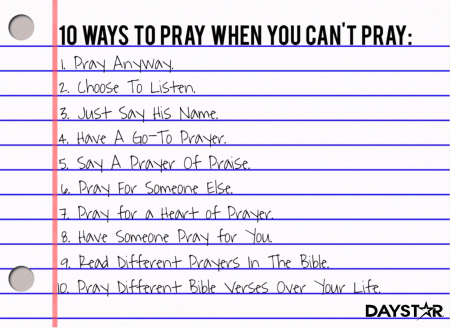
Below we find a way to jumpstart our prayer life. I hope you can use it.

One more thought. “Conversational Prayer” is a good thing for me lately. Talk with Jesus as if He was in the same room with you (He is) and just converse. Share your ups and downs, and it’s okay if you feel messed up. Relax. He’s your Father!

He absolutely loves talking with you.

God’s Good and Perfect Gifts

I often hear people say that the bad things that happen to them are God’s punishment for something wrong they have done. I have a friend who desires to find someone to marry, but has said she doesn’t think God will ever bring her a mate because of all the wrong she has done in the past with respect to relationships. In the news we hear televangelists say natural disasters are God’s punishment for the sins of the people in the area hit by the disaster.

But I don’t think God works that way.

Photo by Pixabay on Pexels.com

James wrote, “Every good and perfect gift is from above, coming down from the Father of the heavenly lights, who does not change like shifting shadows. He chose to give us birth through the word of truth, that we might be a kind of firstfruits of all he created.” James 1:17-18 (NIV). God desires to give good gifts, not punishment.

I also think of Job, a man who endured great suffering and loss. But none of it was punishment from God. Rather, all of his sorrows came from Satan, albeit with God’s permission, so that Satan would see that God’s redeemed and faithful servants would never reject Him simply because of trials they face. See Job 1-2 (NIV).

For the believer in Christ Jesus, all the punishment for our sins has already been meted out at the cross. As Jesus said, “It is finished.” John 19:30 (NIV). To believe that we need to suffer punishment for our own sin is to believe that Jesus’ sacrifice was insufficient. The apostle John wrote, “My dear children, I write this to you so that you will not sin. But if anybody does sin, we have one who speaks to the Father in our defense—Jesus Christ, the Righteous One. He is the atoning sacrifice for our sins, and not only for ours but also for the sins of the whole world.” 1 John 2:1-2 (NIV). God does not seek to punish, but to restore and redeem those He loves.

There are, however, natural consequences of sin.

If we are gluttonous, we are likely to be overweight and suffer various illnesses that come from poor eating habits.

If we get drunk, especially habitually, we will suffer in terms of health problems, possibly losing a job, or having financial difficulties because we spend too much money on alcohol.

If we get involved with other drugs, the same problems can happen, perhaps even worse if they are illegal drugs because we could end up in prison for breaking the law.

If we are sexually promiscuous we may contract diseases, end up with a child we didn’t want, or will suffer emotional damages and loneliness.

If we gossip and badmouth others, we will damage others view of us and damage our relationships.

Every sin has natural consequences. Sometimes we are fortunate to avoid the worst of the natural consequences, but not always. And all sin results in the natural consequence of separating us from God because our guilt and shame cause us to avoid God. That has been the case from the first sin in the Garden of Eden, when Adam and Eve hid from God.

When the woman saw that the fruit of the tree was good for food and pleasing to the eye, and also desirable for gaining wisdom, she took some and ate it. She also gave some to her husband, who was with her, and he ate it. Then the eyes of both of them were opened, and they realized they were naked; so they sewed fig leaves together and made coverings for themselves.

Then the man and his wife heard the sound of the LORD God as he was walking in the garden in the cool of the day, and they hid from the LORD God among the trees of the garden. But the LORD God called to the man, “Where are you?”

He answered, “I heard you in the garden, and I was afraid because I was naked; so I hid.”

Genesis 3:6-10 (NIV).

God knows what is best for us and has declared what is sin based on His superior knowledge of what is beneficial for our physical and emotional well-being. Just as He gave to Adam and Eve all that they needed in the Garden, He desires to give us good and perfect gifts.

In addition to the natural consequences of individual sinful behavior, the sinful nature of mankind over the centuries has brought into our lives a brokenness that leads to pain and suffering. The evil nature of some people can lead to suffering by others, such as a violent man who beats his wife, or the drunk driver who causes an accident that kills others, or a serial killer who tortures his victims. Our sinfulness is also engrained in our DNA and can lead to sickness and disease that brings suffering as well.

So if you are suffering and think that God is punishing you, think again. Return to God and seek His face, seek the good and perfect gifts that He has offered. Lean on Jesus in your suffering because He desires to restore and redeem you, not cause you more suffering. “This is the message we have heard from him and declare to you: God is light; in him there is no darkness at all.” 1 John 1:5 (NIV). Come into the light and rest in His love.