Assurance of Salvation for Desperate People

 For all who are led by the Spirit of God are sons of God. 15 For you did not receive the spirit of slavery to fall back into fear, but you have received the Spirit of adoption as sons, by whom we cry, “Abba! Father!

Romans 8:14-15

Abba! Father!

That’s a title of intimacy. You belong in His family. You’re His son, His daughter. But as broken believers we can struggle a lot. Many in the Church don’t understand us, and we hardly understand ourselves. But we know we’re His own. We’re the shaky ones it seems.

We’re often aware that there’s a mixture of good and bad things regarding our faith. Because of this, we often see what others can’t.

  • The Good: we don’t have to be convinced of our sin.  We live in a broken world, and we’re pretty sure that we have formidable issues. We’re needy. We’ve tried lots of things, and we just might be a little wary (but that can be good too).
  • The Bad: our consistency fluctuates from day-to-day. We never know what our state of mind will be. Some of us have problems socially that hinders us. Attendance at our local church can be hard. We struggle in our relationships with others. We seem to make excuses for everything.

From day to day many of us struggle terribly.

The existence of this ‘flightiness’ is painfully evident. And as strugglers it’s hard to maintain anything, much less a spiritual life. But experience has taught me that the Holy Spirit not only makes an allowance, but even pours out extra grace on the troubled believer. The Lord loves His misfits.

But no matter what, we can’t put any confidence in our flesh. We do bounce around, but salvation is not of our own doing. What stabilizes us is a serious dedication to the promises we have in the Word of God. He gives us His Words to strengthen.
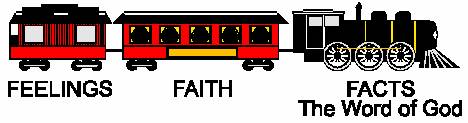
faith-train

Obviously, the engine must pull the other cars. We must look to the promises of God to stay on track. And both faith and feelings must follow the engine. Some struggle a great deal because they are led by their feelings. Confusion will follow if we get the proper order mixed up.

  1. First facts, (the Bible, God’s word to you)
  2. then comes faith,
  3. and finally feelings, (these cannot come first!)

The Word of God is our only safety.

Our faith is to be connected to the promises of God. For those of us with a disability, we realize that we deal with issues that others seem to skate through. (But hey, aren’t used to that now?) And yet the Father makes some things easier for us too. 

Please, read the Word. The Psalms or the Gospels are always good for us.

Focus on God’s promises to you. If you collect up His words, in your mind and heart, the Holy Spirit will bring to your mind these verses when you really need them. (I draw much strength from the Psalms. These keep me on track.)

We’ve been adopted by the Holy Spirit as sons and daughters.

We are deeply loved by God Himself. He has gone and made us ‘heirs’ without any of our own effort (Romans 8:14-17). We are a people in need of stability. What God gives us is His own constancy. Read the Word, fresh just for you. The promises applied lavishly will enable you to be like Jesus.

 “And because of his glory and excellence, he has given us great and precious promises. These are the promises that enable you to share his divine nature and escape the world’s corruption caused by human desires.”

2 Peter 1:4, NLT

“In the darkest of nights cling to the assurance that God loves you, that He always has advice for you, a path that you can tread and a solution to your problem–and you will experience that which you believe.”

“God never disappoints anyone who places his trust in Him.”

 Basilea Schlink

Bryan Lowe

Learning to Walk Again

Hosea 11:3

Early in my walk, over 40 years ago, I concluded that I would be able to acquire all the knowledge that I could ever want.  I was on the short track, going up of course.  It was a glorious thing, it took me some time to realize I was very ignorant of so much.

The Bible communicates truth, not always facts.

As I age, I start to understand that things are much more enigmatic and unfathomable than I ever dreamed they would be.  It is a step of faith to accept the truth when there are still a lot of things that are still vague. 

Take the mystery of healing for example:

“You say you have faith to be healed, but what about the faith to be sick?”

Mike Mason

That’s a penetrating question, indeed.  “Why are some healed, and others are not?  Why do I have eternal life, and my friend does not?  Why should AIDS sweep through poor African villages when I live in a very comfortable suburb in the US?” 

I have many other questions like this.

And I’m not making a whole lot of headway here.  Reasons and facts are not there. Life becomes more mysterious and inscrutable.  But there is a word we must know–it is the word “trust.”  It is a faith that assists us through the landscape of challenging questions.

As a sometimes struggling, mentally ill Christian, many (even in my own church) create more questions for me.  “Therapists, psychiatrists, and daily medications are really good, but do you really need them?” or  “Did God create in you the need for lithium and Zoloft?” and ” How can you follow Jesus when you have all of these depression issues?”

And here’s a humdinger that stings, “Where is your joy?”

But it is precisely these issues that help me be a disciple. Someone who must trust.

I’ve been slowly learning you see.  And my weaknesses are becoming my strengths.  They lead me to exercise my feeble faith.  I trust in Jesus; my faith helps me trust. I find it interesting to note that the Book of Psalms, for the most part, was written by “a broken believer” like David– a king and (also) a rascal.

These nebulous areas have only increased. 

And ironically my trust has only grown.  I have more questions than ever before, but my faith in him only gets stronger. I suppose I will never, ever be a gleefully upbeat, cheery person.  But I am learning “to trust and obey, there is no other way…” 

He himself has taken up the chore of teaching me to walk again. But just one thing, He wants me to keep trusting.

Psalm 131:1-2

Always Be Children, [Always]

Matthew 18:1-3, ESV

I have always believed that maturity brings wisdom and growth, a beautiful journey to embark on. When it comes to spiritual matters, it is an opportunity to delve deeper into the richness of faith. I eagerly embraced the challenge of expanding my understanding and exploring the profound teachings. Jesus’ devoted disciples, too, were presented with invaluable guidance and encouraging direction:

15 “Now they were bringing even infants to him that he might touch them. And when the disciples saw it, they rebuked them. 16 But Jesus called them to him, saying, “Let the children come to me, and do not hinder them, for to such belongs the kingdom of God. 

17 Truly, I say to you, whoever does not receive the kingdom of God like a child shall not enter it.”

Luke 18:15-17

Jesus makes a special effort to get his followers to see their need. He voices the dictate that they must become children again; that they must learn that the basics are the core. We won’t grow out of them.

Real faith remains childlike even as it gets old.  

As we see the children that are in our midst, we should see in them the pattern for us as we connect with the Lord, and with each other. It’s a paradox, but we mature as children, and this doesn’t ever change. Jesus told us that the Kingdom belongs to those whose faith is childlike.

Childlike faith seems to have three focuses:

  1. Areas of intimacy, coming together in the presence of the Lord as His sons and daughters.
  2. Areas of relationships, between each other as brothers and sisters in love with each other.
  3. Issues of spiritual warfare, facing the daily battle with sin and darkness with a steady awareness of the ones alongside us.

Holding a child’s faith has an extraordinary power to shape our lives in profound ways. It’s a delicate balance of innocence, trust, and vulnerability that leaves an indelible mark on our hearts and souls. The childlike belief in something greater than ourselves and it opens up a world of possibilities and invites us to embrace the wonders of the unknown with open arms.

Our Father is with us.

But what does it truly mean to hold onto a child’s faith? It goes beyond the simple act of believing in something beyond our understanding. It requires a humility that allows us to acknowledge our own limitations and embrace the beauty of our imperfections. In a world that often values strength and self-assuredness, the child’s faith reminds us of the importance of embracing vulnerability and being open to being led in fresh ways.

Picture for a moment the scenario of being suddenly clothed in nothing but our humility. It is a humbling thought, isn’t it? In that state, stripped of all pretenses and facades, we are forced to confront our true selves. We are reminded of our humanity, and our weakness with the swirling world around us. It’s in those vulnerable moments that we truly come to appreciate the depth and power of a child’s faith.

In a society that often prioritizes material success, power, and self-exaltation, we may find ourselves striving to shed our humility in favor of more desirable qualities. However, it’s precisely in cherishing our humility that we can find true wisdom and grow into more compassionate and merciful people. It’s through humility that we can connect with others on a deeper level, understanding their joys and sorrows with a genuine empathy.

Let’s embrace the innocence of a child’s faith.

Let’s allow it to ‘infect’ our lives with a sense of real wonder, curiosity, and a supernatural love. Let’s never forget the lessons it teaches us about the importance of embracing humility in our journey through life.

Let’s hold onto a child’s faith tightly, for within its grasp lies the power to transform our lives and the world around us. May it be a constant reminder of the child-like beauty that exists within each and every one of us.

Humility is the stuff Jesus uses to make a place for His Kingdom.

Becoming a person of childlike faith will take a lifetime, that is why we should stay small and keep growing in our dependence on Him.

Martin Luther

bry-signat (1)

A Life for a Life

entertain-cross

We must decide upon some things. This is not easy theology. It calls us to take decisive action.

The idea of Jesus dying on the cross for my sin is brutal. I’m left with the idea that I contributed to His death. But my sin had to be covered, and alas, and He did so. But I can never repay God for the drastic measures He took. But I do know that my life is now His. His for mine.

In many cultures it is a life for a life.

Some people groups believe that the person who saves another person is owed a “life debt” out of gratitude. I become His “property” because He died in my place. A life for a life. His for mine.

There are sins that I commit that He must pay for. This is not as easy as you might think; I confess my sin, and Jesus Christ picks it up. He has chosen to pay every and all penalties for it. I go “scot-free” while He must die. This is what He decided to do for me. A life for a life.

The cross was not just a Roman method of execution. It was planned in eternity for the rebellion of mankind. It was God’s “method.” He knew those “from the foundation of the world” but had to find a way to atone for their sin, and redeem them from Satan’s control. He must die for them. And it’s a life for a life. His for mine.

I’ve been ransomed and redeemed.

His death gives me eternal life– something which can ever be taken away. His own death makes me “holy.” The Bible promises me even more than this: forgiveness, peace, joy and “real” holiness. He has done everything, I have done nothing except believe.

His life for mine. A life for a life.

Oh, the depth of the riches and wisdom and knowledge of God! How unsearchable are his judgments and how inscrutable his ways!”

Romans 11:33, ESV