
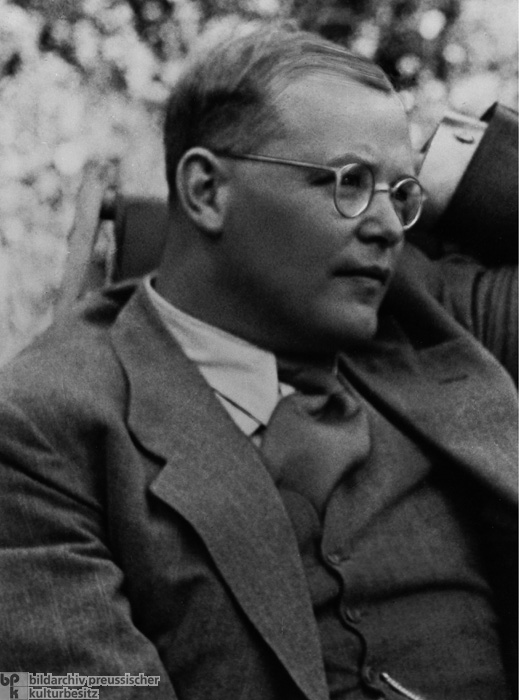
Who Am I? by Dietrich Bonhoeffer

bonhoeffer-ins1

From the Journal of Dietrich Bonhoeffer

Dietrich Bonhoeffer (1906-1945)

Dietrich Bonhoeffer was a German Lutheran pastor and theologian. He was also a participant in the German Resistance movement against Nazism, a founding member of the Confessing Church. His involvement in plans by members of the Abwehr (the German Military Intelligence Office) to assassinate Adolf Hitler resulted in his arrest in April 1943 and his subsequent execution by hanging in April 1945, shortly before the war’s end.

Protestant theologian Dietrich Bonhoeffer stands out among the Christian leaders during the Nazi era, for he was one of the few to actively resist the racist actions of the Nazi regime. In addition to his legacy of courageous opposition to Nazism, Bonhoeffer’s theological writings are still widely read in Christian communities throughout the world. “At the place of execution, he again said a short prayer and then climbed the steps to the gallows, brave and composed. His death ensued after a few seconds. In almost fifty years that I worked as a doctor, I have hardly ever seen a man die so entirely submissive to the will of God.” Source: Prison doctor witness to Bonhoeffer’s death  

From His Writings–

Who am I? They often tell me

I stepped from my cell’s confinement

Calmly, cheerfully, firmly,

Like a squire from his country-house.

Who am I? They often tell me

I used to speak to my warders

Freely and friendly and clearly,

As though it were mine to command.

Who am I? They also tell me

I bore the days of misfortune

Equally, smilingly, proudly,

Like one accustomed to win.

Am I then really all that which other men tell of?

Or am I only what I myself know of myself?

Restless and longing and sick, like a bird in a cage,

Struggling for breath, as though hands were

compressing my throat,

Yearning for colors, for flowers, for the voices of birds,

Thirsting for words of kindness, for neighborliness,

Tossing in expectation of great events,

Powerlessly trembling for friends at an infinite distance,

Weary and empty at praying, at thinking, at making,

Faint, and ready to say farewell to it all?

Who am I? This or the other?

Am I one person today and tomorrow another?

Am I both at once? A hypocrite before others,

And before myself a contemptibly woebegone weakling?

Or is something within me still like a beaten army,

Fleeing in disorder from victory already achieved?

Who am I? They mock me, these lonely questions of mine.

Whoever I am, Thou knowest, O God, I am Thine!

–July 18, 1944

cropped-cropped-cropped-christiangraffiti1-11.jpg


The Art of Offending God

SinfulInside1

“Oh, how often they rebelled against him in the wilderness
    and grieved his heart in that dry wasteland.”

Psalm 78:40, NLT

“For forty years I was angry with them, and I said,
‘They are a people whose hearts turn away from me.
    They refuse to do what I tell them.’”

Psalm 95:10, NLT

“And do not grieve the Holy Spirit of God [do not offend or vex or sadden Him], by Whom you were sealed (marked, branded as God’s own, secured) for the day of redemption (of final deliverance through Christ from evil and the consequences of sin).”

Ephesians 4:30, AMP

I must say, we instinctively know how to offend God.  No one has to teach us how it’s done, we just know how to do it. We have the amazing ability to sadden God. Our sins, and our rebellion causes God to tremble and weep. Disobedience, in any form affects the very essence of God’s well-being.

As a believer in Jesus, I know that sin is never permanent. It is not like getting a spiritual tattoo on our hearts. Our faith prevents sin from completely attaching itself to our hearts. But my sorrow or grief over my sin, must drill itself directly into my heart. I should come to the point where I can not sin against Him who loves me hysterically.

To turn back to Him involves “contrition.” To be contrite is to imply a very simple acknowledgment of our sin– and the rebellion that is often seen within. Somehow this is possible. I do not understand the mechanics of it all. But I am very glad it is there. God loves a heart that is contrite.

God is very offended by our sin. But somehow we do not grasp this. More or less this is a bit intangible. In our mind, we go don’t ever stop sinning against Him. We feel that we are getting away of something, which isn’t true at all.

As a closet-Lutheran, I propose the Lutheran Church which also has its own act  of contrition, which is said during Holy Absolution. The following version, taken from the Lutheran Service Book (2006), says:

    O Almighty God, merciful Father, I a poor, miserable sinner, confess to you all my sins and iniquities, with which I have ever offended you and justly deserved your punishment now and forever. But I am heartily sorry for them and sincerely repent of them, and I pray you of your boundless mercy, and for the sake of the holy, innocent through many bitter sufferings and death of your beloved son, Jesus Christ, to be gracious and merciful to me, a poor sinful being.

I can say nothing more than this. I will simply rest in this kindness that isn’t me at all. He loves each of us, as if we were the only ones. Thank you Father.

Y

ybic, Bryan

*

Velcrocity, My New Amazing Word

velcro-magnified
Velcro magnified

I like inventing new words, especially for words that have far too much mileage on them. A car runs great, but even the best autos start to have issues after the odometer goes over 200,000 miles.

So I’m purposing a new word even though I’m not quite ready to completely toss the old one yet. The new word is “Velcrocity”. I will define velcrocity as a mix of love, faithfulness and endurance. (Possible forms of this word– Walk in velcrocity, be velcroized more and more. Wasn’t that velcroful worship? And on and on.)

Just in case you’re wondering, Velcro is a fastener mostly used for clothing. It consists of two strips, one is covered in tiny loops and the other in tiny flexible hooks. The two strips ‘adhere’ when they are pressed together and separate when pulled apart.

“Velcro is strong enough that a two inch square piece is enough to support a 175-pound (79 kg) person. The strength of the bond depends on how well the hooks are embedded in the loops, how much surface area is in contact with the hooks, and the nature of the force pulling it apart.” –Wiki

Why velcrocity? Thinking about the Father God’s love for me (and others) made me start thinking about Velcro– and being “laid up” with my health sucking so poorly has helped me pray and think. And being way too curious I did a frontal assault on the internet of the sticky subject of Velcro.

The best info came from Wikipedia, of course. http://en.wikipedia.org/wiki/Velcro

The more contact between the strips of Velcro will strengthen the bond. The tighter the hook part pushes into mesh part more effort required to pull them apart.  The negatives of this wonder are they have to stay clean. Lint, dirt of hair get between and can keep the strips from bonding.

As I write this, the imagery parallels what I’ve already learned from my Bible, prayer, fellowship and worship. Spiritual lessons quite often will come from what I see physically. But I need to be teachable and a whole lot more perceptive.

Focus on Jesus, and stick to the things of God. There is an adhesion needed in the Church today, and it truly starts with your heart. The covenant heart of God is that you would more and more cling to Him. He is truly tenacious, in the best use of the word.

“I will never leave you, or forsake you.”

“The Love of God endures forever.”

&

Kyrie eleison.

ybic, Bryan

(How about Velcrophobic? Velcroful? Velcrology? Velcrophobic? —and then maybe not,)

Olympic Sized Hearts

 Seven rules for running the Christian race.

  1. Run to win: “Do you not know that in a race all the runners run, but only one gets the prize? Run in such a way as to get the prize” (1 Corinthians 9:24-25).
  2. Observe strict discipline: “Everyone who competes in the games goes into strict training… I beat my body and make it my slave so that after I have preached to others, I myself will not be disqualified” (1 Corinthians 9:25-27).
  3. Don’t look back: “Brothers, I do not consider myself yet to have taken hold of it. But one thing I do: Forgetting what is behind and straining toward what is ahead, I press on toward the goal to win the prize for which God has called me heavenward in Christ Jesus” (Philippians 3:13-14).
  4. Get constant encouragement: “Therefore, since we are surrounded by such a great cloud of witnesses, let us…run with perseverance the race marked out for us. Let us fix our eyes on Jesus, the author and perfecter of our faith, who for the joy set before him endured the cross, scorning its shame, and sat down at the right hand of the throne of God. Consider him who endured such opposition from sinful men, so that you will not grow weary and lose heart” (Hebrews 12:1-3).
  5. Throw off restraints: “Let us throw off everything that hinders and the sin that so easily entangles, and let us run with perseverance the race marked out for us” (Hebrews 12:1).
  6. Discount pain: “And now, compelled by the Spirit, I am going to Jerusalem, not knowing what will happen to me there. I only know that in every city the Holy Spirit warns me that prison and hardships are facing me. However, I consider my life worth nothing to me, if only I may finish the race and complete the task the Lord Jesus has given me-the task of testifying to the gospel of God’s grace” (Acts 20:22-24).
  7. Don’t let up until you cross the line: “For I am already being poured out like a drink offering, and the time has come for my departure. I have fought the good fight, I have finished the race, I have kept the faith. Now there is in store for me the crown of righteousness, which the Lord, the righteous Judge, will award to me on that day-and not only to me, but also to all who have longed for his appearing” (2 Timothy 4:6-8).                                                 Jim Elliff