The Prisoner of Jesus

Does being in prison change a person? How would it affect you? I imagine the Apostle Paul’s frustration. He loved to disciple and establish churches. To be confined like this would be quite difficult. What a spiritual trial it would’ve been. Me, personally, I would have definite issues. I made a list. I probably would be:

  • Angry? Depressed?
  • Frustrated? Anxious?
  • Full of self-pity?
  • Isolated, lonely?
  • Frightened?

During his imprisonment, I’m sure that the Apostle Paul had to work through all of these things–I’m certain that Satan tempted him repeatedly. I think the man Paul had dealt with the enemy through all of this (and more besides). Most feel that he would be imprisoned in Rome for at least two years. That’s a long time.

It’s generally agreed that he wrote the four epistles in 60-62 AD. These letters are regarded as written from his prison cell in Rome: Ephesians, Philippians, Colossians, and Philemon. Each of these four is different. (But admittedly, Philemon is the most unalike.)

And yet the scent of the prison can be found in these writings.

Despite the possible response of an incarcerated man, Paul’s writings from the Mamertine Prison are incredibly encouraging–he shows none of the issues of a man locked in a cell–but yet there are hard things he must deal with. Take a second to look at some direct references to his imprisonment.

  • “I appeal to you, instead, on the basis of love. I, Paul, as an elderly man and now also as a prisoner of Christ Jesus,” (Philemon 9.)
  • I am going to Jerusalem, constrained by the Spirit, not knowing what will happen to me there, except that the Holy Spirit testifies to me in every city that imprisonment and afflictions await me. But I do not account my life of any value nor as precious to myself, if only I may finish my course and the ministry I received from the Lord Jesus, to testify to the gospel of the grace of God (Acts 20:22-24).
  • “For this reason I, Paul, a prisoner of Christ Jesus on behalf of you Gentiles,” (Ephesians 3:10).
  • “I, Paul, write this greeting with my own hand. Remember my chains. Grace be with you.” (Col. 4:18).
  • “I want you to know, brothers, that what has happened to me has really served to advance the gospel, so that it has become known throughout the whole imperial guard and to all the rest that my imprisonment is for Christ.” (Philippians 1:12-14).
  • “The following night the Lord stood by him and said, “Take courage, for as you have testified to the facts about me in Jerusalem, so you must testify also in Rome.” (Acts 23:11).

It’s clear to me that Paul used this time to witness through his writings. He never grew bitter, only better. One could suggest that it’s we have been blessed by these epistles. His time in prison was the time he needed to bless us today. Where would we be without these books?

A papyrus fragment from Paul’s epistle to the Ephesians.

How many times was Paul imprisoned? Was he jailed once, twice, or several times? I’ve read different commentaries and they can’t decide. It’s a challenge to put together a solid timeline. There seems to be more evidence for two different confinements. Check out this site if you want to dig deeper.

But no matter what. These writings are God’s gift to us today.

From a dark prison, Paul writes these absolutely incredible letters. I believe Satan wanted to destroy Paul. I also think that this was a tremendous trial for him. He was a spiritual dynamo, wanting to establish and strengthen churches and then being chained to a wall must’ve been a challenge for him. There was so much for him to do.

But we desperately needed these letters!

Perhaps, out of our confusion and challenges, God’s purpose goes far beyond what we think. Sometimes we have no idea what our “imprisonment” is going to do. That encourages me. He turns our hard times into spiritual gold!

Through these letters, we’ve been given so much. These epistles are written from Rome’s dungeon, and yet they continue to shake the world!

Grinding It Out

 Sometimes the only way out is through. 

Often there is so much of  ‘life’ that we must try to handle. There’s far too many things that confuse us. Faced with many issues beyond our control, we seldom seek the best answer. We are hoping just to survive reasonably unscathed through the latest intense conflict.

Mental illness has its unique trials. Those of us afflicted know the instability it brings us. We go from crisis-to-collapse everyday, (and sometimes even before lunch-time!) Some people have no concept of how much energy it takes just trying to appear ‘normal.’

Sometimes sadness is the best we can do. Trying to find a positive note seems empty and futile. I know a woman who must battle with pain every day. She has to manage every minute of every day with her handicap. She is a wonderful Christian, and she still exudes a gentle faith in her Savior.

We may seem cursed in this life. But Jesus died for this. His love for you is constant and sure.

Sometimes however the only way out is through. We simply must go through the many issues that face us. We must plow through such darkness, that has no precedent. We are the rescued ones, but only because he has made us so. The lost are now found. And we were really, really lost.

We go through, but not without grace. We may step through, but not without pain. So much of our confusion rides on a fascination with the ways of sin and darkness. The ways of the “dark one” may enchant us, but never fulfill us.

We can rest in that we are our Father’s foremost concern.

“He guides me in the paths of righteousness for His name’s sake”

We can puncture the surrounding evil by a simple decision to be faithful to Jesus. Darkness may pursue us, but it will never defeat us. We advance through this pain to the glory of God. He alone can make us triumph. Only Him.

For I am confident of this very thing, that He who began a good work in you will perfect it until the day of Christ Jesus”

Philippians 1:6

“I do not understand the mystery of grace — only that it meets us where we are and does not leave us where it found us.”

— Anne Lamott

A Few Bipolar Basics

Bipolar disorder symptoms are characterized by an alternating pattern of emotional highs (mania) and lows (depression). The intensity of signs and symptoms can vary from mild to severe. There may even be periods when your life doesn’t seem affected at all. Take care when this happens.

The manic phase of bipolar disorder–
Signs and symptoms of the manic phase of bipolar disorder may include:

  • Euphoria
  • Extreme optimism
  • Inflated self-esteem
  • Poor judgment
  • Rapid speech
  • Racing thoughts
  • Aggressive behavior
  • Agitation
  • Increased physical activity
  • Risky behavior
  • Spending sprees, credit card irresponsibility
  • Increased drive to perform or achieve goals
  • Increased sexual drive
  • Decreased need for sleep
  • Tendency to be easily distracted
  • Inability to concentrate
  • Drug abuse

The depressive phase of bipolar disorder–
Signs and symptoms of the depressive phase of bipolar disorder may include:

  • Sadness
  • Hopelessness
  • Suicidal thoughts or behavior
  • Anxiety
  • Guilt
  • Sleep problems
  • Appetite problems
  • Fatigue
  • Loss of interest in daily activities
  • Problems concentrating
  • Irritability
  • Chronic pain without a known cause

Types of bipolar disorder
Bipolar disorder is divided into three main subtypes:

  • Bipolar I disorder. You’ve had at least one manic episode, with or without previous episodes of depression.
  • Bipolar II disorder. You’ve had at least one episode of depression and at least one hypomanic episode. A hypomanic episode is similar to a manic episode but much briefer, lasting only a few days, and not as severe. With hypomania, you may have an elevated mood, irritability, and some changes in your functioning, but generally, you can carry on with your normal daily routine and functioning, and you don’t require hospitalization. In bipolar II disorder, the periods of depression are typically much longer than the periods of hypomania.
  • Cyclothymia. Cyclothymia is a mild form of bipolar disorder. Cyclothymia includes mood swings but the highs and lows are not as severe as those of full-blown bipolar disorder.

Other bipolar disorder symptoms:

In addition, some people with bipolar disorder may have rapid-cycling bipolar disorder. This is the occurrence of four or more mood swings within 12 months. These moods shifts can occur rapidly, sometimes within just hours. In mixed state bipolar disorder, symptoms of both mania and depression occur at the same time.

Severe episodes of either mania or depression may result in psychosis or a detachment from reality. Symptoms of psychosis may include hearing or seeing things that aren’t there (hallucinations) and false but strongly held beliefs (delusions).

Taken from the Mayo Clinic/Bipolar Disorder Symptoms.

Jumpstarting a Prayer Life

We must (MUST!) pray as believers in Jesus. Prayer is the oxygen of our spiritual life. We must breathe, or else. When I go to my doctor she puts an 0ximeter on my finger so she can assess how my lungs are using oxygen. I suppose if we would put it on our “spiritual finger,” might it reveal something?

We don’t know exactly how to pray, I think communicating with God isn’t natural. We must be taught. The disciples wanted desperately how to pray–they didn’t know how, (Luke 11:1-2). So, we too must have Jesus teach us.

We can only learn how if the Spirit teaches us.

Also, we must practice praying. We may do it terribly rotten, but we should never give up–it’s not natural–it’s supernatural. But we learn by doing. We may get discouraged but keep at it. Even if you’re a pro, the Holy Spirit will make sure you keep learning. Our walk should always grow deeper.

For me praying the Psalms is good practice, and there are 150 of them. The Jewish people have a 4000-year start on us–they’ve used the Psalms as their prayer/praise book. My sense is that this covers every human need–the entirety of our spiritual walk!

I think that Psalms 103 might be a great place to get started.

I’ve been told by some that the “Lord’s Prayer” is quite useful as well. I guess if you honestly take it phrase by phrase, something good will happen. I’m still learning (and I suspect I still will).

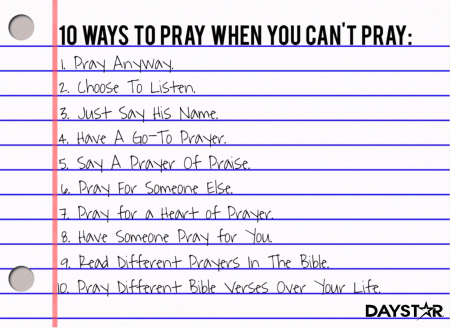
Below we find a way to jumpstart our prayer life. I hope you can use it.

One more thought. “Conversational Prayer” is a good thing for me lately. Talk with Jesus as if He was in the same room with you (He is) and just converse. Share your ups and downs, and it’s okay if you feel messed up. Relax. He’s your Father!

He absolutely loves talking with you.