Chosen People of Faith

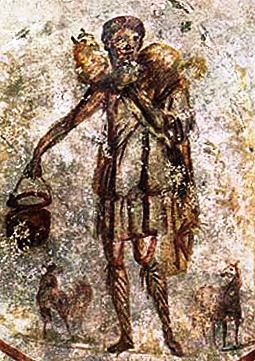
Good_shepherd_02b_close
Shepherd of Hermes, (catacombs c. 160)

The Shepherd of Hermas, written c.125 AD, repeatedly declares that the Church has always existed, since the beginning of creation. The Old Testament believers are joined by those in the New Testament Christians in one single community of faith. Paul asserts that this faith unites us with each other; that we all have a common calling. (Hebrews 11.)

It seems you share a familiar bond, perhaps closer than you think, with Abraham, Noah or Isaiah. All of the OT saints are welded to us as we walk out our faith in Jesus. Personally I find that comforting.

God has always had a people who have been “chosen.” As a broken believer I will take all the godly encouragement I can. We are pulled in so many different directions; it’s hard sometimes to cope. Knowing I walk in an “unbroken line” of the faithful gives me “vim and vigor.”

I can now more deeply relate to guys like Joseph, who faithfully followed God from slave-to-prince. Or the three Hebrew children who walked around in the fiery furnace. By faith we possess the same hope as they did, we have the same God and Father. I believe it wouldn’t be off-base to call them family.

The nuances become clearer as we reflect on our mental illnesses. Noah built an ark. I’m constructing a sane mind. He went through the jeering abuse from his neighbors. I have to decide to get out of bed. All must be done through faith. Faith in God unites us. Faith is that which gives us “a sound mind” (2 Tim. 1:7.) Faith in God connects me with Noah.

“Faith is the confidence that what we hope for will actually happen; it gives us assurance about things we cannot see. Through their faith, the people in days of old earned a good reputation.”

Hebrews 11:1-2, NLT

Hebrews 11 connects our faith with theirs. It even hints that our own faith enhances their own.

“All these people earned a good reputation because of their faith, yet none of them received all that God had promised. 40 For God had something better in mind for us, so that they would not reach perfection without us.”

Hebrews 11:39-40

I didn’t mean to dump a load of “dry theology” on you. But I suspect that there could be healing for us if we venture to take it up. Good theology can be like good hygiene, if you don’t have it you will notice. (So will your friends.) I have come to see that the things we believe, affect us in significant and profound ways.

Your 21st century struggle of faith is as significant as David’s own battle with Goliath. It’s something to consider anyway. Read Hebrews 11.

“Faith makes all things possible… love makes all things easy.” 

D.L. Moody
bry-signat (1)

cropped-christiangraffiti1.jpg

A 100% Authentic Sinner

‘This is a trustworthy saying, and everyone should accept it: “Christ Jesus came into the world to save sinners”—and I am the worst of them all.”  

1 Tim. 1:15, NLT

There are some things that can be easily understood, they are obvious.  As believers, there are certain things that are just written in stone.  They are revealed to us in a moment of time, and give us dimensions to a knowable truth.  In this case, ‘people sin all the time’. Our essential nature as a human being is to sin. We are “factories of sin.”

Paul’s relationship has its starting point in theology.  He declares to us directly the perhaps ultimate fact in the entire universe.  Jesus has come for sinners.  Sinners, transgressors, perverts, and the foolishly ignorant are special recipients of a grace that is irresistible.  This is why Jesus came, to find us who have been so twisted up by life, and left wrecked by the side of the road.

It’s funny but I have a point of departure with Paul’s proclamation of being the worst, or the chief of sinners.  I contend with it because I know and believe in my own wickedness.  (I’ve always felt Paul was a bit premature on this).  My own iniquity is such that I feel I can supplant Paul’s personal place.

But in this central verse in 1 Tim 1:15 lays out some vital truth.

  • Jesus has come.
  • He has focused on the “world.”
  • His purpose in coming was to save each of us.
  • Paul understands and thinks he is the ultimate sinner.

Who are we, exactly?  I think we need to realize that scriptural truth has come to us, and rather some diverse mist that just accepts all of us just as we are.  Rather, it’s more like each of us accepting God’s terms of what is theologically real and walking away from it, having absorbed the truth.

It is true, that united with Christ I live a resurrected life. But there can be no resurrection with something dying first. Both are needful. Both are to be part of our theology. Thats what is really important.

bry-signat (1)

cropped-christiangraffiti1.jpg

It’s Friday, but Sunday’s Coming!

easter
 “he humbled himself in obedience to God
    and died a criminal’s death on a cross.”

Philippians 2:8

Dr. Tony Campolo tells the story of a little preaching competition that he had with his pastor during services at the church where he attends. Dr. Campolo tells how he preached the “perfect” sermon, perfect in every way. He had taken the congregation to the heights of glory. And as he sat down beside his pastor, Dr. Campolo patted him on the knee and simply said, “Top that.” The older black pastor looked at him and said, “Boy, watch the master.”

It was a simple sermon, starting softly, building in volume and intensity until the entire congregation was completely involved, repeating the phrases in unison. The sermon went something like this.

It’s Friday. Jesus is arrested in the garden where He was praying. But Sunday’s coming.
It’s Friday. The disciples are hiding and Peter’s denying that he knows the Lord. But Sunday’s coming.
It’s Friday. Jesus is standing before the high priest of Israel, silent as a lamb before the slaughter. But Sunday’s coming.
It’s Friday. Jesus is beaten, mocked, and spit upon. But Sunday’s coming.
It’s Friday. Those Roman soldiers are flogging our Lord with a leather scourge that has bits of bones and glass and metal, tearing at his flesh. But Sunday’s coming.
It’s Friday. The Son of man stands firm as they press the crown of thorns down into his brow. But Sunday’s coming.
It’s Friday. See Him walking to Calvary, the blood dripping from His body. See the cross crashing down on His back as He stumbles beneath the load. It’s Friday; but Sunday’s a coming.
It’s Friday. See those Roman soldiers driving the nails into the feet and hands of my Lord. Hear my Jesus cry, “Father, forgive them.” It’s Friday; but Sunday’s coming.
It’s Friday. Jesus is hanging on the cross, bloody and dying. But Sunday’s coming.
It’s Friday. The sky grows dark, the earth begins to tremble, and He who knew no sin became sin for us. Holy God who will not abide with sin pours out His wrath on that perfect sacrificial lamb who cries out, “My God, My God. Why hast thou forsaken me?” What a horrible cry. But Sunday’s coming.
It’s Friday. And at the moment of Jesus’ death, the veil of the Temple that separates sinful man from Holy God was torn from the top to the bottom because Sunday’s coming.
It’s Friday. Jesus is hanging on the cross, heaven is weeping and hell is partying. But that’s because it’s Friday, and they don’t know it, but Sunday’s a coming…”


Dr. Tony Campolo

Campolo’s web site: http://www.tonycampolo.org/

(This sermon is in an audio format as well: http://tonycampolo.org/its-friday-but-sundays-coming/)


1brobry-sig4

cropped-christiangraffiti1 (1)

The Micro and the Macro, by John Piper

10piper
John Piper, Pastor of Bethlehem Baptist Church, Minneapolis. Writer and Speaker, DesiringGod.org

Originally dated, July 14, 2008 | By: John Piper 

One of the reasons God rarely gives micro reasons for his painful providences, but regularly gives magnificent macro reasons, is that there are too many micro reasons for us to manage, namely, millions and millions and millions and millions and millions. God says things like:

  1. These bad things happened to you because I intend to work it together for your good (Romans 8).
  2. These happened so that you would rely more on God who raises the dead (2 Corinthians 1).
  3. This happened so that the gold and silver of your faith would be refined (1 Peter 1).
  4. This thorn is so that the power of Christ would be magnified in your weakness (2 Corinthians 12).

But we can always object that there are other easier ways for God to accomplish those things. We want to know more specifics: Why now? Why this much? Why this often? Why this way? Why these people?

The problem is, we would have to be God to grasp all that God is doing in our problems. In fact, pushing too hard for more detailed explanations from God is a kind of demand that we be God.

horseshoe-anvil-clipartThink of this, you are a blacksmith making horseshoes. You are hammering on a white hot shoe and it ricochets off and hits you in the leg and burns you. In your haste to tend to your leg you let the shoe alone unfinished. You wonder why God let this happen. You were singing a hymn and doing his will. Your helper, not knowing the horseshoe was unfinished gathered it up and put it with the others.

Later there was an invasion of your country by a hostile army with a powerful cavalry. They came through your town and demanded that you supply them with food and with shoes for their horses. You comply. Their commander has his horse shod by his own smith using the stolen horseshoes, and the unfinished shoe with the thin weak spot is put on the commander’s horse. In the decisive battle against the loyal troops defending your homeland the enemy commander is leading the final charge. The weak shoe snaps and catches on a root and causes his horse to fall. He crashes to the ground and his own soldiers, galloping at full speed, trample him to death. This causes such a confusion that the defenders are able to rout the enemy and the country is saved. Now you might say, well, it would sure help me trust God if he informed me of these events so that I would know why the horseshoe ricocheted and burned my leg. Well maybe it would help you. Maybe not.

God cannot make plain all he is doing, because there are millions and millions and millions and millions of effects of every event in your life, the good and the bad. God guides them all. They all have micro purposes and macro purposes. He cannot tell you all of them because your brain can’t hold all of them.

Trust does not demand more than God has told us. And he has given us immeasurably precious promises that he is in control of all things and only does good to his children. And he has given us a very thick book where we can read story after story after story about how he rules for the good of his people. Let’s trust him and not ask for what our brains cannot contain.

flourish1


http://www.desiringgod.org/Blog/1307_why_god_doesnt_fully_explain_pain/

Need Immediate Help? Call 1-888-NeedHim