
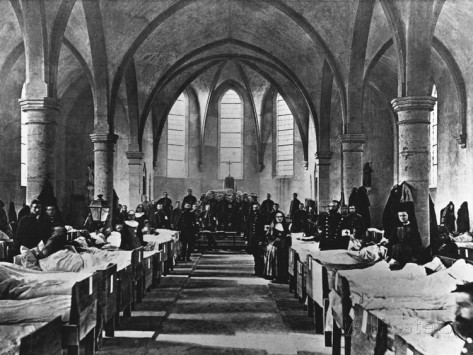
The Church Triumphant

the-church-military-hospital
A church as a hospital during WW1
“The church is not a select circle of the immaculate, but a home where the outcast may come in. It is not a palace with gate attendants and challenging sentinels along the entrance-ways holding off at arm’s-length the stranger, but rather a hospital where the broken-hearted may be healed, and where all the weary and troubled may find rest and take counsel together.” 

James H. Aughey

I have heard of a hospital in England that gives a loaf of bread to everyone who asks. This tradition has been going on for over 800 years. The hungry are fed at St. Cross Hospital by just knocking at a door. This hospital takes ministry very seriously.

Jesus Christ so loves sinners that He gives to all who come to Him. Hungry sinners have to do is knock. But there is more than this. He provides a bath to all who are filthy. A wardrobe to cover up any nakedness. A bed to everyone who is weary and sad, for the Gospel meets every spiritual need.

I like to think that there is room for the mentally ill at Jesus’ hospital. A safe place for those who are exhausted by their battles, a room where Jesus can bless those who are afflicted. I believe there is such a place. For my own soul has been comforted by Him.

The Church carries on the ministry— it’s a St. Cross Hospital— for the immense needs of human beings. The sons of Adam and the daughters of Eve can find salvation and comfort from a world that intends only to destroy. Furthermore we now represent Jesus to a desperate world. We become Christ-like for this reason. The Church triumphs during times like this.

The poor and needy– the sick, the lame, the mentally ill, the prisoner, the addict are the Church’s glory. This little group of rag-tag disciples are responsible for the care of the lost. We just need to figure out how we can reach them. The Holy Spirit will help us.

The World is watching us. We welcome this, for we are the salt and light lifted up so all can see. We were born to serve.

 “You are the salt of the earth. But if the salt loses its saltiness, how can it be made salty again? It is no longer good for anything, except to be thrown out and trampled underfoot.

14 You are the light of the world. A town built on a hill cannot be hidden.”

Matthew 5:13-14

We dare not remove and nullify our mission. When we do so we become nothing more than another institution that is trying hard to secure a place in this world, Our distinctiveness is “blood bought” and our mandate is to be  “the Salt and Light” in this dark place. It is our sure calling. It is the Father’s will. We will be the Church triumphant.


bry-signat-1

cropped-christiangraffiti1 (2)

Check out: https://en.wikipedia.org/wiki/Hospital_of_St_Cross

A Deep Crisis of Faith

faith-mental-illness

Church response to the mentally ill

By Peter Andres

Are people of faith with a mental illness different from those who have a physical illness? Much about mental illness still remains a mystery. That’s one of the reasons people are tempted to spiritualize the problem. They hope that the person with mental illness would be able to gain spiritual strength and thus gain victory over the illness.

What remains hard for many to understand is that having a mental illness and being a strong person of faith is no different than having a serious physical illness and being a strong person of faith.

How can church leaders encourage support of people with a mental illness? What does a person with a mental illness need to help him or her feel accepted and part of the congregation? How does the Christian message and experience take on meaning under these circumstances? What exactly is mental illness, anyway?

Marja Bergen, in her book, Riding the Roller Coaster (Northstone, 1999), describes her experiences living with bipolar disorder. She talks about the many important factors that helped make her life with this illness tolerable and manageable. Having a supportive husband, friends, and service systems were critical, but she also acknowledges the importance of a spiritual home.

Her church friends learned to understand her illness and provided spiritual nurture, especially during difficult times. She speaks about friendships which include a common belief as being the most valuable ones she’ll have. But she also admits that she was fortunate in this regard.

Sadly, many people with mental illness who look for spiritual help during difficult times face ignorance, stigma, avoidance, and judgment. The spiritual counsel and prayer these people receive frankly do more harm than good.

Understanding mental illness, even from the professional, scientific perspective, is still very much a work in progress. Schizophrenia and its related disorders, bipolar disorder (also known as manic depression), major depression, panic and obsessive-compulsive disorders, are all considered mental illnesses. It is estimated that between 15 percent to 20 percent of North Americans will, at some time in their lives, experience a mental illness. Most of these will suffer debilitating depression.

Evidence suggests there are probably organic (biochemical) reasons for the illness, or psycho-social origins — or a combination of the two. Treatments that deal with the symptoms include medications, psychotherapy or a blend of both.

What is clear to people working in the field is that the experience of the illness goes far beyond living with the symptoms. While a person who has a physical illness — even cancer — suffers discomfort and anxiety related to the illness, those who have a mental illness suffer from a constellation of additional issues. These all affect their ability to return to wellness. One of them is stigma, both internally and externally imposed. There’s also the loss of self-worth and self-efficacy that might come with a loss of job, friends, marriage and the feelings of being separated from God.

How can the church assist someone in a situation as devastating as this?

1. Church leaders and church members need to know that a mental illness is not the same as a spiritual crisis. Nor is the absence of healing, especially after fervent prayer, a sign of judgment or lack of faith.

2. There should be no judgment about the use of mood altering medications. Medications are commonly needed to treat the bio-chemical causes for the disorder and radically help many keep their symptoms under control.

3. Quality of life for a person suffering from mental illness does not depend on a complete remission from the illness.

What church members need to know is that many experience a recovery which allows them to return to an active and fulfilling life — but still continue to experience times that are difficult. Recovery from mental illness means: the return of a positive sense of self, usually through meaningful endeavour (work, vocation), a circle of meaningful relationships, a place to live that the person can call his or her own, and a spiritual life that feels a reconnection with God.

The recovering person can be experiencing personal brokenness and limitations, yet have valuable gifts to offer to the church community.

Peter Andres is a regional director for MCC Supportive Care Services, a non-profit charitable organization which supports people with disabilities — including people with mental health issues. He can be contacted at peter@mccscs.com.


Who Am I? by Dietrich Bonhoeffer

bonhoeffer-ins1

From the Journal of Dietrich Bonhoeffer

Dietrich Bonhoeffer (1906-1945)

Dietrich Bonhoeffer was a German Lutheran pastor and theologian. He was also a participant in the German Resistance movement against Nazism, a founding member of the Confessing Church. His involvement in plans by members of the Abwehr (the German Military Intelligence Office) to assassinate Adolf Hitler resulted in his arrest in April 1943 and his subsequent execution by hanging in April 1945, shortly before the war’s end.

Protestant theologian Dietrich Bonhoeffer stands out among the Christian leaders during the Nazi era, for he was one of the few to actively resist the racist actions of the Nazi regime. In addition to his legacy of courageous opposition to Nazism, Bonhoeffer’s theological writings are still widely read in Christian communities throughout the world. “At the place of execution, he again said a short prayer and then climbed the steps to the gallows, brave and composed. His death ensued after a few seconds. In almost fifty years that I worked as a doctor, I have hardly ever seen a man die so entirely submissive to the will of God.” Source: Prison doctor witness to Bonhoeffer’s death  

From His Writings–

Who am I? They often tell me

I stepped from my cell’s confinement

Calmly, cheerfully, firmly,

Like a squire from his country-house.

Who am I? They often tell me

I used to speak to my warders

Freely and friendly and clearly,

As though it were mine to command.

Who am I? They also tell me

I bore the days of misfortune

Equally, smilingly, proudly,

Like one accustomed to win.

Am I then really all that which other men tell of?

Or am I only what I myself know of myself?

Restless and longing and sick, like a bird in a cage,

Struggling for breath, as though hands were

compressing my throat,

Yearning for colors, for flowers, for the voices of birds,

Thirsting for words of kindness, for neighborliness,

Tossing in expectation of great events,

Powerlessly trembling for friends at an infinite distance,

Weary and empty at praying, at thinking, at making,

Faint, and ready to say farewell to it all?

Who am I? This or the other?

Am I one person today and tomorrow another?

Am I both at once? A hypocrite before others,

And before myself a contemptibly woebegone weakling?

Or is something within me still like a beaten army,

Fleeing in disorder from victory already achieved?

Who am I? They mock me, these lonely questions of mine.

Whoever I am, Thou knowest, O God, I am Thine!

–July 18, 1944

cropped-cropped-cropped-christiangraffiti1-11.jpg


CCM Spotlight- Keith Green

Brother Keith was a remarkable man.  He was a gifted song writer and a wonderful pianist.  This video is live Keith Green performing,  “When I Hear The Praises Start” (live) He left many of us with an indelible mark.

Some of his quotes:

“It’s time to quit playing church and start being the Church (Matt. 18:20)” — Keith Green

“I repent of ever having recorded one single song, and ever having performed one concert, if my music, and more importantly, my life has not provoked you into Godly jealousy or to sell out more completely to Jesus!” — Keith Green

“If your heart takes more pleasure in reading novels, or watching TV, or going to the movies, or talking to friends, rather than just sitting alone with God and embracing Him, sharing His cares and His burdens, weeping and rejoicing with Him, then how are you going to handle forever and ever in His presence? You’d be bored to tears in heaven, if you’re not ecstatic about God now!!” — Keith Green

Keith Green
October 21, 1953 – July 28, 1982

http://en.wikipedia.org/wiki/Keith_Green