
Tears Do Things

I’ve been thinking a lot about tears lately—in part because Pastor Bryan pointed out to me how many hits my post titled God Keeps Your Tears in a Bottle has had, in part because I’ve cried more than a few tears this year, and in part because I’ve been listening to Johnny Cash’s Cry, Cry, Cry in my car all week—and I thought I’d share my thoughts with you all here.

First of all, people cry for a lot of reasons.

Earlier this year my sister died of breast cancer at only 61 years old. I cried, a lot. It’s normal and even helpful to shed tears over the death of a loved one even if we know where they are going when they die, because it allows us to express the grief we feel over not having them in our lives any more here on earth.

I remember a time I had a previous boss say some very cruel things to me in front of other people. She accused me of having done things I had not based on motives I did not have. I was very angry, hurt, and frustrated. And I cried, a lot. I didn’t cry in front of her, mind you, but afterwards I did. And it was good to express that anger to others.

Just yesterday I experienced unexpected tears.

I was reciting the prayers of the people in church, which I’ve done many times. Our church has many prayer concerns for members, family, and friends with health concerns and more. Towards the end of the prayer I began to lift up prayers for a church member’s brother-in-law who is a pastor back in New York because he is faced with conducting the funerals of two teens who had been killed in an accident last week.

I recently wrote this poem.

Tears

Tears of sorrow, anger
drench my soul
course without end
eroding pain, anguish

Where once only aching
occupied my heart
now is a deep empty ravine
carved by a river of tears

Tears of forgiveness
water my soul’s riverbed
allowing flowers of love
to flourish and grow

Peace arises in my heart
held aloft by God’s promises
the fragrance of sweet alyssum
blossoms of my soul

I think the saddest tears of all, though, are the tears of major clinical depression. These tears are so sad because the one who cries them doesn’t know what purpose they serve.

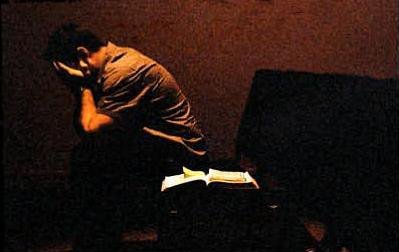
I remember when I was suffering from depression sitting in a chair and just crying. When someone asked me why I was crying all I could say was, “I don’t know.” And I truly didn’t. The tears didn’t wash away pain; they only seemed to make it all the worse.

In the midst of such tears, there is One who knows their purpose.

Romans 8:26 says: “In the same way, the Spirit helps us in our weakness. We do not know what we ought to pray for, but the Spirit himself intercedes for us through wordless groans.” Through prayer God can sometimes lead us to an understanding of the purpose of the tears of depression, and ultimately to healing.

That makes your tears a good thing.

Henry Ward Beecher

Check out Linda’s site.

The Lost Ones

broken_heart

“Light shines in the darkness for the godly.
    They are generous, compassionate, and righteous.”

Psalm 112:4, NLT

The glory of Jesus lies in this: in weakness, vulnerability, and apparent failure. He has called forth disciples to come after Him, willing and able to carry the cross and relive His passion with compassion.

They are marginal people, not part of the scene, irrelevant to the “action.” In their ministry or quiet presence they do not need to win or compete. They may even look like losers, even if its just to themselves.

The world ignores them. But they are building “the Kingdom of God” on earth by reaching out in vulnerability and weakness to share the suffering of their brothers. They work by love rather than continue in sin.

“Where the compassionate One is, there will His servants be.”


Manning-devo-coverBrennan Manning, “Reflections for Ragamuffins.”

From an entry dated June 27th.  “A Stranger to Self Hatred,” by Brennan Manning.

Copyright @ 1982 by Brennan Manning, reprinted by permission of Dimension Books, Inc.

The Church Collects Sinners

The following excerpt is from the devotional book, “Living the Message,” by Eugene H. Peterson.  This pastor-professor is probably the person I want to grow up to be like; he has a gentleness and eloquence that is seldom seen–and highly respected.
Dr. Peterson died in 2018.
The author of many books, and his translation of the Bible, titled “The Message” is regarded by many as a masterpiece of the English language. 
Additionally, he has recently focused on the pastor, and on the many issues, a pastor might face.  He understands being a servant of the Gospel and the Church. 
I encourage you to read his stuff.  

***********

“When Christian believers gather in churches, everything that can go wrong sooner or later does.  Outsiders, on observing this, conclude there is nothing to this religious business, except perhaps, business…and a distant one at that.  Insiders see it much differently.”
“Just as a hospital gathers the sick under one roof and labels them as such, the Church collects sinners.” 
“Many people outside are just as sick as the ones inside, but their illnesses are either undiagnosed or disguised.  It is similar with sinners outside the church.”

********

 Some other quotes by Eugene Peterson:

  • “All the persons of faith I know are sinners, doubters, uneven performers. We are secure not because we are sure of ourselves but because we trust that God is sure of us.”
  • “When we submit our lives to what we read in scripture, we find that we are not being led to see God in our stories but our stories in God’s. God is the larger context and plot in which our stories find themselves. “
  • “When we sin and mess up our lives, we find that God doesn’t go off and leave us- he enters into our trouble and saves us.”
  • “American religion is conspicuous for its messianically pretentious energy, its embarrassingly banal prose, and its impatiently hustling ambition.”
More Eugene Peterson Quotes…
 
 
bry-signat (1)

Rembrandt’s Prodigal Son

Rembrandt-The_return_of_the_prodigal_son
Rembrandt, “The Return of the Prodigal Son,” c. 1661

17 “But when he came to himself, he said, ‘How many of my father’s hired servants have more than enough bread, but I perish here with hunger! 18 I will arise and go to my father, and I will say to him, “Father, I have sinned against heaven and before you. 19 I am no longer worthy to be called your son. Treat me as one of your hired servants.”’ 20 And he arose and came to his father. But while he was still a long way off, his father saw him and felt compassion, and ran and embraced him and kissed him. 21 And the son said to him, ‘Father, I have sinned against heaven and before you. I am no longer worthy to be called your son.’ 22 But the father said to his servants, ‘Bring quickly the best robe, and put it on him, and put a ring on his hand, and shoes on his feet. 23 And bring the fattened calf and kill it, and let us eat and celebrate. 24 For this my son was dead, and is alive again; he was lost, and is found.’ And they began to celebrate.

Luke 15:17-24, ESV

Two hundred and eighty-nine words– these describe the life of every man, woman, and child who has ever lived. These 289 words reveal to us a God who loves far too much, way too easy. Perhaps we sort of expect that he will ‘appropriately’ punish his son– at least put him on probation at least. It only makes sense. But we find that is legalism talking.

“Every saint has a past, and every sinner has a future.” 

Many of us have lived as prodigals, and we have spent our inheritance like ‘drunken sailors.’ We really have nothing at all to show for it. The prodigal, completely destitute, takes the only work he can find. (Imagine a good Jewish boy feeding hogs.)

He is so far gone that he starts inspecting the filthy slop buckets for something to eat.

Many of us will understand his despair. Often there comes to us a crystalline moment of simple awareness. The prodigal, sin-crusted and impoverished, still has a lingering memory of the Father’s house.

The servants there had far more than him right now. Sometimes I wonder if in our captivity, we instinctively want to go home, if only in our minds, to be a servant there.

The Father has dreamed of this precise moment.

The parable says, “He saw him–felt compassion–ran out to him–embraced him–and kissed him.” The Father is a whirlwind of agape love. I’ve read the Parable of the Prodigal Son a hundred times or more. It never loses its punch. I simply want to bring some observations: 

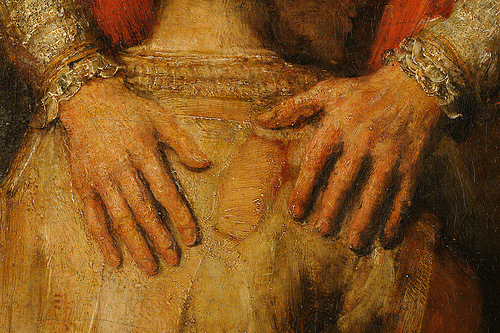
  • We see that his father receives him with a tender gesture. His hands seem to suggest mothering and fathering at once; the left appears larger and more masculine, set on the son’s shoulder, while the right is softer and more receptive in gesture.
  • The son’s head is downy, almost like a newborn’s. We must enter the kingdom like little children. 
  • The Prodigal Son seems to be protected by his father. He snuggles near the Father’s breast. It’s love that holds him there.
  • Consider his sandals. It has taken a long time for him to come home. 
  • Standing at the right is the prodigal son’s older brother, who crosses his hands in stoic judgment; we read in the parable that he objects to the father’s compassion for his brother.
  • We see his mother in the background in the painting, and a seated steward or counselor. One stands in profound joy, the other in sits in stunned perplexity.

But Rembrandt had painted the Prodigal once before, when he was considerably younger. And it is a very good painting. The prodigal is happy and gay; there is absolutely no indication of the consequences of sin.

The Prodigal Son in the Brothel, 1635

He’s a charming young man at the height of his popularity, and we see him at a happy party. He is spending the inheritance of his father.

But Rembrandt chooses at the very end of his life to re-paint it to reflect reality.

This is one of the last paintings he will do, and it is the Prodigal Son–destitute and repenting. I can only imagine; the years have taken a toll and he doesn’t really feel his first painting is enough. He wants to paint what is true.

He now is painting our spiritual condition.

We are given a work that some critics call as the greatest painting ever completed. The painting is now in St. Petersburg, Russia. It is seldom seen by visitors. It is a clear echo of the grace of God for fallen men and women. Like the father in the painting, He’s ready to forgive every sin saturated son and daughter.

The Father’s Prodigal

bry-signat (1)