“Darkness is My Only Companion”

Ambrose of Milan (340-397)

Our theology makes all the difference in fighting depression, writes Kathryn Greene-McCreight, Author of “Darkness, Is My Only Companion” and Episcopal priest.

In his Problem of Pain, C. S. Lewis says that suffering is uniquely difficult for the Christian, for the one who believes in a good God. If there were no good God to factor into the equation, suffering would still be painful, and  ultimately meaningless.

For the Christian, who believes in the crucified and risen Messiah, suffering is always meaningful. It is meaningful because of the one in whose suffering we participate, Jesus. This is neither to say, of course, that suffering will be pleasant, nor that it should be sought. Rather, in the personal suffering of the Christian, one finds a correlate in Christ’s suffering, which gathers up our tears and calms our sorrows and points us toward his resurrection.

In the midst of a major mental illness, we are often unable to sense the presence of God at all. Sometimes all we can feel is the complete absence of God, utter abandonment by God, the sheer ridiculousness of the very notion of a loving and merciful God. This cuts to the very heart of the Christian and challenges everything we believe about the world and ourselves.

I have a chronic mental illness, a brain disorder that used to be called manic depression, but now is less offensively called bipolar disorder. I have sought help from psychiatrists, social workers, and mental health professionals; one is a Christian, but most of my helpers are not. I have been in active therapy with a succession of therapists over many years, and have been prescribed many psychiatric medications, most of which brought quite unpleasant side effects, and only a few of which relieved my symptoms. I have been hospitalized during the worst times and given electroconvulsive therapy treatments.
All of this has helped, I must say, despite my disinclination toward medicine and hospitals. They have helped me to rebuild some of “myself,” so that I can continue to be the kind of mother, priest, and writer I believe God wants me to be.

During these bouts of illness, I would often ask myself: How could I, as a faithful Christian, be undergoing such torture of the soul? And how could I say that such torture has nothing to do with God? This is, of course, the assumption of the psychiatric guild in general, where faith in God is often viewed at best as a crutch, and at worst as a symptom of disease.

How could I, as a Christian, indeed as a theologian of the church, understand anything in my life as though it were separate from God? This is clearly impossible. And yet how could I confess my faith in that God who was “an ever-present help in trouble” (Ps. 46:1) when I felt entirely abandoned by that God? And if this torture did have something to do with God, was it punishment, wrath, or chastisement? Was I, to use a phrase of Jonathan Edwards’s, simply a “sinner in the hands of an angry God”?

I started my journey into the world of mental illness with a postpartum depression after the birth of our second child. News outlets are rife with stories of women who destroy their own children soon after giving birth. It is absolutely tragic. Usually every instinct in the mother pushes toward preserving the life of the infant. Most mothers would give their own lives to protect their babies. But in postpartum depression, reality is so bent that that instinct is blocked. Women who would otherwise be loving mothers have their confidence shaken by painful thoughts and feelings.

Depression is not just sadness or sorrow.

When I am depressed, every thought, every breath, every conscious moment hurts.

And often the opposite is the case when I am hypomanic: I am scintillating both to myself, and, in my imagination, to the whole world. But mania is more than speeding mentally, more than euphoria, more than creative genius at work. Sometimes, when it tips into full-blown psychosis, it can be terrifying. The sick individual cannot simply shrug it off or pull out of it: there is no pulling oneself “up by the bootstraps.”

And yet the Christian faith has a word of real hope, especially for those who suffer mentally. Hope is found in the risen Christ. Suffering is not eliminated by his resurrection, but transformed by it. Christ’s resurrection kills even the power of death, and promises that God will wipe away every tear on that final day.

But we still have tears in the present.

We still die. In God’s future, however, death itself will die. The tree from which Adam and Eve took the fruit of their sin and death becomes the cross that gives us life.

The hope of the Resurrection is not just optimism, but keeps the Christian facing ever toward the future, not merely dwelling in the present. But the Christian hope is not only for the individual Christian, nor for the church itself, but for all of Creation, bound in decay by that first sin: Cursed is the ground because of you … It will produce thorns and thistles for you …” (Gen. 3:17-18).

This curse of the very ground and its increase will be turned around at the Resurrection. All Creation will be redeemed from pain and woe. In my bouts with mental illness, this understanding of Christian hope gives comfort and encouragement, even if no relief from symptoms. Sorrowing and sighing will be no more. Tears will be wiped away. Even fractious [unruly, irritable] brains will be restored.

“Darkness: My Only Companion”

Kathryn Greene-McCreight is assistant priest at St. John’s Episcopal Church in New Haven, Connecticut, and author of Darkness Is My Only Copanion: A Christian Response to Mental Illness (Brazos Press, 2006).

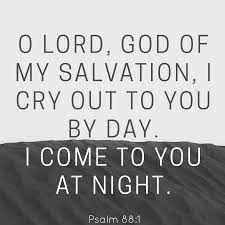
Click to read Psalm 88

A Very English Pigeon

“I will instruct you and teach you in the way you should go; I will counsel you with my eye upon you.”

Psalm 32:8

In April 2002, I was sitting in a cavernous waiting room at King’s Cross in London, England.  I was waiting for a bus to Cambridge, UK.  I sat all alone and stared at the tiled floor at my feet.  The doctors had warned me not to travel alone, but I ignored their advice.

And now I was starting to really unravel.

Depression had followed me all the way from Alaska to England. I had pushed my limits and was completely drained and was becoming very confused.  I began to cry out to the Lord, very desperately. Sometimes madly. (Read Psalm 88.)

As I sat there staring intensely at the floor, several pigeons seemed to put on a show, just for me. They were fat little guys, apparently scratching out a good living. Several very large windows were open, and these pigeons seemed to have no fear as they took advantage of a meal from bored travelers.

All of a sudden something very odd happened. 

A pigeon came across the floor and “presented” himself, right square in front of me.  I watched him intently and saw that he was crippled, one of his feet was nothing more than a twisted claw.  He had been profoundly injured in such a way, that he would never be the same.  He was damaged, and yet somehow he was surviving, but even more, and he was thriving!

It was like experiencing a lightning bolt. God’s own light switch was being flipped.

I saw that pigeon, and I saw myself, and it was a moment of clarity, a shining grace.  In the mega-hustle of 13.6 million people in London, and in the midst of my own profound mental crisis, I knew God’s caring touch and it gave me real grace, love, and goodness–far greater than all my sin and confusion. He was just letting me know that He was very, very close. (See Psalm 34:18.)

I had seen my damaged pigeon, completely oblivious to self-pity.

I started to call out to the Father out of my confusion.  Within a few minutes, I found myself sitting on the top level of a double decker bus, with the driver aware of my problems and who specifically drove me to the place I was staying. 

I was being cared for. Between a crippled pigeon and the dutiful ministrations of a bus driver, I’d finally found my hotel. (See Matthew 6:26.) 

I have come to realize that this trip to England was not for me to see Big Ben, Parliament, or wander the academic schools of Cambridge University.  Rather I was brought there to make contact with a certain pigeon, who was waiting to meet me and pass on vital instructions. 

The Father shared things that I need to know.  British castles and churches are beautiful and worth seeing but I must admit I’ve forgotten much. I hope I can return someday.

But on this trip, all I really needed to see was a crippled English pigeon who was just waiting to meet me.

God Used My Trials


Trigger Warning: This post involves rape. If you are sensitive, please tread lightly. It is not my intention to cause more pain, but to show how God can use even our worst trauma for good.

But Joseph said to them, “Don’t be afraid. Am I in the place of God? You intended to harm me, but God intended it for good to accomplish what is now being done, the saving of many lives.”

Genesis 50:19-20 (NIV)

When you’re fourteen, they call it puppy love. I thought it was real because he claimed he loved me, too. He was older and cute in a rugged sort of way, with shaggy long brown hair and a scruff of facial hair, not quite a beard and mustache.

One day he asked me to go for a walk, just to talk. The biting cold drove us indoors to his house. In my naiveté, I never saw it coming. At the tender age of 14, my 105-pound frame was overpowered and violated. Without a second thought, he crushed my spirit and devoured an innocence I can never redeem.

It can sound like a platitude, or worse, this oft repeated verse:

“And we know that in all things God works for the good of those who love him, who have been called according to his purpose.”

Romans 8:28, NIV

Surely, Paul didn’t mean all things? He couldn’t have meant the rape I suffered? God certainly can’t bring any good from the suffering, shame, and depression that followed me for decades after?

Or can He?

Even now—as a powerless, frightened little girl lives in me and I sometimes struggle with deep despair, doubting God’s blessings—God reminds me I am His beloved. He has empowered me to survive any trial. I may feel powerless and frightened, but the truth is He will not allow me to be utterly destroyed.

Trauma and loss are inevitable for all of us. I’m not alone even in this dreadful experience of sexual assault.

When I consider my experiences in the light of God’s purposes for my life, I see the blessing. His bigger plan becomes less fuzzy, if not clear. I see how my troubles drew me closer to Jesus as my only refuge.

The path my life may have taken—had there been no pain, no loss of innocence—is one in which I may have never understood my need for a Savior. When all is well, what does one need saving from? But I did need to be saved from a darkness that grew deeper with each successive trauma I experienced. I desperately needed rescuing so I could live this wonderful, light-filled life He gave me.

I like the woman God has shaped me into, even if suffering was required for the Potter to mold this piece of clay. God did not plan or desire my suffering, but He certainly used it to develop in me the compassion, mercy, and humility that have become my hallmark. In all my experiences, He worked for my good because He loves me. He has called me to use my experience to give hope to others.

Do you need this hope today?

It’s just a story away. I’d love if you would share your story so that God can begin to use it for good, too. If you don’t know how to even start writing your story, check out my guided poetry journal, which you can request here: https://anotherfearlessyear.net/i-believe-you.

A Few Bipolar Basics

Bipolar disorder symptoms are characterized by an alternating pattern of emotional highs (mania) and lows (depression). The intensity of signs and symptoms can vary from mild to severe. There may even be periods when your life doesn’t seem affected at all. Take care when this happens.

The manic phase of bipolar disorder–
Signs and symptoms of the manic phase of bipolar disorder may include:

  • Euphoria
  • Extreme optimism
  • Inflated self-esteem
  • Poor judgment
  • Rapid speech
  • Racing thoughts
  • Aggressive behavior
  • Agitation
  • Increased physical activity
  • Risky behavior
  • Spending sprees, credit card irresponsibility
  • Increased drive to perform or achieve goals
  • Increased sexual drive
  • Decreased need for sleep
  • Tendency to be easily distracted
  • Inability to concentrate
  • Drug abuse

The depressive phase of bipolar disorder–
Signs and symptoms of the depressive phase of bipolar disorder may include:

  • Sadness
  • Hopelessness
  • Suicidal thoughts or behavior
  • Anxiety
  • Guilt
  • Sleep problems
  • Appetite problems
  • Fatigue
  • Loss of interest in daily activities
  • Problems concentrating
  • Irritability
  • Chronic pain without a known cause

Types of bipolar disorder
Bipolar disorder is divided into three main subtypes:

  • Bipolar I disorder. You’ve had at least one manic episode, with or without previous episodes of depression.
  • Bipolar II disorder. You’ve had at least one episode of depression and at least one hypomanic episode. A hypomanic episode is similar to a manic episode but much briefer, lasting only a few days, and not as severe. With hypomania, you may have an elevated mood, irritability, and some changes in your functioning, but generally, you can carry on with your normal daily routine and functioning, and you don’t require hospitalization. In bipolar II disorder, the periods of depression are typically much longer than the periods of hypomania.
  • Cyclothymia. Cyclothymia is a mild form of bipolar disorder. Cyclothymia includes mood swings but the highs and lows are not as severe as those of full-blown bipolar disorder.

Other bipolar disorder symptoms:

In addition, some people with bipolar disorder may have rapid-cycling bipolar disorder. This is the occurrence of four or more mood swings within 12 months. These moods shifts can occur rapidly, sometimes within just hours. In mixed state bipolar disorder, symptoms of both mania and depression occur at the same time.

Severe episodes of either mania or depression may result in psychosis or a detachment from reality. Symptoms of psychosis may include hearing or seeing things that aren’t there (hallucinations) and false but strongly held beliefs (delusions).

Taken from the Mayo Clinic/Bipolar Disorder Symptoms.