Picking Up a Stone

” “Let him who is without sin among you be the first to throw a stone at her.””

John 8:7, ESV

“None knows the weight of another’s burden.”

-George Herbert

Definitely, we must discern motives and false doctrine. We’re to be constantly aware of people and issues that swirl around us–of this, there is no doubt, we mustn’t be ignorant. This is a healthy “discernment.”

But we must learn that having discernment isn’t a way that passes out a ‘guilty’ penalty? We are ‘seeing’ things these things–not to pass judgment, but that we might pray clearly and earnestly, and grow into His love for the weak.

But ‘passing a guilty sentence’ is His exclusive jurisdiction.

It’s far beyond our ‘pay grade.’ He is the final judge in everything. He judges justly and lovingly. He alone knows and understands everything very clearly.

It becomes imperative that we understand this; that any real discernment given is only to intensify and escalate the calling of every ‘saint,’ intercessor, or pastor. We discern, not to pass judgment, but to pray more clearly and effectively.

What you see or sense is for the prayer closet, not before a judge’s bench.

And yet how foolish we are. Do we really have the ability to ascribe a penalty to someone else? Could it be when we decide to throw rocks at certain people we’re in terrible danger of forfeiting our own salvation? “But if you do not forgive others their sins, your Father will not forgive your sins.” (Matt. 6:15.)

(If you have a ‘rock’ in your hand, you are in considerable danger. Please consider this–it’s never easy, is it?)

“Don’t judge others, or you will be judged. You will be judged in the same way that you judge others, and the amount you give to others will be given to you.

“Why do you notice the little piece of dust in your friend’s eye, but you don’t notice the big piece of wood in your own eye?

Matthew 7:1-3

We are broken people. We struggle with many different things. Some of us are mentally or physically ill. We are not whole yet. Some of us must take meds to help us be ‘normal.’ We deal with issues that would devastate someone else. And we don’t have it anywhere near together.

And yet out of our ‘hot mess,’ do we think we can penalize someone else? Really?

We really don’t have a problem with worldly people. We understand that they are lost in their sins, terribly wrapped up in their own personal darkness, and that should definitely disturb us. We must point to the Blood of Christ that forgives us. We share the good news of true repentance and faith. His Spirit teaches us to be witnesses of His love to everyone we meet.

“The life of faith is a struggle enough in a broken world without us complicating it for other believers.”

–Jake Colsen

It just may come as a shock to some, but it’s extremely difficult to throw stones at someone when we are busy “washing” their feet.

Granted, “we are to be wise as serpents,” But that same verse instructs us “to be as harmless as doves.” (Matt. 10:16.) A loving meekness and gentleness, need to be combined with intense spiritual power. We must embody “the fruits of the Spirit.” These things are the characteristics of the Spirit-saturated believer.

“The nature and end of judgment or sentence must be corrective, never vindictive; it is always for healing, and never for destruction.”

–John Owen

Perhaps when we judge others, we reveal that we don’t understand what ‘real’ discipleship with Jesus is? Somehow it seems, we really aren’t quite grasping the immensity of His grace on guilty people? Do we really understand His profound love for the fallen? “God so loved the World…” Have we had any idea how patient He is with us? Do we doubt His ability to correct others? (Again, these are awfully hard questions.)

“Judge not lest you be judged.” (Jesus’ words really do scare me sometimes. )

Certainly, I intend to confront the darkness. “You are the light, a city set on a hill!” I am His salt and light and I do shine into this black night. But that is His doing, not mine. I do not generate light on my own. The Bible declares me as ‘self-righteous’ when I try. I am a broken person, who is just starting to understand the scope of my own brokenness and weaknesses. I’m starting to realize I’m not in the position to Judge someone else. I’m not quite healed myself yet and I must not think I can point to someone else as being worse than me.

Quite simply, I can’t throw ‘rocks’ at other believers anymore. I can no longer pass out any condemnation from my own limited understanding. My chief concern right now is to be a humble, earnest Christian who is always ready to forgive those who, in their awful sin and confusion, are hurting others.

I’m beginning to see that my calling is to be; a simple servant to my brothers and sisters, nothing more, and nothing less.

Wolves Clothed As Sheep

wolf-sheeps-clothing1

“Watch out for false prophets. They come to you in sheep’s clothing, but inwardly they are ferocious wolves.” 

 Matthew  7:15, NIV

My channel changer flips through the enormous darkness that exists in the world.  I’m reminded that Jesus clearly warns His flock of the cold, hard realities of deception and deceitfulness they face. 

Trickery abounds and things simply are not what they seem to be.

Darkness has a dark grasp on so many. The devil’s cunning is his ability to adapt to each person’s weakness. Deception has worked well for him for thousands of years. But understand: Lucifer is alive and well and he is prowling planet Earth.

An alert has been sounded by Jesus.

The reality of deception is now made obvious. Sometimes, some sheep will not really be sheep. Our senses are not always trained to look for counterfeit Christians.  We get confused by the outside (“it looks like wool to me”).  But it’s a lie.  The wolf has deliberately taken on the attire of a believer.

Jesus explains what really is taking place around us.

(Oh my, how He wants us to discern!)  I think every believer should have a holy skepticism of outward displays of faith.  This is not cynicism or negativity; rather it is a cautious faith– one in which we can discern the realities of a world that routinely destroys people. The first-generation Church understood the reality of evil and what it would do when it’s unleashed.

“The first step on the way to victory is to recognize the enemy.” 

Corrie Ten Boom

Ferocious” in verse 15 is a sobering word.  When I read it, I think of my home in Alaska with its wilderness and its wolves and brown bears; or maybe the grasslands of the ‘Serengeti’ with its lions or leopards.   A dangerous carnivore is often hidden by its camouflage.

Ferocity is a ‘predator’ word, a word that intensifies danger. Satan can patiently stalk for days, and maybe even months, and then he springs his trap and ambushes its victims.

wolf-sheeps-clothing

“I know that as soon as I’m gone, vicious wolves are going to show up and rip into this flock, men from your very own ranks twisting words so as to seduce disciples into following them instead of Jesus. So stay awake and keep up your guard.”

Acts 20:29, MSG

The Bible tells us that we must understand two critical things: 

1) Deception is quite possible for the real believer, that in 2000 years the darkness is still potent. Satan is alive and well on planet Earth.

2) Living in close proximity to Jesus will protect us in the dark. The true Shepherd keeps His flock. He is our complete protection and safe place against evil things we don’t quite see.

When we’re alerted that the enemy is close to us, the best thing we can do is to move closer to our Shepherd. The battle is His, we are His.

“The devil is nimble; he can run apace; he is light of foot; he hath overtaken many. They that would have heaven must run for it.”

     John Bunyan


*

Martyrdom Maybe?

martyers

Believers must consider the issues of being salt and light in a pagan culture who refuses to claim Christ as Lord.

The Words of Jesus demand our complete response to the Gospel. The temptation is often reducing the call to something easier and more comfortable. We don’t really want to give up the world’s system for all that the Kingdom of God declares to be true.

It’s imperative as disciples that we fully understand that Jesus is Lord, not a political leader–not a nation or a political party. We’ve become citizen’s of something that is superior to a patriotic physical reality. We don’t fit. (Philippians 3:20 and Ephesians 2:19.)

Steps to faithful living as we seperate ourselves from the World’s way of doing things really must be considered:

In order to do this must make the choice:

  • To be true. Endure. Continue to pray and witness. Be faithful to Him.
  • To be prayerful. At least working on it. I know prayer is supremely powerful, linking my inadequacy with God’s capability.
  •  To be joyful. Sing often. Thanksgiving all the time. Our tormentors hate joyful hearts. It seems to disturb the darkness that is part of sin and rebellion.
  • To be real. Being faithful to Jesus. No lies, no illusions. Every aspect of our lives is to be the truth. We understand that Jesus is alive, and He is Lord.
  • To be giving. Time or talent, it’s a stringent test of a believer’s maturity. Money is secondary. We serve Jesus with an open hand.
  • To be convinced. We need to become fully convinced of the message of the gospel, and to be sure of His love. Not easy, but always needful. 

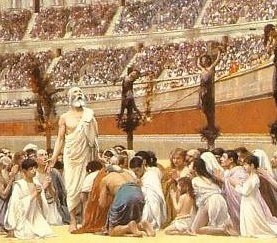
In the time of ancient Rome, Christians were in the limelight, it seems, but only as martyrs. Believers made a definite decison to die rather than renounce their faith. Often faithfulness was especially hard–one had to count a cost to follow.

It’s good to understand the world never burned a casual Christian at the stake.

The lions in the Coliseum made quick work of the Christian’s faith. Thousands of believers were burned at the stake. But these martyrs succeeded in reaching many by their witness, and a pagan empire was brought to Christ, en masse!

Someone said that “the blood of martyrs is the seed of the Church.”

Perhaps martyrdom will be our path to reach America with the Gospel.  The New Testament word for “witness” is martyr.  It very well may be that our blood will be the seed for a new generation of believers. It should come as no surprise. 

martyrdomI preached once on the UC Berkeley campus.  It’s a  challenging place; a condensed stronghold of a godless ‘intellectualism’ (if you can imagine that).  There is always a few people that for the most part bright and engaging. 

But as I got ready to leave, I met a university professor.  He looked at me in his tweed jacket and sweater vest and said something I will never forget.  “Too bad we can’t feed you to the lions”.  That’s all he said. When he spoke to me it was was a flat-calm statement–terse, cold and frightening–it was eerie and quite weird– mostly because I knew he meant it. 

In this ‘enlightened’ campus, there was a coldness–a hatred that I never encountered in the areas of inner San Francisco–Polk Street. or the Tenderloin’ where I preached also.

True, the Haight/Ashbury neighborhood in SF can be a little ‘rough’ at times, I once was punched in the face while preaching by an angry ex-believer, but to be honest, nothing compared to ‘Berzerkeley‘ (that’s what we called it.)

In three years of full-time evangelism I never met another man that was as hateful to the gospel of Jesus Christ as this professor in Berkeley. This incident was a brazen and deliberate calculation against the Gospel. Perhaps persecution by hardcore intellectuals will become the catalyst for our martyrdom to come. (?!).

No matter what happens. We are in God’s hands. Period. 

Our obedience to Jesus should be a decision we must make right now.  We can’t just hope to stand, or hope to be faithful. We must actively plan for persecution. This could very well be our time. It’s coming. And please get ready, you must watch and pray.

“But others trusted God and were beaten to death, preferring to die rather than turn from God and be free—trusting that they would rise to a better life afterwards.”

Hebrews 11:35


Post art “The Christian Martyrs’ Last Prayer,”  by Jean-Leon Gerome (1824-1904)

Discernment and Your Ministry

zebras

“He begs God on behalf of a human
as a person begs for his friend.”

Job 16:21, NCV

I’ve been thinking about a class I had in Bible School.  The instructor made a comment that has stuck in my thinking for over 30 years now.  I have relied on it countless times in ministry since. It has helped me piece together certain issues of the heart.

When we “preach” to a person, we are actively accelerating the judgement of God in their life. When we pray for that same person, we delay this judgement and allow more room for the Holy Spirit to work.


Preaching

Now I know this is a generalization, and yet the basic premise of preaching and praying has a specific action.  When you preach, you are calling that person to make a decision.  They meet up with the truth and must decide for themselves.  This is a very sensitive moment.  If they consider your message at all– you must understand, one way or the other, that it will require a decision.  Either they act on it, or they’ll decide to reject it.

Within the Bible we often see judgement coming to someone, and very often it comes right after a “declaration of the truth” by a witness or a sermon.  Those who hear the word must choose to believe it, or spurn it.  Even a neutral position is a position. A decision must be made on all light that comes their way.

Prayer

Perhaps this may be easier to see.  The Word is full of men and women who interceded for others.  If preaching accelerates God’s judgement on a person (or group,) than prayer decelerates it.  In a sense, authentic intercession can give them more time.  It delays things, without approving them.

A classic case is Abraham.  He intercedes, and by doing so desires to save and deliver God’s own.  He “stands in the gap” for the unaware.  We see him “negotiating” with the Lord, trying to make a deal of sorts. He is bold and somewhat presumptuous. And actually, this is a regular occurrence with different circumstances.  Many in scripture do seem to get intensely involved in the lives of the people they represent.

“I will surely not stop praying for you, because that would be sinning against the Lord. I will teach you what is good and right.” 

1 Samuel 12:23

 Conclusion

Should we preach or pray?  We must consider, I think, the certain obligations of both.  I believe at the end of a person’s life, they have had both dynamics working.  Its like the tide– it ebbs and then advances, and perhaps that will help us to do the right thing at the right time.  We understand the necessity of preaching, and just as important the work of prayer.  We must do both, but grasp the issues behind each work.  Both are necessary for one to come to faith in Jesus.

Seeing the effects of our actions brings us into a deeper understanding of the life in the Spirit.  It motivates and will guide us.  We start to understand the Lord’s ways and become aware of what is happening in the world that is around us. This new discernment can only sharpen our work.

bry-signat

flourish9