

17 “But when he came to himself, he said, ‘How many of my father’s hired servants have more than enough bread, but I perish here with hunger! 18 I will arise and go to my father, and I will say to him, “Father, I have sinned against heaven and before you. 19 I am no longer worthy to be called your son. Treat me as one of your hired servants.”’ 20 And he arose and came to his father. But while he was still a long way off, his father saw him and felt compassion, and ran and embraced him and kissed him. 21 And the son said to him, ‘Father, I have sinned against heaven and before you. I am no longer worthy to be called your son.’ 22 But the father said to his servants, ‘Bring quickly the best robe, and put it on him, and put a ring on his hand, and shoes on his feet. 23 And bring the fattened calf and kill it, and let us eat and celebrate. 24 For this my son was dead, and is alive again; he was lost, and is found.’ And they began to celebrate.
Luke 15:17-24, ESV
Two hundred and eighty-nine words– these describe the life of every man, woman, and child who has ever lived. These 289 words reveal to us a God who loves far too much, way too easy. Perhaps we sort of expect that he will ‘appropriately’ punish his son– at least put him on probation at least. It only makes sense. But we find that is legalism talking.
“Every saint has a past, and every sinner has a future.”
Many of us have lived as prodigals, and we have spent our inheritance like ‘drunken sailors.’ We really have nothing at all to show for it. The prodigal, completely destitute, takes the only work he can find. (Imagine a good Jewish boy feeding hogs.)
He is so far gone that he starts inspecting the filthy slop buckets for something to eat.
Many of us will understand his despair. Often there comes to us a crystalline moment of simple awareness. The prodigal, sin-crusted and impoverished, still has a lingering memory of the Father’s house.
The servants there had far more than him right now. Sometimes I wonder if in our captivity, we instinctively want to go home, if only in our minds, to be a servant there.
The Father has dreamed of this precise moment.
The parable says, “He saw him–felt compassion–ran out to him–embraced him–and kissed him.” The Father is a whirlwind of agape love. I’ve read the Parable of the Prodigal Son a hundred times or more. It never loses its punch. I simply want to bring some observations:
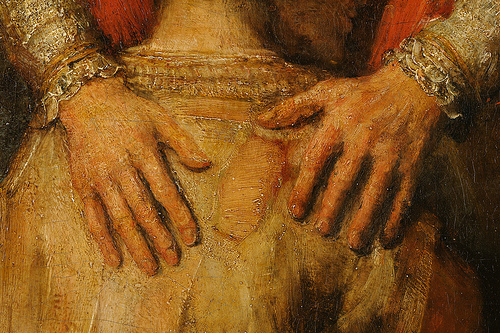
- We see that his father receives him with a tender gesture. His hands seem to suggest mothering and fathering at once; the left appears larger and more masculine, set on the son’s shoulder, while the right is softer and more receptive in gesture.
- The son’s head is downy, almost like a newborn’s. We must enter the kingdom like little children.
- The Prodigal Son seems to be protected by his father. He snuggles near the Father’s breast. It’s love that holds him there.
- Consider his sandals. It has taken a long time for him to come home.
- Standing at the right is the prodigal son’s older brother, who crosses his hands in stoic judgment; we read in the parable that he objects to the father’s compassion for his brother.
- We see his mother in the background in the painting, and a seated steward or counselor. One stands in profound joy, the other in sits in stunned perplexity.

But Rembrandt had painted the Prodigal once before, when he was considerably younger. And it is a very good painting. The prodigal is happy and gay; there is absolutely no indication of the consequences of sin.
The Prodigal Son in the Brothel, 1635
He’s a charming young man at the height of his popularity, and we see him at a happy party. He is spending the inheritance of his father.
But Rembrandt chooses at the very end of his life to re-paint it to reflect reality.
This is one of the last paintings he will do, and it is the Prodigal Son–destitute and repenting. I can only imagine; the years have taken a toll and he doesn’t really feel his first painting is enough. He wants to paint what is true.
He now is painting our spiritual condition.
We are given a work that some critics call as the greatest painting ever completed. The painting is now in St. Petersburg, Russia. It is seldom seen by visitors. It is a clear echo of the grace of God for fallen men and women. Like the father in the painting, He’s ready to forgive every sin saturated son and daughter.




Yes I have, and I wove some of that book into this piece.
LikeLike