Preaching (and Listening) to Yourself

By Terry Powell,

Have you ever “preached to yourself?” I’m referring to the act of fighting negative and unbiblical thought patterns with the Word of God. It’s also called “biblical self-talk,” reminding yourself of truth that counteracts Satan’s lies. In Future Grace, John Piper illustrates how the Psalmist battled despondency by preaching to himself:

In Psalm 73:26 the psalmist says, “My flesh and my heart may fail.” Literally the verb is simply “My flesh and my heart fail!” I am despondent! I am discouraged! But then immediately he fires a broadside against his despondency: “But God is the strength of my heart and my portion forever.” The psalmist does not yield. He battles unbelief with counterattack.

The poem that follows is a type of sermon delivered to myself. The stanzas are painfully realistic about the hopelessness that accompanies my depression. Yet the poem ends on a more positive note, citing another verse from the Psalms in which the author talks back to despair and exalts God as the object of hope. What makes preaching to myself effective is reminding myself of God: Who He is, what He has done and what He had pledged Himself to do.

Hopeless?

Fleeting, it’s like a bird in flight,

Or like a shooting star at night,

Or lightning that spans the sky—

Gone in the blink of an eye.

Elusive, like the fog that lifts

When morning sun sends its gifts;

Or the zigzagging butterfly

That you can’t catch. No use to try.

That’s my relationship to hope:

It’s like a wet bar of soap

That keeps giving me the slip.

Can’t keep it within my grip.

Hope that a blinding beam of light

Will penetrate my soul’s dark night.

Hope that it won’t seem so strange

That habits of the heart can change.

Can God plant hope within a heart

For peace of mind and a fresh start?

Though right now I am without it,

God shouts “Yes!” Should I doubt it?

“Why are you in despair, O my soul? And why have you become disturbed within me? Hope in God, for I shall yet praise Him, The help of my countenance, and my God.”

Psalm 42:11

When inward or outward trials come, what are some Bible truths or text that you “preach to yourself”?

ybic,

Terry


Terry teaches in the areas of Church Ministry and Ministry Leadership at Columbia International University in South Carolina. He has served as a Christian Education staff member for three  churches, and he’s a licensed preacher in the Presbyterian Church of America.  His current books in print are Serve Strong:  Biblical Encouragement to Sustain God’s Servants, and  Now That’s Good A Question!  How To Lead Quality Bible Discussions. Terry has been married for 46 years, and has two sons, a daughter-in-law, one grandson, and a dachshund.  His constant prayer is, “Lord, make me half the man my dog thinks I am!”

Check out his blog at https://penetratingthedarkness.com/. His ministry is focused on Christians experiencing clinical  depression and other mental issues.


Recurring Depression and Fruitful Ministry

Charles Spurgeon, “The Prince of Expositors” 1834-1892

DOES RECURRING DEPRESSION PREVENT A FRUITFUL MINISTRY?

The ‘Depression-Prone’ Preacher

by Terry Powell

Long before the proliferation of mass media, he was known and revered throughout the Christian world. Scholars of his era labeled him, “the prince of expositors.” His commentaries, devotionals, and sermons are still being published, generations after his death.

So many folks in London wanted to hear him preach that he occasionally pleaded with church members to stay home so unsaved visitors could get a seat and hear the gospel. The pages of his book, Lectures to My Students, should be dog-eared by every vocational or volunteer teacher of Bible.

Yet, depression dogged Charles Haddon Spurgeon (1834-1892) most of his adult life. A major bout with despondency occurred in 1858 when he was 24, serving as a pastor in London. That’s when he wrote, “My spirits were sunken so low that I could weep by the hour like a child, and yet I know not what I wept for.” Repeated episodes spawned these words: “Causeless depression cannot be reasoned with…as well fight with the mist as with this shapeless, undefinable, yet all-beclouding hopelessness.”

What can we learn from this depression-prone, yet outrageously fruitful leader?

  1. Depression doesn’t necessarily hinder ministry effectiveness. He often didn’t feel like serving, yet enabled by God’s grace, he kept giving himself to others. No matter how physically and emotionally drained he was, most Mondays he wrote out by longhand the previous day’s sermon so it could later be published.
  2. The pain of despondency may expand one’s usefulness by cultivating dependency and humility. Spurgeon said that despondency was “my trial, my thorn in the flesh that Satan wanted to use to take me down, and God wanted to use to deepen my dependency on Him.” A favorite verse of his was 2 Corinthians 12:9, where God told Paul, “My grace is sufficient for you, for my power is made perfect in weakness.” In reference to this verse, Spurgeon said, “My job is not to supply the power, but the weakness. That’s one job I’m good at! It’s God’s job to supply the power.”

  3. Openness about one’s depression may encourage others, and point them to God’s sustaining grace. Spurgeon’s transparency concerning his depression was rare for his day. Knowing how many people suffered in silence with this malady, he preached a message to show others how he coped with it (titled “When a Preacher Is Downcast”). From experience he learned and taught an ironic truth captured in my favorite Spurgeon quote: “God gets from us most glory when we get from Him much grace.”

  4. His life and ministry demonstrate that depression and spiritual maturity aren’t mutually-exclusive. Depression didn’t negate Spurgeon’s godliness, nor did his steadfast use of spiritual disciplines cure it.

Biographies of and articles about Spurgeon don’t always mention his predilection for depression. Yet reading about his accomplishments and ministry output will show you what God can do through a yielded person not in spite of depression, but possibly because of it. Spurgeon also suffered from severe gout in his later years, long before medical intervention could eliminate or minimize the pain.

I benefited enormously from Arnold Dalimore’s Spurgeon (Banner of Truth, 1984). Also, in a chapter of John Piper’s Future Grace, titled “Faith in Future Grace Versus Despondency,” you can read about Spurgeon’s battle with depression. In 2014, Zack Eswine wrote a more thorough coverage of Spurgeon’s despondency: Spurgeon’s Sorrows: Realistic Hope for Those Who Suffer from Depression (Christian Focus Publishers)

Terry teaches in the areas of Church Ministry and Ministry Leadership at Columbia International University in South Carolina. He has served as a Christian Education staff member for three  churches, and he’s a licensed preacher in the Presbyterian Church of America.  His current books in print are Serve Strong:  Biblical Encouragement to Sustain God’s Servants, and  Now That’s Good A Question!  How To Lead Quality Bible Discussions. Terry has been married for 46 years, and has two sons, a daughter-in-law, one grandson, and a dachshund.  His constant prayer is, “Lord, make me half the man my dog thinks I am!”

Check out his blog at https://penetratingthedarkness.com/. His ministry is focused on Christians experiencing clinical  depression and other mental issues.


Plunging the Depths of Grace

“One of the Pharisees asked him to eat with him, and he went into the Pharisee’s house and reclined at the table. 37 And behold, a woman of the city, who was a sinner, when she learned that he was reclining at table in the Pharisee’s house, brought an alabaster flask of ointment, 38 and standing behind him at his feet, weeping, she began to wet his feet with her tears and wiped them with the hair of her head and kissed his feet and anointed them with the ointment. 39 Now when the Pharisee who had invited him saw this, he said to himself, “If this man were a prophet, he would have known who and what sort of woman this is who is touching him, for she is a sinner.”

Luke 7:36-39, ESV

A woman of the city, that explains so much.  She comes with a lot of baggage; she has seen all the world at its worst.  Her life has been hard, she has made poor decisions. Enough to pull her into the presence of Jesus.

She may be a stripper, an addict, a porn star. It doesn’t matter, she is a sinner, and scripture does not elaborate beyond this.  All we know is she is ‘a woman of the city,” and that she is referred to as “a sinner.” The sin has made her a desperate person. She steps forward, and does not care about what the crowds are saying about her. She has heard it all before. She comes with her flawed and inadequate heart, to anoint him with an ointment that is somewhat susceptible because of her past.

She pushes forward, pressing past the inner ring of disciples who are ‘protecting’ Jesus.  She takes what she has, and pours it on Jesus’ feet.  It is a concentrate of a perfume that is intense, and very much a declaration of what her heart is wants to do. The scent of this ointment undoubtedly very strong, and lingers, being a concentrate. It probably comforted Jesus while he was being nailed to the cross. He would remember what she had done to him. Her love would comfort him as he was dying.

Jesus acknowledges her decision to bless him in this unique way.  She pushes to him with a single mindedness that we can only marvel at.  She falls at his feet, and Jesus allows himself to be touched by a women that has such a difficult and dark past.  I truly believe He takes everyone whoever comes to him. He passes no judgement on her, and people who are like her— like me.

He has no issues, and accepts all who the Father brings to him.

This sinful woman has shown the way for sinners like us to connect.  Her action establishes for us a precedent— a sure way to advance into his presence.  We start by admitting that we are in a very desperate state.  Her example focuses everyone to all  what is truly important, and we dare not slip past her example. “All have sinned, and come short of the glory of God.” We know that this is true.

We must come, as she has come, in faith that only He can forgive us.  We should come with a radically intense intention to be with him.  There must be a real decision (on our part) to follow after him.  When we actually fall at his feet, we will find ourselves to be completely forgiven.

“Therefore I tell you, her sins, which are many, are forgiven—for she loved much. But he who is forgiven little, loves little.” 48 And he said to her, “Your sins are forgiven.”

Luke 7:47-48

bry-signat (1)

cropped-christiangraffiti1.jpg

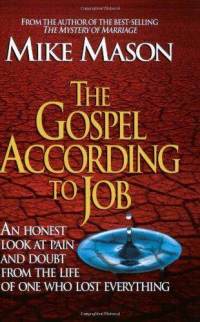
The Gospel According to Job

Today, I want to bring out this book, out into the spotlight.  It is a tremendous devotional that makes its way through the book of Job.  I have leaned on it, and it has held me nicely.  I challlenge you to get a copy of this, and to let it work in the confines of your spirit and mind. ––Bryan

A

Excerpt from “The Gospel According to Job,” by Mike Mason


“An Honest Look at Pain and Doubt from the Life of One who Lost Everything”

_______________________

A“Once I met a man who, like Abraham, had moved his entire household halfway around the world on the strength of a vision from God. When I asked him to tell me the story, he answered that there were three versions of that story, and which one did I want to hear? First, there was the version of the story that he told to Christians. Then there was the version he told to non-Christians. Finally, there was the truth. Job is a book that tells things from the third point of view. Probably, along with Ecclesiastes, it does this better than any other book in the Bible.

Not that the other Scriptures do not tell the truth. But Job tells the truth in a way that makes it almost impossible to pervert the truth into pious pabulum. A few years ago I went through a difficult time. Never mind what the problem was. It was nothing compared to the trials of Job. In fact, it was nothing at all compared to the sufferings of many of my neighbors right there on the quiet street where I lived.

But pain is pain, and suffice it to say that my pain was enough to drive me to my knees, totally defeated, half-crazy at times, and crying out for relief. Month after month the battles raged on, thick, dark, agonizing. I prayed, but somehow prayer did not ‘work.’ Usually nothing at all worked, except lying low and gritting my teeth until, for reasons entirely obscure to me, the straightjacket of oppression began to loosen a little––at least enough for me to get on with my life for another day or so before the screws tightened again. What else could I do? How was I to fight this?

In retrospect I can see that a large part of my anguish was rooted in the fact that there really was nothing I could do to control what was happening to me. I was absolutely helpless, and it is this, perhaps, that is the soul of suffering, this terrifying impotence. It is a little taste of the final and most terrifying impotence of all, which is death.

We Christians do not like to think about being absolutely helpless in the hands of our God. With all of our faith, and with all of His grace, we still prefer to maintain some semblance of control over our lives. When difficulties arise, we like to think that there are certain steps we can take, or attitudes we can adopt, to alleviate our anguish and be happy. Sometimes there are. But anyone who has truly suffered will know that when it comes to the real thing there is no help for it, no human help whatsoever.

Simply put, when we are in a deep dark hole we cannot think our way out; neither can we hope, sing, pray, or even love our way out. In fact there is absolutely nothing either we or anyone else can do to better our situation. We can have faith, yes; but in itself faith will not change anything. Neither faith, nor any other good thing that a person might have or do, can actually lift the cloud, move the mountain, or bring about an end to the problem.

Only the Lord Himself can do that, and when He does, as Exodus 6:6 puts it, “Then you will know that I am the Lord your God, who brought you out from under the yoke.” How will we know? Simply because nothing and no one else could possibly have done it. In this kind of crucible, therefore, we come to a new understanding of what it means to be saved, what it means to be snatched away from the brink of destruction.

Here we get down to the bedrock of the gospel. During my night of anguish, I turned to the book of Job, and there I began to make contact with the gospel in a way that somehow I never had in studying the New Testament. Reading Job, I found myself experiencing in new and astonishing depth the reality of Jesus’ promise in John 8:32,

 “You will know the truth, and the truth will set you free.”


cropped-christiangraffiti1.jpg