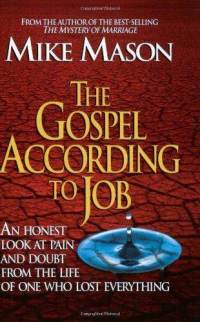
The Gospel According to Job

Today, I want to bring out this book, out into the spotlight.  It is a tremendous devotional that makes its way through the book of Job.  I have leaned on it, and it has held me nicely.  I challlenge you to get a copy of this, and to let it work in the confines of your spirit and mind. ––Bryan

A

Excerpt from “The Gospel According to Job,” by Mike Mason


“An Honest Look at Pain and Doubt from the Life of One who Lost Everything”

_______________________

A“Once I met a man who, like Abraham, had moved his entire household halfway around the world on the strength of a vision from God. When I asked him to tell me the story, he answered that there were three versions of that story, and which one did I want to hear? First, there was the version of the story that he told to Christians. Then there was the version he told to non-Christians. Finally, there was the truth. Job is a book that tells things from the third point of view. Probably, along with Ecclesiastes, it does this better than any other book in the Bible.

Not that the other Scriptures do not tell the truth. But Job tells the truth in a way that makes it almost impossible to pervert the truth into pious pabulum. A few years ago I went through a difficult time. Never mind what the problem was. It was nothing compared to the trials of Job. In fact, it was nothing at all compared to the sufferings of many of my neighbors right there on the quiet street where I lived.

But pain is pain, and suffice it to say that my pain was enough to drive me to my knees, totally defeated, half-crazy at times, and crying out for relief. Month after month the battles raged on, thick, dark, agonizing. I prayed, but somehow prayer did not ‘work.’ Usually nothing at all worked, except lying low and gritting my teeth until, for reasons entirely obscure to me, the straightjacket of oppression began to loosen a little––at least enough for me to get on with my life for another day or so before the screws tightened again. What else could I do? How was I to fight this?

In retrospect I can see that a large part of my anguish was rooted in the fact that there really was nothing I could do to control what was happening to me. I was absolutely helpless, and it is this, perhaps, that is the soul of suffering, this terrifying impotence. It is a little taste of the final and most terrifying impotence of all, which is death.

We Christians do not like to think about being absolutely helpless in the hands of our God. With all of our faith, and with all of His grace, we still prefer to maintain some semblance of control over our lives. When difficulties arise, we like to think that there are certain steps we can take, or attitudes we can adopt, to alleviate our anguish and be happy. Sometimes there are. But anyone who has truly suffered will know that when it comes to the real thing there is no help for it, no human help whatsoever.

Simply put, when we are in a deep dark hole we cannot think our way out; neither can we hope, sing, pray, or even love our way out. In fact there is absolutely nothing either we or anyone else can do to better our situation. We can have faith, yes; but in itself faith will not change anything. Neither faith, nor any other good thing that a person might have or do, can actually lift the cloud, move the mountain, or bring about an end to the problem.

Only the Lord Himself can do that, and when He does, as Exodus 6:6 puts it, “Then you will know that I am the Lord your God, who brought you out from under the yoke.” How will we know? Simply because nothing and no one else could possibly have done it. In this kind of crucible, therefore, we come to a new understanding of what it means to be saved, what it means to be snatched away from the brink of destruction.

Here we get down to the bedrock of the gospel. During my night of anguish, I turned to the book of Job, and there I began to make contact with the gospel in a way that somehow I never had in studying the New Testament. Reading Job, I found myself experiencing in new and astonishing depth the reality of Jesus’ promise in John 8:32,

 “You will know the truth, and the truth will set you free.”


cropped-christiangraffiti1.jpg

When is Suicide the Solution?

The Contemplative Suicidal

There are times, difficult times when we are maneuvered into a place where we start to think that suicide is an answer.  There is a certain mechanism to it, almost an art, which has a limited “air-time.”.  But I have several suicide attempts to my credit.  Once in a psych ward (and being watched 24/7) I cut my wrists on the broken shards of the clock over my bed.  (Looking back, it was pretty innovative the way I did it.)

I’ve intentionally overdosed a couple of times.  My last effort was to duct tape heavy training weights to drown myself in Kachemak Bay, off a pier.  Numerous times I have slashed my wrists trying very hard to die.

I suppose that for these many attempts there was a distinct and desperate cry for help.  When I went into the cycle of wrist cutting, I did not have a full and an aware understanding of what I was trying to do.  But when I attempt to drown myself, I most definitely did.  Perhaps there is an understanding of the two different concepts of suicidal depression. (But I’ve chosen not to ‘research’ this out.)

Although there is room to be alarmed by the first kind.  There is reason to be mega-concerned with the second approach.  I guess there is kind of a morbid graduation from one phase to the next. (I may speak brazenly, but I know it is a dark thing we talk about.)

To commit suicide is perhaps the ultimate act of vengeance that we can do.

It is final and yet speaks to everyone we’ve ever met  It also is a hard statement to all we used to love.  Family, and friends;  I guess we often can’t inventory or enumerate those we touch.  So many people will be affected by my suicide. I can’t overstate this. There are literally thousands of people who will be rocked by what I have done. I will destroy many when I try to destroy myself.

The pain of the mind of the suicidal depressive is awful.  It saturates all that I think and everything I do.  The suicide person is in a difficult agony.  It’s like being soaked in gasoline and looking around for a match.  There is a fearfulness about it all.  If we were not so enamored by ‘self-murder’ it would shake us to our core.

So very many are on the edge.  It really wouldn’t take much to nudge us over. There must be an understanding that there is a spiritual element to all of this. The enemy of our souls would delight in our destruction.  He salivates over our confusion and lostness.  He is a dark cheerleader in support of our self-destruction.

We must work things out, even with our darkest issues.  We really need to “regrip” and refocus.  Often a good nights sleep and a good meal will incrementally move us through this moment.  This may be trite, but resisting suicidal thinking will often turn on small things like this.

To be honest, patience seems to be the main factor to recovery.  It seldom is a dramatic leap forward.  It seems that certain nuances will push themselves against dark thinking.  As you are led by the Holy Spirit, you will discover exactly how to drive against this strong momentum of the Flesh.  Know this though– the Lord is actively at work on behalf of your loved one.  This should give you a honest peace and assurance.  You will survive, and you will bring Him glory.

For immediate help, call 911. For guidance, call 1-888-NEEDHIM.

bry-signat (1)

cropped-christiangraffiti1.jpg

Related articles

Book Review: “When the Darkness Will Not Lift”

There are Christians for whom joy seems unattainable.

What will we tell them . . . “When the Darkness Will Not Lift?”

…………………………………………………………

“It is utterly crucial that in our darkness we affirm the wise, strong hand of God to hold us, even when we have no strength to hold him.”

–John Piper

The title of this reviewed book is terribly unyielding, but with a quick glimpse into its contents, and you realize what you hold in your hands is worth its weight in gold.  When the Darkness Will Not Lift: Doing What We Can While We Wait for God—And Joy,  John Piper gives guidance and hope to suffering believers and to those whom God has given to walk beside them.  The father of Christian hedonism reminds readers that joy is a duty even as he teaches them how to fight for it. At eighty pages, this slim volume commends itself to readers who, struggling under the weight of spiritual darkness, might be daunted by an exhaustive treatment of the subject.

Because the book starts from despair, it is a uniquely accessible tool for those who hurt. In the pastoral tone for which he is beloved, Piper shows that joy begins with despair in oneself. In “When the Darkness Will Not Lift”, Piper tackles difficult issues including:

• The physical nature of depression and the role of medication

• How to wait on the Lord through darkness

• The relationship between obedience and thanksgiving

• How unconfessed sin can clog our joy

Piper also provides insight for those who love depressed Christians—showing them how to exhort without crushing, and how they can help the struggling believer to distrust the “certainties of despair.”

PiperbookWhen the Darkness Will Not Lift: Doing What We Can While We Wait for God—And Joy Publisher Crossway Books, Author John Piper, ISBN 1581348762 Price $7.99, Released, January 2007

Available through your Bookstore, or just go to www.Amazon.com, like me.

John Piper’s website, http://www.desiringgod.org/

flourish15

Bedlam: Prisons and the Mentally Ill

Taking a Stand for Our Brothers and Sisters

 By Mark Earley, Christian Post Guest Columnist, Wed, Aug. 08, 2007
The least of these is my brother

In the 16th century, London’s mentally ill were often kept at Bethlem Royal Hospital. The conditions inside the hospital were notoriously poor. Patients were often chained to the floor and the noise was so great that Bethlem was more likely to drive a man crazy than to cure him. The conditions were so infamous that the nickname locals gave the hospital—Bedlam—has come to mean any scene of great confusion.

Unfortunately five hundred years later, we’re still treating the mentally ill more like prisoners than patients. Fifty years ago, more than 550 thousand people were institutionalized in public mental hospitals. Today, only between 60 and 70 thousand are, despite a two-thirds increase in the country’s population.

Since there’s no evidence that the incidence of mental illness has dropped precipitously, the mentally ill who previously had been institutionalized had to have gone somewhere. While some are being treated successfully in their communities, at homes and groups homes, but for many that “somewhere” is behind bars. This last part shouldn’t come as a surprise.

Five years ago, the Washington Post told the story of “Leon,” a one-time honor student, who had 17 years in and out of jail on various drug-related charges. It was only after several suicide attempts, including drinking a “bleach-and-Ajax cocktail,” that Leon was diagnosed with bipolar disorder. Leon’s story was a microcosm of a larger problem: “Prisons and jails are increasingly substituting as mental hospitals.”

As one advocate for the mentally ill told the Post, “a lot of people with mental illness are charged with minor crimes as a way to get them off the streets.” In effect, they are behind bars for “being sick.” Fast forward five years and little, if anything, has changed. A few weeks ago, another piece in the Post discussed the same problem.

Psychiatrist Marcia Kraft Goin told readers something that should shock and outrage them: “The Los Angeles County Jail houses the largest psychiatric population in the country.” As with the earlier Post piece, the conclusion was inescapable: “People with [untreated] mental illnesses often end up with symptoms and behaviors that result in jail time.” You don’t have to be a “bleeding heart” to understand that this is an injustice—any kind of heart will do.

Not only are the mentally ill not getting the help they need, they are as lambs to the slaughter in our crowded and violent prisons. They are being victimized twice over. They’re not the only ones being victimized.

At a time when most state prisons are unlawfully overcrowded, there are better uses for prison beds than as makeshift mental hospitals. As Goin wrote, “treating” mental illness as a criminal justice problem costs “more than treating patients appropriately in their community.”

As part of its ministry to prisoners and their families, Prison Fellowship supports community-based alternatives to incarceration. Not only because it makes “financial sense” but because it’s what Christ would have done. In Matthew 25 he called the ill and the prisoner his “brothers” and he expects us to offer them something more than bedlam.

“There but for the Grace of God go I…” –Bryan

 __________________________________

From BreakPoint®, August 6, 2007, Copyright 2007, Prison Fellowship Ministries. Reprinted with the permission of Prison Fellowship Ministries. All rights reserved.  “BreakPoint®” and “Prison Fellowship Ministries®” are registered trademarks of Prison Fellowship.

Good Links:

http://en.wikipedia.org/wiki/Bethlem_Royal_Hospital

http://www.bethlemheritage.org.uk/

http://www.pbs.org/wgbh/pages/frontline/shows/asylums/etc/faqs.html

http://www.afscme.org/publications/6042.cfm