Tardive Dyskinesia (TD) is a condition of involuntary, repetitive movements of the jaw, tongue or other body movements. It frequently is a side effect of the long-term use of antipsychotic drugs used to treat schizophrenia or bipolar disorder. It is almost always permanent. I’ve been told Vitamin E might help a bit. Benzodiazepines have also been used with mixed results on a short-term basis.
Some examples of these types of involuntary movements include:
Grimacing
Tongue movements
Lip smacking
Lip puckering
Pursing of the lips
Excessive eye blinking
(Wikipedia)
I recently was diagnosed as having TD after the use of Zyprexa. My version is my lower jaw moves from side-to-side, unless I concentrate on not doing it. I quickly revert to this involuntary movement when I’m not aware of it. I recently saw a video of myself (with my family) and sure enough there I was, doing the ‘jaw thing.’ It was very obvious. It was also very embarrassing. (I have the ‘lithium jitters’— where my hands always shake, but TD is different.)
There are a couple of things I might mention:
1) I’ve discovered that there is a real social isolation with this TD stuff. To be doing this in public is “not acceptable.” I have had people come up to me wanting to know what’s my problem. Since I can’t control the movement I just say, “It’s my meds— they affect me this way.” In a way it’s like wearing a neon sign saying, “I’m a fruit cake.” Having a mental illness is stigma enough, but the TD just puts a new edge on it.
2) As a natural introvert the isolation has only deepened. (I avoid crowds and most social engagements.) I guess if the truth be told, I’m uncomfortable when others look at me strangely or whisper to each other. My standard ‘paranoia level’ has taken a new twist. I feel I’m compelled to explain. I guess I’m embarrassed when others are embarrassed.
3) I settle myself down in my faith to cope. I know I’m not alone in this– the Lord Jesus is always with me. He holds me tight through all these twists and turns. Since I isolate myself so much, I savor the connection I have with a few friends who have become inured to my condition. Social media helps out— Facebook is a big help, as well as my two blogs.
4) One of the things I try to remember are the issues of selfishness and pride. I keep reminding myself it’s not about me all the time. One of the significant areas mentally ill people deal with is self-absorbed thinking. It seems it comes with the illness.
5) I try to keep a sense of humor everyday. It breaks down the mental pain to tolerable levels. We can take ourselves too seriously sometimes. Be more patient with yourself. I know I have to.
I ask that you remember me in prayer from time-to-time. I’m in ‘uncharted waters’ (it seems) and I sometimes feel all alone with my mental illness and all its tangents. I want good to come out of this. (An instantaneous healing would be o.k. But, I’m not too finicky.) Sorry for so much.
If you can’t pray, don’t feel at all impinged upon.
“Simon, Simon, Satan has asked to sift each of you like wheat. But I have pleaded in prayer for you, Simon, that your faith should not fail.”
“So when you have repented and turned to me again, strengthen your brothers.”
Luke 22:31-32
I’ve been thinking about failure; it is something that I am really, really good at. In my over 40 years of walking with Jesus, I realized that I’ve experienced more weak moments then strong. I have easily failed more than I have succeeded. I am embarrassed by this. I’ve sinned, and failed more as a Christian, than I ever did as a pagan sinner. And things sometimes show little sign of improving.
Simon Peter is about to undergo a trial so intense and difficult, that unless Jesus intervenes it will probably destroy Peter.
(The only other blatant attack where Satan seeks permission is in the life of Job. It is reasonable to believe that the forces of hell are concentrated on Peter.)
You and I undergo some of this onslaught ourselves. We go through periods of intense trial. Everything just falls apart, and we lose hope. I’ve had several periods like that, it’s like a tornado from hell bears down upon my life.
But there is something remarkably good in all of this.
First, Jesus is praying for me to endure. He is the faithful intercessor for my soul.
Second, He gives us a modicum of understanding by warning us of the approaching storm. Peter is told ahead of time of what was going to happen.
Third, the wheat will be sifted. Sifting or winnowing of the grain is necessary, it’s a good and godly work of the Holy Spirit. It is a good thing, as it builds your faith.
Four, you will survive to strengthen your brothers and sisters.
All pain and failure gives us a mandate to serve others. Our weakness gives us a spiritual license to become a shepherd of mercy and hope. (You could say that you are now a licensed minister.)
We can ask for nothing more; it is a good and profound work to serve others.
In love’s work, only sifted people can truly serve.
My chronic pain makes my quadriplegia feel like a walk in the park.
People often ask how I manage my pain. Well, when its fangs sink deep into my hips and back, that’s my signal. I begin deep breathing, slow and steady. And when fiery pain threatens to overtake me—just as the flames threatened to consume Shadrach, Meshach, and Abednego in that fiery furnace found in the book of Daniel—I have a conversation with it.
I don’t say, “I can’t stand this; it’s killing me,” because words like that are fraught with anxiety. Fear only makes things worse. Instead, I calmly ask Jesus to meet me in my pain, to not let it crush me. And the Son of God never fails to meet me, just as he met those three Hebrews in that hot furnace of fire.
And what does Jesus say to me in that agonizing place of pain?
He comforts me with his own words. He will say something like, “Joni, my Spirit inspired 2 Corinthians 4:8 for a good reason. For although you are ‘hard pressed on every side,’ you will not be crushed.”
Oh, what a promise! Pain may tighten its vice grip, but it cannot crush me. As I cling to God’s promises, my pain pushes me further into Jesus’s heart. There is nothing sweeter than finding my Savior in the middle of my hellish circumstances. It helps deflect the pain and helps me to suffer well. Jesus helps me be in that unhappy place well.
All the years I’ve lived in my wheelchair, I never got delivered from pain. But I met my Deliverer in it. I didn’t get healed, but I found intimate fellowship with the Healer.
Friend, pain does not have to crush you.
As you courageously look at the stern countenance of pain and enter unafraid into its recesses, you will defang it of its terror. You’ll see that the Lord is in your pain, having transfigured it to become a place of union with him. Jesus conquered the insidious ways of pain and because of that, he is your best prescription for pain—whether it’s in your hip, your head, or your heart.
And remember, there is a glorious day coming when it says, “He will wipe every tear from their eyes. There will be no more death or mourning or crying or pain, for the old order of things has passed away.” (Revelation 21:4). Until then, when pain encroaches, start deep breathing and cling to a Bible promise. There are thousands to hold onto.
Perhaps my favorite is this one uttered by almighty God to you and me, promising, “I have made you and I will carry you; I will sustain you and I will rescue you” (Isaiah 46:4b).
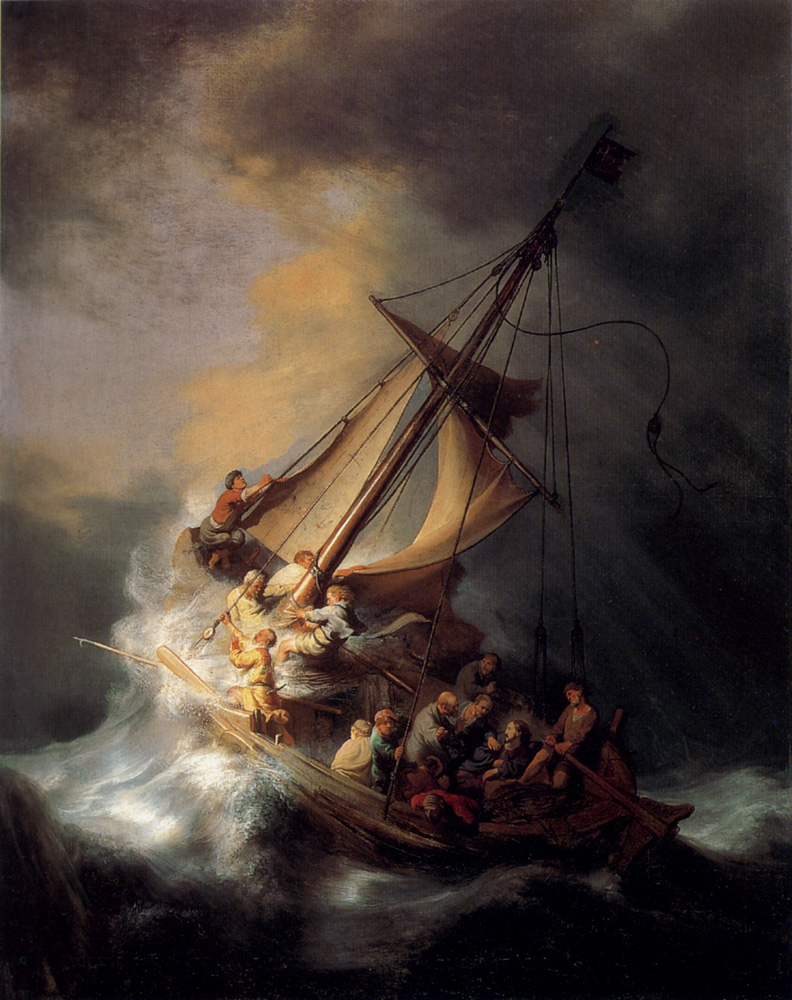
“He saw the disciples straining at the oars because the wind was against them.”
Mark 6:48
It’s good to know that Jesus sees our labor. He truly understands all that concerns us, and he understands every issue that concerns us. Attentive and keenly aware He comes to our boat. It’s quite common for us to think that he isn’t aware, and we may feel that He’ll pass us by without a word.
Jesus watches over us all the time.
He knows all about our battles, the fight we have with our flesh, the difficulty we have with the challenging people in our lives. I often struggle to steer my boat. Jesus knows when and why I labor like I do. And He doesn’t condemn me.
The disciples were straining hard to keep the boat afloat.
Every oar was being used and every man had his seat. They must work together. Some were frantically bailing, and a couple gripped the tiller. A lot of effort was being expended but nothing was working. The wind continued to push harder against them.
This is really quite perplexing. If you remember, they’re simply trying to obey the command of Jesus to cross the sea. They were being obedient, and yet they were starting to sink.
Why do things have to be so difficult?
I’m intrigued by believers who expect sunshine, blue sky, and red roses just because they are doing God’s will. They don’t seem to think through the issues of conflict and challenge, weakness and humility. That’s not how it’s suppose to work.
“It is necessary to go through many hardships to enter the kingdom of God.”
Acts 14:22
Doing the will of God will often mean that there will be a headwind directly at us.
The seas will become impossible, and we may even be driven back. But special comfort comes when we realize we’re being watched. Jesus is doing constant surveillance on us, and He sees our toil on the oars. And then He comes to us, walking on the water.
Even in our storm, our hearts should trust and rejoice.
“Lo, I am with you always, even to the end of the age”









 Broken Believers