Love Wears Work Gloves

 “But if anyone has the world’s goods and sees his brother in need, yet closes his heart against him, how does God’s love abide in him?”

“Little children, let us not love in words or talk but in deeds and in truth.”

1 John 3:17-18, ESV

Love is a noble idea, it’s admired and extolled by practically everyone–we see it in our music and poetry, ethics and religion. For the most part it’s a word for something decent and virtuous and honorable. It’s a good thing, but I’m afraid it’s not always scriptural.

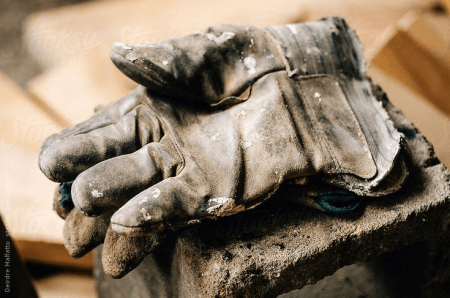
You see, Bible love wears work gloves.

It labors and sweats and works. Bible love has chores to do, and it actively looks and sees what needs to be done. 1 John 3 tells us that we shouldn’t deceive ourselves and only see the world’s definition. That love a believer has is to be different.

Love, in John’s eyes, is most assuredly “doing.” It burns spiritual calories as it labors to serve our brothers and sisters. Love finds things it can do–it doesn’t just talk but it gets busy. Love sees the need and then gets down to serve.

“You must show sincere love to each other as brothers and sisters. Love each other deeply with all your heart.”

1 Peter 1:22

Working (serving) has nothing to do with our salvation, that is a free gift. We’re saved by grace through the blood of Jesus–that’s a given. But this love isn’t  drudgery, as a matter of fact, working and serving each other is a joy. The deepest kind of joy there is.

Our words, although important, are really an insufficient way of proving our authenticity.  The love we serve another with isn’t “pretty poetry” kind of love. It’s so easy to just shout out truth and never ever show a working, serving kind of love. That sort of love is impressive, and can’t ever be duplicated.

That disconnect is a bit disturbing.

But when do we start to realize that this love is really a verb?

Our prayer and intercession really begins when we go to work for someone else. (Our lunch box is our Bible.) We read it and it energizes us to work for one  another. When we pray we truly are loving another brother or sister. It’s work that they can’t or won’t do for themselves. At least not yet. So we pray.

John is calling believers to a more real kind of love. His love is a love that sweats.

“The church is made up of individuals. It can do nothing except as its members work, and work together.”

     James H. Aughey

Dear reader–I really do pray for you. Your love impacts so many.


Mary Magdalene

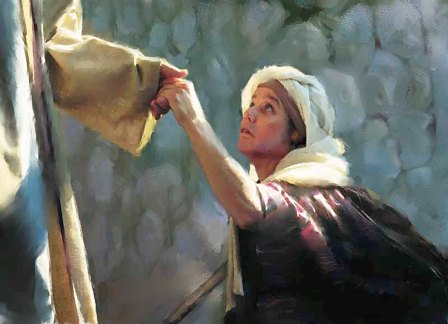
“Dear woman, why are you crying?” Jesus asked her. “Who are you looking for?”

She thought he was the gardener. “Sir,” she said, “if you have taken him away, tell me where you have put him, and I will go and get him.”

16 “Mary!” Jesus said.

She turned to him and cried out, “Rabboni!” (which is Hebrew for “Teacher”).

John 20:15-16, NLT

 A word, a name– and when He speaks it, it crackles.  “Mary!”  His recognition and affection saturates His greeting.  

And instantly Mary ignites.  Her love for Jesus is instantly awakened. Her heart bounds to Him, and she can see no one else.  Simply, “Mary”, and her routine universe is changed forever.

The Lord does not see masses, or crowds. 

He sees people, individuals that have names.  He simply doesn’t accept the idea of mass communications to make disciples.  His heart is for individuals.   He does not make styrofoam cups, He makes individual people. And that is exactly how He responds.

Her immediate response is just as forthcoming.  “Rabboni”.  The simple Hebrew word for “teacher”.  Obviously her relationship with Jesus has infused this word with much more than meets the eye.  As we trace her history with Jesus we develop a deep understanding into her walk.

You might say that Mary was well acquainted with spiritual things— for her it was almost exclusively evil. Mark 16 tells us of seven demons that had tortured her. Jesus had cast these dark powers out of her. She understood the dark torment Satan once had over her.

Mary speaks just one profound word. 

Rabboni.’ That word has deep and strong connotations.  Primarily, it has the concept of someone superior and yet exercising that gift in a quality way.  Mary has been given a quite exceptional gift–an opportunity to be a student who sits at Jesus’ feet.  Teacher.

Her ‘turning’ to Jesus is remarkable, but she is still not quite there yet.  However she turns to look at Him who now has risen out of death.  She already has evaluated all of this and she decides to commit.  Mary has arrived at the very place Jesus has chosen for her.

Jesus fully intends to make us His disciples. 

Embracing Him as God is a serious and brave step.  Actually, it is a ‘reality shifting’ concept that will change us.  That does not mean we will stop struggling.  But what it does mean is that certain things are now established.  

Can you trust Him that far?
“Christ will always accept the faith that puts its trust in Him.”

     Andrew Murray


Rembrandt’s Prodigal Son

Rembrandt-The_return_of_the_prodigal_son
Rembrandt, “The Return of the Prodigal Son,” c. 1661

17 “But when he came to himself, he said, ‘How many of my father’s hired servants have more than enough bread, but I perish here with hunger! 18 I will arise and go to my father, and I will say to him, “Father, I have sinned against heaven and before you. 19 I am no longer worthy to be called your son. Treat me as one of your hired servants.”’ 20 And he arose and came to his father. But while he was still a long way off, his father saw him and felt compassion, and ran and embraced him and kissed him. 21 And the son said to him, ‘Father, I have sinned against heaven and before you. I am no longer worthy to be called your son.’ 22 But the father said to his servants, ‘Bring quickly the best robe, and put it on him, and put a ring on his hand, and shoes on his feet. 23 And bring the fattened calf and kill it, and let us eat and celebrate. 24 For this my son was dead, and is alive again; he was lost, and is found.’ And they began to celebrate.

Luke 15:17-24, ESV

Two hundred and eighty-nine words– these describe the life of every man, woman, and child who has ever lived. These 289 words reveal to us a God who loves far too much, way too easy. Perhaps we sort of expect that he will ‘appropriately’ punish his son– at least put him on probation at least. It only makes sense. But we find that is legalism talking.

“Every saint has a past, and every sinner has a future.” 

Many of us have lived as prodigals, and we have spent our inheritance like ‘drunken sailors.’ We really have nothing at all to show for it. The prodigal, completely destitute, takes the only work he can find. (Imagine a good Jewish boy feeding hogs.)

He is so far gone that he starts inspecting the filthy slop buckets for something to eat.

Many of us will understand his despair. Often there comes to us a crystalline moment of simple awareness. The prodigal, sin-crusted and impoverished, still has a lingering memory of the Father’s house.

The servants there had far more than him right now. Sometimes I wonder if in our captivity, we instinctively want to go home, if only in our minds, to be a servant there.

The Father has dreamed of this precise moment.

The parable says, “He saw him–felt compassion–ran out to him–embraced him–and kissed him.” The Father is a whirlwind of agape love. I’ve read the Parable of the Prodigal Son a hundred times or more. It never loses its punch. I simply want to bring some observations: 

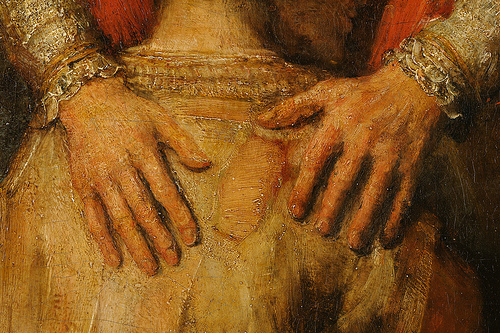
  • We see that his father receives him with a tender gesture. His hands seem to suggest mothering and fathering at once; the left appears larger and more masculine, set on the son’s shoulder, while the right is softer and more receptive in gesture.
  • The son’s head is downy, almost like a newborn’s. We must enter the kingdom like little children. 
  • The Prodigal Son seems to be protected by his father. He snuggles near the Father’s breast. It’s love that holds him there.
  • Consider his sandals. It has taken a long time for him to come home. 
  • Standing at the right is the prodigal son’s older brother, who crosses his hands in stoic judgment; we read in the parable that he objects to the father’s compassion for his brother.
  • We see his mother in the background in the painting, and a seated steward or counselor. One stands in profound joy, the other in sits in stunned perplexity.

But Rembrandt had painted the Prodigal once before, when he was considerably younger. And it is a very good painting. The prodigal is happy and gay; there is absolutely no indication of the consequences of sin.

The Prodigal Son in the Brothel, 1635

He’s a charming young man at the height of his popularity, and we see him at a happy party. He is spending the inheritance of his father.

But Rembrandt chooses at the very end of his life to re-paint it to reflect reality.

This is one of the last paintings he will do, and it is the Prodigal Son–destitute and repenting. I can only imagine; the years have taken a toll and he doesn’t really feel his first painting is enough. He wants to paint what is true.

He now is painting our spiritual condition.

We are given a work that some critics call as the greatest painting ever completed. The painting is now in St. Petersburg, Russia. It is seldom seen by visitors. It is a clear echo of the grace of God for fallen men and women. Like the father in the painting, He’s ready to forgive every sin saturated son and daughter.

The Father’s Prodigal

bry-signat (1)


Hiding Our Wounds

Brennan Manning Quote
“You are the light of the world. A city set on a hill cannot be hidden. 15 Nor do people light a lamp and put it under a basket, but on a stand, and it gives light to all in the house.”

Matthew 5:14-15, ESV

Overall, I think this Manning quote is a great observation. We, the torn and wounded, often try to hide, secluding ourselves in the “Island of Misfit Toys.” (Got to love those 60s Christmas cartoons.) We pretty much accept our lot as damaged merchandise.

Maybe we choose to isolate ourselves more than we want to admit. Could that be what we do? Are we still embarrassed and ashamed by all that we’ve done? That’s quite possible.

This may come as a shock, but the Church doesn’t need any more gifted people.

But it does need broken people who understand ‘the giftedness of the flawed.” When we conceal, we diminish the Church by our absence. We can ostracize ourselves, through a self imposed shame— but the Church will suffer. We need to show them that everyone can be healed, even screwy ‘fruit-cakes’ like us.

I recently had the privilege of speaking to a class of young Bible college students.

My subject was decidedly not on being successful, but on being a failure. Whole courses are geared toward ministerial success– but where are the ones for failure? I think that it just might be even more important, in the long run.

No human effort is going to erase your past.

I have tried and it can’t be done. I have blitzed my brains on drugs and booze, but I still remember the people I’ve hurt. (And I pray for them.) There really isn’t a cure for the evil we have done. I believe in forgiveness. And I hold to the idea that are sins are never to be a subject of  guilty accusation–

“He will again have compassion on us;
    he will tread our iniquities underfoot.
You will cast all our sins
    into the depths of the sea.”

Micah 7:19

Our dark iniquity is put in a very deep place. But there are the memories of an unkind word, or a sad and dark foolishness that we must learn to live with. There will be many regrets, and we face the terrible consequences of our sins, but it’s enough to know that all is under the blood of Jesus.

We are indeed forgiven. Completely.

We are now to live as forgiven sinners, yet precious in God’s eyes. We discover that although the Father has no favorites among His children, but He does have intimates. We are to live the rest of our lives for His glory, exploring that intimacy.

“Leave the broken, irreversible past in God’s hands, and step out into the invincible future with Him.”

  Oswald Chambers