Love Wears Work Gloves

 “But if anyone has the world’s goods and sees his brother in need, yet closes his heart against him, how does God’s love abide in him?”

“Little children, let us not love in words or talk but in deeds and in truth.”

1 John 3:17-18, ESV

Love is a noble idea, it’s admired and extolled by practically everyone–we see it in our music and poetry, ethics and religion. For the most part it’s a word for something decent and virtuous and honorable. It’s a good thing, but I’m afraid it’s not always scriptural.

You see, Bible love wears work gloves.

It labors and sweats and works. Bible love has chores to do, and it actively looks and sees what needs to be done. 1 John 3 tells us that we shouldn’t deceive ourselves and only see the world’s definition. That love a believer has is to be different.

Love, in John’s eyes, is most assuredly “doing.” It burns spiritual calories as it labors to serve our brothers and sisters. Love finds things it can do–it doesn’t just talk but it gets busy. Love sees the need and then gets down to serve.

“You must show sincere love to each other as brothers and sisters. Love each other deeply with all your heart.”

1 Peter 1:22

Working (serving) has nothing to do with our salvation, that is a free gift. We’re saved by grace through the blood of Jesus–that’s a given. But this love isn’t  drudgery, as a matter of fact, working and serving each other is a joy. The deepest kind of joy there is.

Our words, although important, are really an insufficient way of proving our authenticity.  The love we serve another with isn’t “pretty poetry” kind of love. It’s so easy to just shout out truth and never ever show a working, serving kind of love. That sort of love is impressive, and can’t ever be duplicated.

That disconnect is a bit disturbing.

But when do we start to realize that this love is really a verb?

Our prayer and intercession really begins when we go to work for someone else. (Our lunch box is our Bible.) We read it and it energizes us to work for one  another. When we pray we truly are loving another brother or sister. It’s work that they can’t or won’t do for themselves. At least not yet. So we pray.

John is calling believers to a more real kind of love. His love is a love that sweats.

“The church is made up of individuals. It can do nothing except as its members work, and work together.”

     James H. Aughey

Dear reader–I really do pray for you. Your love impacts so many.


“Go and Learn” [Discipleship]


“When Jesus heard this, he said, “Healthy people don’t need a doctor—sick people do.” 13 Then he added, “Now go and learn the meaning of this Scripture: ‘I want you to show mercy, not offer sacrifices.’ 

“For I have come to call not those who think they are righteous, but those who know they are sinners.”

Matthew 9:12-13

This passage can be a bit of a challenge. But these two verses fit together like an old watch mechanism, small gears and wheels in precise motion, keeping time in a treasured grace.  My father had an old one, used once by a train conductor.  It was made of gold, and had been used for almost 100 years.

The complexity of these verses were never meant to confuse the disciples.  But for them it is simple, to go and learn.”  Certainly, there are times we will be ‘schooled’ in what we learn.  And really the only way to approach this is in humility.  Trying to extract the truth will take patience and a broken heart.

Jesus states the truth of being a doctor, and there is a singular work that a doctor does.  It is serving all who come to him with sickness or injury.  Jesus clarifies a truth that has to be in place.

“Go and learn what the Scriptures mean when they say, `Instead of offering sacrifices to me, I want you to be merciful to others.’ I didn’t come to invite good people to be my followers. I came to invite sinners.” v.13, CEV

“Go and learn!” This implies that there are lessons for us, classes that we need to take in order to grow-up, how to touch sick and desperate people.  Funny, but it’s all about mercy, and nothing to do with “sacrifices.”  Mercy is what matters. I want you to be merciful to others.”

I admit that I’d rather be right than to be merciful. (It’s good to be both.)  But mercy– and gentleness should be our driving impulse.  These attitudes assist us to move us forward. “Go and learn.”

The last verse reveals the thinking that Jesus has.  He has come to help those of us in trouble.  The good people don’t understand, after all, isn’t their ‘sparkly goodness’ enough?  As his disciples, we share our faith to all; but maybe we should consider the weak, poor and the sick already prepared for the words of Jesus? “Go and learn.”

“Discipleship is a lifelong process and journey rooted in a relationship with Jesus, whereby we become more like Christ.”

Greg Atkinson

1brobry-sig4


cropped-christiangraffiti1 (1)

(

Go Lower Yet

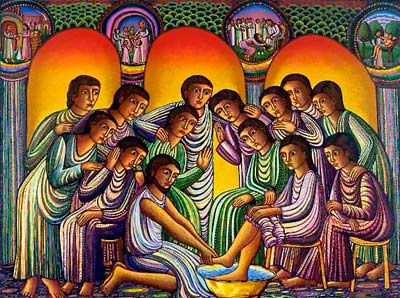
footwashing

“Now that I, your Lord and Teacher, have washed your feet, you also should wash one another’s feet.”

John 13:14

Some Christians reading this part of scripture, have concluded that foot washing should be part of the Churches customary routine.  Their case is compelling, and they may be right in their interpretation.  There is as much support for this as with other things, and Lord knows we could use the humility by getting on your knees with a basin and towel before a brother. 

It probably would relieve issues between saints. It may even heal Church splits. (Oh my!)

Jesus pronounced that His act of service was to be imitated by everyone who would follow.  He further would assert that His example would be emulated by every believer that followed after Him.  Our service to our brother, or sister is to help them become clean Christians. 

We have this ministry of the basin and towel to remove the dirt and filth that comes from walking in this world.  Of course, we cannot remove sins.  But we can serve as Jesus would and intervene with His power.

Cleansing people that we meet will be a challenge. 

It will call us to strip our lives down to a minimum, and to get lower.  We need to get so low that we’re on the floor.  This requires much grace and discipline.  We must weed out every pretense and pride–especially the kind that says, “Look at me serving; am I not wonderful?  I am a true disciple now.”  We are to shake off thoughts like that. 

We are to love others, and perhaps be honestly brutal on ourselves. (Not in a morbid way, just less of ‘yourself.’)

While in my first year of Bible college, I developed a bitter dislike for a classmate.  He had been a lead guitarist; he was handsome and popular, and he oozed pride from every pore (at least I could see it).  I actually took it on myself to be God’s hand in humbling him.  I became antagonistic and scorned him every chance I could.

Within days, my prayer life shut down and the heavens became brass.  One day I was praying and the Holy Spirit graciously zapped me.  I became aware of my sin toward my brother, and I repented. There was a real definite leading, to find a basin and a towel, and then to wash his feet.

God reconciled us, as I knelt at his feet in that dorm room.  From that point on we became very good friends.

We must go lower still.   Water always finds the lowest point, were it pools and gathers into the place of healing others. Perhaps the Holy Spirit will not lead us ‘deeper’ until we start practicing true humility.

When we lower ourselves even deeper we find His presence waiting for us.  But we must cleanse our own hands first, and His blood must work its ministry on me. It’s then I can proceed to clean the filth off of their feet.  If I am not clean myself I will only perpetuate the dirt on to my brother with my dirty hands.

We must scrub our way into the heart of our sister or brother with a basin, some soap and a towel. 

The challenge for us will be a super-challenge.  Christlikeness will always demand this humble grace.  When we think about being like Jesus we must make sure we are following the Jesus in the Bible.  The Jesus who washed dirty feet as a slave.

But let’s not have any foolish nonsense of a discipleship that doesn’t kneel before our brothers in humility.


Bond Servants of Jesus

Body piercing has become pretty much acceptable just in the last ten years.  Studs are placed in a hole or piercing to make a permanent decoration.  I have seen a fair amount of it, and I think that a stud in the tongue has got to be the most intrusive.  (I recently read of a young girl who died after her tongue was pierced from an infection).

There is “body piercing” in scripture.  In Deuteronomy 15:12-18, slaves who are set free by their master after six years of service, if they loved and were loved by their master, could choose to remain a slave to him.

“But if your slave says to you, “I don’t want to leave you,” because he loves you and your family and has a good life with you,17 stick an awl through his ear into the door; he will be your slave for life. Also do this to a female slave.”

Deuteronomy 15:12-18

This was a decision that required elders to act as witnesses.  It was significant as well as completely binding.  I like to think of the ceremony to be kind of a cross between a wedding and a circumcision. (Sounds fun, huh?!)

The slave would be led to a doorpost and the master would take an awl, and push it through his ear lobe.  This designated the slave to be forever “owned” by a specific master.  Herein lies a picture of the Christian.

Many times in the New Testament we are called to be servants (slaves) of Christ.

Peter, Paul, James, and Jude referred to themselves as “bond servants of Jesus Christ” in their epistles.This image has an empty alt attribute; its file name is awl-piercing-faith-1.jpg This is not a forced servitude. It’s a choice made in love!

There are many believers who have done the same, they have fallen in love with their Savior.  They do not plan on a life apart from Him.  So spiritually they have gone to the doorpost, the awl is pushed through their ear, and they are marked from that point on.

Although the ear was pierced physically in the Old Testament, a different kind of piercing takes place in the New.  In Romans 6:16 we read,

“Surely you know that when you give yourselves like slaves to obey someone, then you are really slaves of that person. The person you obey is your master. You can follow sin, which brings spiritual death, or you can obey God, which makes you right with him.”

Romans 6:16, (NCV)

When the prodigal son returned home from the far country he fell before his father and humbly ask,make me your servant.” (Luke 15:19,21) He, in essence, was saying to the father, “pierce my ear.” The father made him a son, but the attitude of the son’s heart had changed to the heart of a servant. So it must be with us. Only then will we live a “pierced ear” life, revealing to all that we are servants of Jesus Christ!

“Savior, I know Thou hast allowed me absolute liberty, to serve Thee, or to go my own way. I would serve Thee forever, for I love my Master. I will not go out free. Mark my ear, Lord, that it might respond only to Thy voice.”

— Jim Elliot, Missionary and Martyr