Social Anxiety Understood

“In any social situation, I felt fear. I would be anxious before I even left the house, and it would escalate as I got closer to a college class, a party, or whatever. I would feel sick in my stomach-it almost felt like I had the flu. My heart would pound, my palms would get sweaty, and I would get this feeling of being removed from myself and from everybody else.”

“When I would walk into a room full of people, I’d turn red and it would feel like everybody’s eyes were on me. I was embarrassed to standoff in a corner by myself, but I couldn’t think of anything to say to anybody. It was humiliating. I felt so clumsy, I couldn’t wait to get out.”

Social phobia, also called social anxiety disorder, is diagnosed when people become overwhelmingly anxious and excessively self-conscious in everyday social situations. People with social phobia have an intense, persistent, and chronic fear of being watched and judged by others and of doing things that will embarrass them. They can worry for days or weeks before a dreaded situation.

This fear may become so severe that it interferes with work, school, and other ordinary activities, and can make it hard to make and keep friends.

While many people with social phobia realize that their fears about being with people are excessive or unreasonable, they are unable to overcome them. Even if they manage to confront their fears and be around others, they are usually very anxious beforehand, are intensely uncomfortable throughout the encounter, and worry about how they were judged for hours afterward.

Social phobia can be limited to one situation (such as talking to people, eating or drinking, or writing on a blackboard in front of others) or maybe so broad (such as in generalized social phobia) that the person experiences anxiety around almost anyone other than the family.

Physical symptoms that often accompany social phobia include blushing, profuse sweating, trembling, nausea, and difficulty talking.

When these symptoms occur, people with social phobia feel as though all eyes are focused on them. 

Social phobia affects about 15 million American adults. 

Women and men are equally likely to develop the disorder, which usually begins in childhood or early adolescence. There is some evidence that genetic factors are involved. Social phobia is often accompanied by other anxiety disorders or depression, and substance abuse may develop if people try to self-medicate their anxiety.

The use of anti-anxiety drugs may be used and they can help you get through “bad patches” when anxiety becomes too much. It’s possible that these meds can help. Let your doctor guide you.

Understand that social anxiety can be successfully treated with certain kinds of psychotherapy or medications. You probably should find someone who understands what you’re dealing with. They need to be good listeners and have an encouraging voice.

Bringing in a pastor or elder must be considered.

Prayer and counsel are critical. Holding on to God’s promises is necessary and as you deal with this it can be God’s way of strengthening your walk. The Word is packed full of His promises. The Lord knows-He wants you to take up and understand what He wants to give you in this.

“Fear not, for I am with you; be not dismayed, for I am your God; I will strengthen you, I will help you, I will uphold you with my righteous right hand.”

Isaiah 41:10

OCD: Rituals and Obsession

“I couldn’t do anything without rituals. They invaded every aspect of my life. Counting really bogged me down. I would wash my hair three times as opposed to once because three was a good luck number and one wasn’t. It took me longer to read because I’d count the lines in a paragraph. When I set my alarm at night, I had to set it to a number that wouldn’t add up to a ’bad’ number.”

“I knew the rituals didn’t make sense, and I was deeply ashamed of them, but I couldn’t seem to overcome them until I had therapy.”

“Getting dressed in the morning was tough, because I had a routine, and if I didn’t follow the routine, I’d get anxious and would have to get dressed again. I always worried that if I didn’t do something, my parents were going to die. I’d have these terrible thoughts of harming my parents. That was completely irrational, but the thoughts triggered more anxiety and more senseless behavior. Because of the time I spent on rituals, I was unable to do a lot of things that were important to me.”

People with obsessive-compulsive disorder (OCD) have persistent, upsetting thoughts (obsessions) and use rituals (compulsions) to control the anxiety these thoughts produce. Most of the time, the rituals end up controlling them.

For example, if people are obsessed with germs or dirt, they may develop a compulsion to wash their hands over and over again. If they develop an obsession with intruders, they may lock and relock their doors many times before going to bed. Being afraid of social embarrassment may prompt people with OCD to comb their hair compulsively in front of a mirror-sometimes they get “caught” in the mirror and can’t move away from it. Performing such rituals is not pleasurable. At best, it produces temporary relief from the anxiety created by obsessive thoughts.

Other common rituals are a need to repeatedly check things, touch things (especially in a particular sequence), or count things. Some common obsessions include having frequent thoughts of violence and harming loved ones, persistently thinking about performing sexual acts the person dislikes, or having thoughts that are prohibited by religious beliefs. People with OCD may also be preoccupied with order and symmetry, have difficulty throwing things out (so they accumulate), or hoard unneeded items.

Healthy people also have rituals, such as checking to see if the stove is off several times before leaving the house. The difference is that people with OCD perform their rituals even though doing so interferes with daily life and they find the repetition distressing. Although most adults with OCD recognize that what they are doing is senseless, some adults and most children may not realize that their behavior is out of the ordinary.

OCD affects about 2.2 million American adults, and the problem can be accompanied by eating disorders, other anxiety disorders, or depression.  It strikes men and women in roughly equal numbers and usually appears in childhood, adolescence, or early adulthood. One-third of adults with OCD develop symptoms as children, and research indicates that OCD might run in families.

The course of the disease is quite varied. Symptoms may come and go, ease over time, or get worse. If OCD becomes severe, it can keep a person from working or carrying out normal responsibilities at home. People with OCD may try to help themselves by avoiding situations that trigger their obsessions, or they may use alcohol or drugs to calm themselves.

OCD usually responds well to treatment with certain medications and/or exposure-based psychotherapy, in which people face situations that cause fear or anxiety and become less sensitive (desensitized) to them.

Source: http://www.nimh.nih.gov/index.shtml

Bryan Lowe

When There’s No Exit: Psalm 88

  Lord, God of my salvation,
    I cry out day and night before you.
Let my prayer come before you;
    incline your ear to my cry!
For my soul is full of troubles,
    and my life draws near to Sheol.
I am counted among those who go down to the pit;
    I am a man who has no strength,
like one set loose among the dead,
    like the slain that lie in the grave,
like those whom you remember no more,
    for they are cut off from your hand.
You have put me in the depths of the pit,
    in the regions dark and deep.

Psalm 88:1-6, ESV

I definitely needed this Psalm today. Yesterday I went to the doctor and was blindsided by news that really isn’t good, at all.  Of course, I also have this ongoing struggle with depression.  Today I feel like I’m running a marathon with ‘leg weights’ on. 

This particular Psalm is radically different than the others. 

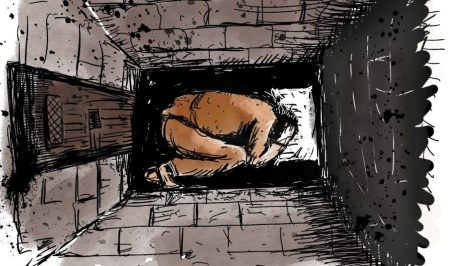
This Psalm has no kind words, and no praise to God for deliverance.  It is a singularly sad song.  Imagine if you will, a huge stone fortress in the mountains.  Every room has a door, and every room a window.  All except one.  No light enters this room.  There is no entrance or exit, no way to get free.  Psalm 88 describes living that torturous experience.

I like my Psalms to be strengthening or encouraging. 

But then comes this one!  Life unravels and frays.  Everything gets confusing. Life comes apart.  The thought of being one who is irretrievably lost and damned, it saturates my thinking.  The despair is beyond belief, I have no words to describe its special variety of darkness. 

Anyone who has walked into this hell will understand.

Am I ‘less’ a Christian because of this vicious despair?  Some would say so.  The writer in verse 1-2, calls out to God.  (I guess this what you are supposed to do).  There is a sense of consistency in his cry.  In verses 3-5, we see him evaluating his position.  Again, there is a underground current of despair. 

There is simply no help, no deliverance for him.

It’s a bitter and painful place to be.  There are no explanations why life has gotten so nasty and bitter and out-of-control.  But one thing that Psalm 88 does quite well, it strips you of any dignity that you have left. 

(Does this make any sense at all?)

There is so much embedded in the book of Psalms.  Comfort, faith, victory and hope are what we find. But in Ps. 88, we find a black pearl, the only one of its kind.  Somehow, we dare not leave it behind, just because we don’t understand it. 

I’m convinced that it has tremendous power to the disciple who is in endless pain.  Just vocalizing this Psalm does something to us.  These real words help.  This Psalm is ours. 

God has provided it for us.


An Attack of Panic

A panic attack affects one out of 75 people, and it often can be quite disconcerting.  My panic attacks occur roughly once a month and last for about 1/2 hour.  When the acute symptoms first appear my first reaction is to resist giving in to it.  I get the “shakes.” For a long time, I didn’t know what caused them or more importantly what could stop it.

A panic attack is a sudden surge of an incredible fear.

Typically it comes without warning and without any obvious reason. It is far more intense than the feeling of being ‘stressed out’ that most people experience.

As a believer in Jesus, the physical symptoms can be quite real, but the spiritual issues become obvious when we consider Satan’s attacks on our faith. Although we may have a proclivity, we don’t have to surrender to panic as the way of life.

Symptoms of a panic attack include:

  • racing heartbeat
  • difficulty breathing, feeling as though you ‘can’t get enough air’
  • a terror, that is almost paralyzing, a seeming irrational fear
  • dizziness, lightheadedness or nausea
  • trembling, sweating, shaking
  • choking, chest pains
  • hot flashes, or sudden chills
  • tingling in fingers or toes, (‘pins and needles’).
  • fear that you’re going to go crazy, or are about to die

You probably recognize this as the classic ‘flight or fight’ response that human beings experience when we are in a situation of danger. But during a panic attack, these symptoms seem to rise from out of nowhere. They occur in seemingly harmless situations–they can even happen while you are asleep.

In addition to the above symptoms, a panic attack is marked by the following conditions:

  1. it occurs suddenly, without any warning and without any way to stop it.
  2. the level of fear is way out of proportion to the actual situation; often, in fact, it’s completely unrelated.
  3. it passes in several minutes; the body cannot sustain the ‘fight or flight’ response for longer than that. However, repeated attacks can continue to recur for hours.

A panic attack is not dangerous, but it can be a bit terrifying.

Largely because it feels ‘crazy’ and ‘out of control.’ Panic disorder is frightening because of the symptoms associated with it, and also because it often leads to other complications such as phobias, depression, substance abuse, medical complications, even suicide.

Its effects can range from mild social impairment or just pretty a total inability to face the outside world.

As a follower of Jesus, I’m certain that Psalm 91 is written for me. If I may, attacks of fear shouldn’t be faced head on, rather we set our hearts on Jesus, and allow Him to defend and protect us. I suppose we’ll always be susceptible, but we dare not be defeated.

Psalm 91:5, ESV

Further reading and help on panic attacks check out these sites: