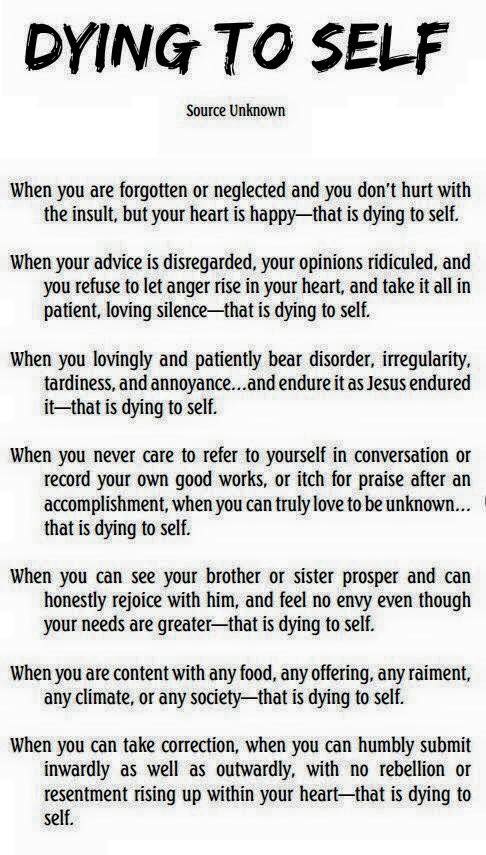
You will never have resurrection power unless there is crucifixion weakness.
In this particular post, we’re looking at an element of Christian discipleship that ties us all together. It’s our common denominator as His disciples. We must learn to die to ourselves to be faithful. There can be no obedience unless we choose to carry our cross to a place of death.
“Those who belong to Christ Jesus have nailed the passions and desires of their sinful nature to his cross and crucified them there.”
Galatians 5:24
But what does that look like? How can I know that I’m really doing this? Maybe this will guide you. I think it’s worth prayerful consideration
By no means is this list exhaustive. Hardly. But you know that may be good. The principle of crucifying self then has the room to fit all areas of your life–the core idea of self-renunciation becomes the way your spirit operates.
“Then Jesus told his disciples, “If anyone would come after me, let him deny himself and take up his cross and follow me.”
Matthew 16:24
“If anyone would come after me, let him deny himself and take up his cross and follow me.
Mark 8:34
“And he said to all, “If anyone would come after me, let him deny himself and take up his cross daily and follow me.”
Luke 9:23
“Whoever does not bear his own cross and come after me cannot be my disciple.”
Luke 14:27
We deny ourselves so real life can begin. There isn’t any other way to follow Him.
We must go to the cross daily in order to find our life. That is the way. “This is a trustworthy saying: If we die with him we will also live with him.”
“Lord, remind me how brief my time on earth will be. Remind me that my days are numbered— how fleeting my life is.”
Ps 39:4, NLT
Typically, we avoid this level of scrutiny. Life is best enjoyed in a relative ignorance, and we certainly don’t welcome the knowledge that our life is limited. We are like people with a bunch of credit cards, and we impulsively buy whatever we want. But soon you’re gonna have to bay the bills.
But, do we really want to be reminded?
Our time is brief. Fleeting. But the psalmist values the reminder… life has been scrutinized, and counted out. We only have a finite number of days [they are counted out] and then we must say ‘good-bye’.
You have an expiration date.
I am convinced that we are to be settled on our ‘finiteness’. We are not immortal, nor are we perpetual. Things wind down, and soon they will lay us embalmed and in a casket, and a memorial service will be held in our memory. This will be, more or less, the end of us. But we will go on.
Are you able to handle the truth?
Your life will end, and there is nothing you can do about it. Let it unfold, and take its lumps. You really do not have a choice. There is a limit to our living on this terrestrial ball. We can make no further advance here. It is finished.
The verse speaks of an eagerness to know one’s limits. Tell me, remind me, how short it all is. I want you to tell me, where the end is, so I can live my life in a response to the truth. I want to respond to reality, whatever that may be.
We must calmly accept the end of our time here on earth. We can’t deceive ourselves. We need to welcome the intrusion of a finish line. Let us live, men and women, in a full understanding of our limits. Let us walk in the fear of our God.
“Life, lovely while it lasts, is soon over. Life as we know it, precious and beautiful, ends. The body is put back in the same ground it came from. The spirit returns to God, who first breathed it.”
It’s been 15 days since I got the news. My sister Suz passed away at 4:00 a.m. on a Thursday morning.
I hate that phrase, “passed away.” It makes it sound like she floated off in a gondola across the sea.
She died. Why do we shroud death in such wishy-washy language?
I never went to visit her before she died. I had plans to visit Memorial Day weekend. But that was a week too late. I really need to stop planning to visit loved ones who are sick and just do it.
The cards and condolences all give me permission to grieve this terrible loss. But I’m scared to let myself grieve. I can’t think about this loss of my oldest sister without remembering the loss of our sister Peggy (who also died on a Thursday), and Daddy before her, and Mom before him. The grief seems too much to bear.
Grieving is doubly difficult when every impulse to let tears fall feels like teetering on the rim of the pit of depression. What if I let the grief run free and it drags me into that hell I haven’t really known in over 20 years? I remember that place of desperation all too well and I refuse to go back there.
It’s not that I haven’t cried about her being gone. I definitely have, but it terrifies me when I do. And why do the tears keep coming back once they’ve been cried? How do I grieve but continue to live?
I know this deep sadness is different from major clinical depression. I know the reason for these tears. When my depression was at its worst I had no idea why I couldn’t stop crying. The incessant tears served no discernible purpose. But the head knowledge that my tears of late do have a purpose—the loss of someone I dearly love—doesn’t alleviate the fear that they may drag me into another bout of depression.
The other day I queued up a few Chris Stapleton songs on YouTube while I worked on a relatively mindless project. I fondly reminisced about when she bought us tickets to see him at a small venue in Portland. Then a song came on that I hadn’t heard him sing before called “Drink a Beer.” The next thing I know I’m bawling and my heart feels like it’s breaking into a million little pieces and being compressed in a vise all at once.
Today, as every day for the last two weeks, the hard cider in the fridge calls to me. I usually wait until after work to have one. But I’m on vacation this week and today 3:00 p.m. seemed like a good time to have one. It’s 5:00 p.m. somewhere, right? And at least I’m not drinking tequila in her honor.
Maybe it’s the compound grief that is making it harder for me to cope with this loss. I don’t remember it being quite so unbearable when Peggy died, but then Suz was there with me for that loss. We began the grieving together. Now all my family support it on the other end of a telephone line.
When Mom and then Dad died, I was already depressed. My grief was fused with the vague despair of my mental illness. I suppose it could be that fusion that makes grieving so difficult now. I can’t seem to separate the two states of sorrow.
And yet this spiritual discipline of writing my thoughts and fears on paper helps me to gain a clearer perspective. I’m reminded as I write of a favorite Bible verse. John 11:35 says, “Jesus wept.” The occasion was the death of his dear friend Lazarus. Even though Jesus knew he was about to raise Lazarus to life again, Jesus modeled grief over the loss of a loved one. He declared in that shortest verse that tears are a normal part of this broken life we live in a world of sorrow upon sorrow.
The same apostle who recorded this verse penned the book of Revelation where we are told God “will wipe every tear from their eyes. There will be no more death or mourning or crying or pain, for the old order of things has passed away.” Revelation 21:4 NIV.
These tears I cry for my sister are normal. This grief is okay. Today won’t be the last time I grieve this loss. This will likely not be the last loss I will know in this broken world.
“We will never be the same as we were before this loss, but are ever so much the better for having had someone so great to lose.”
It’s very real and it’s very possible. Often we see suicide as the only way out. It becomes an option for us. We can plot it, and entertain it. I have personally seen it first hand, and I understand its seductive pull. It seems logical. Suicide has become a real possibility.
We feel like a magnet; bad stuff gets pulled into our thinking, and we plunge into dark thoughts and a deep pain. I know, I’ve been down this road. I’ve had to walk through this stuff myself. It scares me. Once (or twice) when we make our way down this trek, it becomes easier and quicker to make the slide into what ending it all.
It happens to Christian believers. I was a pastor of a church and a teacher in a Bible college. I acquired a degree of having a competent religion but without real knowledge. I professed but never attained. There were moments though, when I got quiet enough to listen, that I knew it really wasn’t working.
Will we go to hell if we commit suicide? The answer evades me, and I can find no definite direction in scripture. King Saul in the Old Testament, and Judas in the New, are those who come to mind. Both men found themselves in a very ugly situation. There isn’t any positives for them both.
Somehow, deeply ingrained in our hearts, we know it’s wrong. Maybe it’s genetic or a societal convention. Deep down we know it can never, ever be an option. It’s completely beyond the pale. And yet, we arrive at a terrible point when it does seem it’s the only thing left open to us. We’ve become our own worst enemy.
“Suicide doesn’t take away the pain, it gives it to someone else.”
Suicide devastates those who are left behind. Our terrible pain gets passed to those who knew us; the closer they are to us, the more it will damage them. Husbands, wives, children and friends will know trauma first-hand. Our decision to die will scar their hearts forever.
We are all connected. We are each tied to each other. Family and friends, churches and communities. We all have relationships that, like it or not, bind us to each other. We’re not solitary entities existing on our own. Consciously or not, we effect others. We will never know the scope of our influence.
There are stages an afflicted person will go through. These are just generalities, but having been down this path I do see them as steps to self-destruction. They blend with each other and sometimes they can be slower or faster, depending on the individual.
Step One: Ideation.
Thinking about it, is it even possible?
Step Two: Fascination.
When the idea begins to become more real, more seductive. We see a burnished glory in it. Suicide seems like logical to us. It seems the only way out. (Besides, isn’t there a certain ‘hubris’ to killing yourself?)
Step Three: Planning
How am I going to do this? What method makes the most sense to me?
Step Four: Committing.
This is the final, ultimate step. Everything up to now is just setting me up for this.
One of the 10 Commandments expressly tells us that “You shall not murder.” Suicide is essentially “self-murder.” This I suppose, is the ultimate
Suicide is never logical. It’s a slide into that which is irrational. It isn’t normal to want to kill yourself. And it does seem that mental illness (schizophrenia, depression, anxiety etc.) can be an incredible factor. Physical illnesses or diseases also can make suicide logical. Or honestly, it can be a ‘blend’ of all that is listed here.
Suicide prevention
If you think someone is at immediate risk of self-harm or hurting another person:
• Call 911 or your local emergency number. Get help as quick as you can.
• Stay with the person until help arrives. Don’t let them alone with their ‘demons,” real or imaginary.
• Remove any guns, knives, medications, or other things that may cause harm.
• Listen, but don’t judge, argue, threaten, or yell. All of these only increase the possibilities.
If you or someone you know is considering suicide, get help from a crisis or suicide prevention hotline. Try the National Suicide Prevention Lifeline at 800-273-8255.
Most of all, PRAY! Get help from a pastor or elder of your local church. (That’s what they’re there for.)
Love,
Bryan
Commentsbb@yahoo.com
Visit my new site at: redletterstudy.wordpress.com