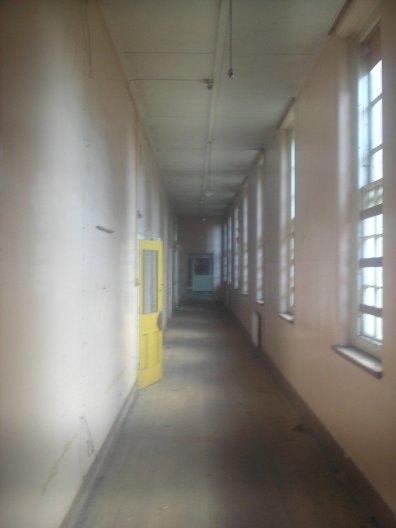
6:30 am. “Rise and shine,” but this is debatable– you simply just breathe and walk, in this kind of a desperate mental fog, (Simply put, ‘there will be no sunshine for you today.’) But, this only just seems to really matter to us, who have no hope. You exchange brief greetings with your roommate, which only just seems proper, even at this level. We are given “ratty” old surgical scrubs to wear through out the day.
We head down ‘en mass’ to the cafeteria. I see the servers on the line, I notice that they avert their eyes from us as we form a hungry queue. Sometimes, they will give us choices: “bacon or sausage?” To a mental patient, this can be a Gordian Knot of complexity. So the line moves slowly, as we try to sort out this conundrum.
There is no coffee for us, as patients. It has been two weeks for me, and I dream of a cup of hot coffee, with cream. Some of the attendants drink Pepsi, although it is done hiddenly, but we all know it. We resent their liberty, especially when we have none. There is a question of equity, with us, which has been violated.
8:40 am. We are all race to be the first in line for our morning meds. It almost seems we are afraid they are suddenly going to run out. I get my Seroquil, my lithium, my Zoloft. Additionally, because I am ‘post-op’ brain tumor, I am given a mild stimulant called Provigil to help me think clearly. I have no idea if it works, or not. (I rather have a cup of coffee.)
We then gather into a day room full of clunky and ugly furniture. It is big, and the chairs encircle a grimy tile floor to make a large open space. This is not an orderly place, as people are wandering about, some stare at the wall or at a fake plant in the corner. It is noisy, some even shout. Others just “rock” back and forth to a song that only they can hear. A few of us lie in “fetal position” of hiddenness, just wanting to disappear.
The thought occurred to me one day, of a ‘giant aquarium.’ It was constantly moving, swirling about. If you stopped moving, it meant that you were dead. Everyone was moving, and oblivious to the others who were also moving. This seems to explain much. (You will need to accept the ‘aquarium’ idea if you really want to process the moment.)
On one of my stays, weeks went by before I realized that this particular meeting actually existed, but I was very confused and seriously beyond any correction. I was really struggling with clinical depression, so meals and meds was all I could manage. When I finally figured this out, I quickly joined the fish bowl. It was both good and bad. But mostly good. Finally as bleak as it was, I started accepting reality.
11:00 am. One thing you do notice is a lot of disjointed conversations. You would speak to someone and 10 minutes later they would answer. And for the most part, conversations would be muted, whispered to people. As if there was a conspiracy involved, and a certain appropriateness must be taken. We were a paranoid bunch.
Sometimes an attendant would turn on the TV. I can remember watching cartoons and just maybe I would think that they were communicating to me in code. We did have a VCR for movies, but because one guy urinated into the machine, it shorted it out. So, alas, no more movies.
During one stay (and there were several) I was suicidal. The staff watched me like a hawk, sitting at my door out in the hallway. But I was desperate to cut my wrists, so I stood up in a chair. I took down a clock and wrapped it in a blanket, to muffle the sound of breaking glass. I managed to slash my wrists deeply and often, before the nurse came in my room. For a moment, I brought an excitement to the staff. And perhaps a certain meaning to me.
When you’re in a psych ward your days are beyond tedious. One day is like the next. The psychiatrist comes to see you for 10 minutes, and it is a high point of your day. You discover that any new explanations, or treatment plans are done solely by the doctor. That is one of the first cardinal rules on the ward. Ask a nurse or an aide, and they invariably dodge. But the psychiatrist “rules the roost.” Everyone follows his decision. This is useful to know.
1:00 pm. Suddenly a young teen girl with schizophrenia, screaming and pounding her head against the wall has now becomes the focus. Every couple of days this happens, and in a twisted way punctuates the drabness of the day. She is artfully restrained by the staff and taken to “the padded cell.” We are all told it is for her own protection, but we as patients, we all rally behind her fight. When she makes a break from the nurses we all cheer her effort and want her to escape.
The second cardinal rule of the floor is that you don’t “stick out” in any way. Creating an issue is never tolerated, whatsoever. Demanding more TV time, or coffee, or a newspaper will hardly ever go over well. Just before Thanksgiving, 2003, I timed my meeting with the pdoc to raise an issue of a fresh cup of coffee. There was a nurse present at our meeting, and she had to respond to the doctor’s order that I was to be given coffee on Thanksgiving morning. The next morning the coffee was delivered, but the nurse insisted that she would set in a chair next to me until I finished. Nevertheless, it was a glorious moment.
3:00 pm. I soon developed auditory hallucinations. First, I kept hearing a CB radio, squawking constantly. A few days later, I started to hear a telegraph, “dit-dot-dash.” They both were very loud and insisting that I pay attention. Also, I would have 3 or 4 moments of seeing black and hairy spiders climbing at me. They were so real, and even volitionally know they were not real, I still panicked.
4:30 pm. They’re other issues as well. I basically hated phone calls from family. When they did come they always seemed intrusive and seemed to work against the thinking on the ward. When a few friends did visit, I would be abrasive and rude. Wishing they hadn’t made the effort. I imagined their hearts processing me and my need to be there, and it disturbed me. Since I lived about 300 miles from the hospital, it took effort on their part to try to see me. Looking back though, I wish I had been nicer.
8:48 pm. Getting ready for bed. It seems that is what I have waited for this all day. These are moments I have started to live for. Sleep = oblivion. I fade to black, and life is paused. There isn’t any issues for me to figure out. For eight hours, I find peace, Sleep is a deep mercy, a gift given to us from the Father. Those of us, who struggle hard against the dark, understand the “gift” of grace in the form of sleep. Depressives very often crave sleep. We often want to hide into it, as if doing so would solve our problems and issues. For me, sleep was the only time I was free from the ward.
I want to sleep, to close my eyes and to be gone. I suppose that is true, for all of us who want to “commit suicide by sleep.” We seek oblivion, and long for the moment when we can “check out.” We want to be forgotten and overlooked. We deeply want to be erased, and move directly into forgottenness.
When we have been committed to the ward as patients, we will probably be shaken to our core. Our insertion into a diverse floor of mental illness, will always introduce us to deep desperation. We are jolted that there is a darkness that is pursing us far beyond what seems is right. We must call out to Him who can save us.
*
kyrie elesion, Bryan





 I have had a strange life.

 The church is God’s hospital. It has always been full of people on the mend. Jesus himself made a point of inviting the lame, the blind, and the possessed to be healed and to accompany him in his ministry, an invitation often spurned by those who thought they were fine as is. We should not be surprised, then, that the depressed populate not only secular hospitals and clinics, but our churches as well. Yet depression remains both familiar and mysterious to pastors and lay church leaders, not to mention to those who share a pew with depressed persons.
 Broken Believers