Are You Sick and Tired Yet?

Matthew 11:28-30, ESV

Weariness and burdens are our common plight. We all have them. They are shared as sort of common identity, like eye color or hair color. We all have them, and wish we didn’t. Sometimes we feel like shutting down, it seems too much to endure.

Weariness, that bone-tiredness that sleep doesn’t seem to help.

We seem to be chronically fatigued by life and what it brings us. We have heavy burdens, we carry a load that only gets heavier (and never lighter.) I suppose we adapt, and simply learn to carry it. But that wears thin, and weariness always breaks through.

Money problems, bills that are past due, marriages, straying children, cars that need fixing, family problems, job hassles, health problems… the list goes on ad nauseam. There are far too many issues, too many problems. Perhaps boredom and tedium are added to the list. They only intensify the hopelessness. (Its own special kind of suffering.)

Some will choose to ‘self medicate’ with alcohol or drugs.

They want something more, and find they only create more burdens (not less). Some will become hopelessly addicted, never finding relief from their burdens, but only increasing them. Suicide very often is seen as the only way out. It seems that it’s an option.

But Jesus will never condemn (leave that to the Pharisees) but instead offers a sort of amnesty to the burnt-out and the burdened. Come to me, all of you who are weary and carry heavy burdens, and I will give you rest.” Jesus did not say, “Get away from me, I am holy and you are not.” Rather, He makes himself to be the solution to all those whose life has overwhelmed.

He desperately wants our burdens and absorbs all our weariness. He wants us. He wants to give us peace and rest. Often Jesus offers but we’ll refuse.

An easy trade, especially since we are so desperate. Some have evaluated Jesus’ offer and made the transaction–piling up our burdens at His feet. We might be a little hesitant about the “my yoke” part, but will quickly find that discipleship can’t be compared to the weight we once carried for so long.

Biblical discipleship is relatively easy. It only asks that we surrender–For my yoke is easy to bear, and the burden I give you is light.” Following Jesus becomes the best way to live. We seem to understand, but unless we commit we will just carry our weight. (But it only gets heavier.)

Here’s a few verses from Isaiah that might help you sort this out:

29 He gives power to the weak
    and strength to the powerless.
30 Even youths will become weak and tired,
    and young men will fall in exhaustion.
31 But those who trust in the Lord will find new strength.
    They will soar high on wings like eagles.
They will run and not grow weary.
    They will walk and not faint.

Isaiah 40:29-31

But you need to deliberately choose. You must decide for yourself–what will you commit to? Will you continue to carry your burden, or will you turn to Jesus?


Memories That Shame Us

And they heard the sound of the LORD God walking in the garden in the cool of the day, and the man and his wife hid themselves from the presence of the LORD God among the trees of the garden. But the LORD God called to the man and said to him, “Where are you?” 10 And he said, “I heard the sound of you in the garden, and I was afraid, because I was naked, and I hid myself.” 

Genesis 3:6-10, ESV

There is a good chance that some of your memories are pretty awful.

When we get looking back we can see shameful, dark things.  Some of us carry things that are profoundly evil, and they go with us wherever we go.

It’s no secret that guilt and mental illness travel hand in hand, for they are brothers. They have tormented us for a terribly long time. They are like playground bullies who have no fear– they only have hatred for us.

I’m quite convinced that the only way to move on is to have Jesus Christ fully cleanse you, and that includes your dark humiliations.  The human tendency is for concealment. We take considerable effort to conceal and cloak our past lives. (Both Adam and Eve understood personal shame.)

I remember back when my dad discovered that one of our dogs had killed a chicken.  He took that dead chicken and wired it around that dog’s neck. That dog wore that chicken for weeks.  It was awful, and it began to putrefy. The smell was terrible.  I can still see that dog, staggering and tongue lolling out and slobbering.  My dad said it was the only cure for a “chicken killer.”  The dog would get very sick, attached to this rotting carcass.  It was a sobering lesson for a young boy to see.

Somehow, that is what our past disgrace has done to us.  

Sure we have moments when we can almost forget.  But, for the most part, it is just a temporary reprieve.  We slide back and rediscover the pain; it’s just waiting for us.   The cost of our mental health is staggering.  

Many of us are driven by a mad movement toward drugs and alcohol.  We are compelled to escape the pain, and for a little while it seems to work. (This is called “co-morbidity.” Which is ‘fancy talk’ for a dual problem.)

It’s like filling a bucket with corrosive acid.  It will eat its way out.

Most of us would quickly trade this mental pain, this misery;  for a physical one. Something shameful that was done 20 or 30 or 50 years ago continues its destructive work.  Our conscience will not allow us to dispose of our self-disgust in this easy, cavalier manner.  We need a ‘hazmat’ crew to help us clean up mentally and spiritually.

You have to forgive yourself.  

You must, or you will destroy yourself and those closest to you as well!

Often we believe these things are simply moldy walls; they seem to just need a coat of paint. Our problem is that it will only cover for a short time.  After 20-30 layers are applied, we realize this isn’t really the answer. Nothing we can do is ever enough.  We must have Jesus– we must!

-Bryan Chapell

Full repentance is critical. Don’t scuff off this first step.  The blood of Jesus isn’t some nicety. It is foundational for salvation. We are to, by faith, start the obedience. Our blistering sin and guilt are absorbed in Jesus’ death and resurrection.

“When someone becomes a Christian, he becomes a brand new person inside. He is not the same anymore. A new life has begun!”

2 Corinthians 5:17, LB

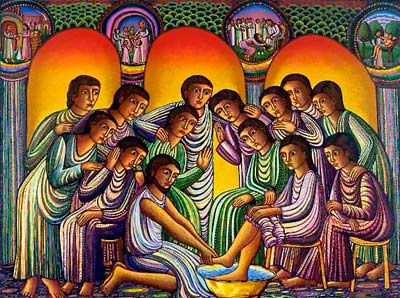
Go Lower Yet

footwashing

“Now that I, your Lord and Teacher, have washed your feet, you also should wash one another’s feet.”

John 13:14

Some Christians reading this part of scripture, have concluded that foot washing should be part of the Churches customary routine.  Their case is compelling, and they may be right in their interpretation.  There is as much support for this as with other things, and Lord knows we could use the humility by getting on your knees with a basin and towel before a brother. 

It probably would relieve issues between saints. It may even heal Church splits. (Oh my!)

Jesus pronounced that His act of service was to be imitated by everyone who would follow.  He further would assert that His example would be emulated by every believer that followed after Him.  Our service to our brother, or sister is to help them become clean Christians. 

We have this ministry of the basin and towel to remove the dirt and filth that comes from walking in this world.  Of course, we cannot remove sins.  But we can serve as Jesus would and intervene with His power.

Cleansing people that we meet will be a challenge. 

It will call us to strip our lives down to a minimum, and to get lower.  We need to get so low that we’re on the floor.  This requires much grace and discipline.  We must weed out every pretense and pride–especially the kind that says, “Look at me serving; am I not wonderful?  I am a true disciple now.”  We are to shake off thoughts like that. 

We are to love others, and perhaps be honestly brutal on ourselves. (Not in a morbid way, just less of ‘yourself.’)

While in my first year of Bible college, I developed a bitter dislike for a classmate.  He had been a lead guitarist; he was handsome and popular, and he oozed pride from every pore (at least I could see it).  I actually took it on myself to be God’s hand in humbling him.  I became antagonistic and scorned him every chance I could.

Within days, my prayer life shut down and the heavens became brass.  One day I was praying and the Holy Spirit graciously zapped me.  I became aware of my sin toward my brother, and I repented. There was a real definite leading, to find a basin and a towel, and then to wash his feet.

God reconciled us, as I knelt at his feet in that dorm room.  From that point on we became very good friends.

We must go lower still.   Water always finds the lowest point, were it pools and gathers into the place of healing others. Perhaps the Holy Spirit will not lead us ‘deeper’ until we start practicing true humility.

When we lower ourselves even deeper we find His presence waiting for us.  But we must cleanse our own hands first, and His blood must work its ministry on me. It’s then I can proceed to clean the filth off of their feet.  If I am not clean myself I will only perpetuate the dirt on to my brother with my dirty hands.

We must scrub our way into the heart of our sister or brother with a basin, some soap and a towel. 

The challenge for us will be a super-challenge.  Christlikeness will always demand this humble grace.  When we think about being like Jesus we must make sure we are following the Jesus in the Bible.  The Jesus who washed dirty feet as a slave.

But let’s not have any foolish nonsense of a discipleship that doesn’t kneel before our brothers in humility.


Taking Your Next Step

J.R. Miller
(1840 – 1912)

“At some point in the Alps, the guides warn tourists not to talk nor sing, nor even to whisper, lest the reverberation of their words in the air may start an avalanche from its poise on the mountain, and bring it down upon the villages and homes in the valley. There are men and women who are carrying such loads of duty, anxiety, or sorrow—that the slightest addition to the weight would crush them. They are battling bravely against odds.

They are holding out under great pressure, sustained by a trembling hope of getting through, at last, successfully. They are bearing up under a burden of difficulty or trouble, comforted by the expectation that in the end—their darkness will turn to light. But everything is “in the balance”.

Then along comes one of these gloomy discouragers.

He has no perception of the fitness of things. He lacks that delicate, sympathetic feeling which enables men of a finer grain and a nobler quality—to enter into the experience of others and put strength into their hearts. He discovers the trouble through which his friends are passing. But instead of speaking a word of cheer to help them to be victorious, he talks in a pessimistic or disheartening way which makes their difficulties seem greater, their burdens heavier, and their sorrows altogether hopeless!

It is hard to be patient with such people, for they are really enemies of human happiness!

They make life immeasurably harder for everyone they meet. They take the brightness out of the sunniest day; the blue out of the clearest sky; and something of the gladness out of the happiest heart. Then they make work harder for every toiler—and pain keener for every sufferer! There ought to be a law making it a crime—for one man to discourage another, and affixing severe penalties to every violation of this law!

How much better it would be—if instead of being discouragers, we would all learn to be encouragers of others! The value of words of cheer is incalculable!

There is an old story of a fireman who was climbing up a ladder amid smoke and flame, trying to reach a high window—to rescue a child from a burning building! The man had almost gained the window—but the heat was so intense, and the smoke so blinding, that he staggered on the ladder and seemed about to turn back. The great crowd below was watching him with breathless interest and, seeing him waver and hesitate, began to “cheer” him! This nerved the fireman anew for his heroic task, and in a moment the brave fellow had entered the house and soon returned, saving the child. It is ‘cheer’ that people need, not discouragement, when they are fighting a hard battle!

Men who give us only their doubts and fears, are misanthropists. True philanthropy brings us hope and heartening. The truest helpers of others—are those who always have words of exhortation and inspiration to speak, who always are encouragers.”

“I would go to the deeps a hundred times to cheer a downcast spirit. It is good for me to have been afflicted, that I might know how to speak a word in season to one that is weary.”

 Charles Spurgeon