The Caged Bird is Now Free

caged-bird

“Whoever dwells in the shelter of the Most High
    will rest in the shadow of the Almighty.
I will say of the Lord, “He is my refuge and my fortress,
    my God, in whom I trust.” 

Psalm 91:1-2, NIV

Psalm 91 focuses on being intimate with our heavenly Father.

Throughout the entire chapter we see personal pronouns used. In contrast to other psalms that are directed to the nation, this one is written to an individual. This personal focus makes this a favorite psalm for many.

Shelter and shadow, refuge and trusting.

These four are the opening ‘word pictures,’ and they are used with wisdom and an alert discernment. The psalmist writes what he knows, and it is apparent that he understand the needs of the human spirit, and our need for protection.

Each of these four words creates a common link between believers. Each of us need a working understanding of all four protections.

These four are necessary elements for Psalm 91 to really work. I should ‘dwell’ in God’s sheltered care. All too often, I wander out past the security of the Lord (or maybe I’m lured out?) But there is safety in having God so close to us.

His proximity is for my protection.
“Surely he will save you
    from the fowler’s snare
    and from the deadly pestilence.
He will cover you with his feathers,
    and under his wings you will find refuge;
    his faithfulness will be your shield and rampart.”

Psalm 91:3-4

silhouette-bird-on-branch-grangerV.v. 3-4, maintains its personal or familiar tone. ‘Save you’ (salvation) is far more that a theological term.  For the psalmist however, it’s not about ‘doctrine’; rather the psalm is an embrace. He is rescued from the trap, and the sickness that seems so contagious never touches him. Moving from metaphor to metaphor, he engages our imaginations to ‘see’ God’s salvation. The writer knows his stuff.

The Lord is pictured as a protective bird that covers his chicks with His wings.

We have a sure confidence as we gather together in that warm and safe spot under His wing. Whatever is after us has to go through God first. His presence is formidable. In His company is found true safety.

“What, then, shall we say in response to these things? If God is for us, who can be against us? Who will bring any charge against those whom God has chosen? It is God who justifies.”

Romans 8:31, 33

All of heaven is rallying for your well-being. You are sure of this based on your faith in God’s own word. He has ‘busted us’ out of a dark cage, and now defends you against all your enemies. And that is a very good thing.


 

The Shepherd’s Oil

I have to admit, I always wondered what this verse in Psalm 23 meant. I thought He anoints my head with oilwas a nice poetic phrase for God blessing David. But as I delved deeper into the context and explored different interpretations, a beautiful and profound meaning unfolded before my eyes.

First of all the act of anointing with oil holds significant cultural and spiritual symbolism in biblical times. It was a practice to anoint guests as a sign of honor and welcome, especially in lavish feasts and celebrations.

Anointing with oil also had medicinal purposes, as it could soothe and heal various ailments. (Now that’s interesting, I thought.)

In the context of Psalm 23, the phrase “He anoints my head with oil” takes on a deeper metaphorical meaning. It signifies God’s abundant blessings, His provision, and His care for His people. Just as a host anoints the head of a guest as an act of honor and hospitality, God lovingly anoints us with blessings and favor.

Moreover, the act of anointing with oil has spiritual connotations. In ancient religious rituals, anointing with oil was a sign of consecration, setting apart someone or something for a holy purpose.

This verse also portrays a practical picture of medicinal shepherding.

In biblical times, shepherds used oil to treat and protect the sheep’s wounds and keep insects away from their heads. By anointing our heads with oil, God brings healing and comfort to our brokenness, soothing our hurts and protecting us from the turmoil of life.

Sheep often can do harmful things to themselves as they try to find relief from flies and ticks.

Their ears and eyes can be targets for tormenting insects as well.

Sheep have been known to bash their heads against rock walls to dislodge flies from their ears, noses, and eyes. A good shepherd watches closely over his flock. He watches over them carefully.

A good shepherd knows that poured out oil forms a barrier of protection against these things that would try to destroy the sheep.

Have you ever asked God to anoint your head with oil?

Psalm 23 as a whole beautifully paints a picture of God as our loving and caring Shepherd, guiding us, providing for us, and protecting us. The imagery of anointing with oil further illuminates the depth of His love and the extent of His care. It reminds us that we are chosen and cherished by God, and that His blessings are abundant and unending.

But ask yourself these questions. Do you have times of mental torment? Do the worrisome thoughts invade your mind over and over? Do you beat your head against a wall trying to stop them?

The Holy Spirit can come with His endless supply of oil!

“You prepare a table before me
    in the presence of my enemies;
you anoint my head with oil;
    my cup overflows.”

Psalm 23:5, ESV

Oh how He loves you!

My Enemy is at the Door

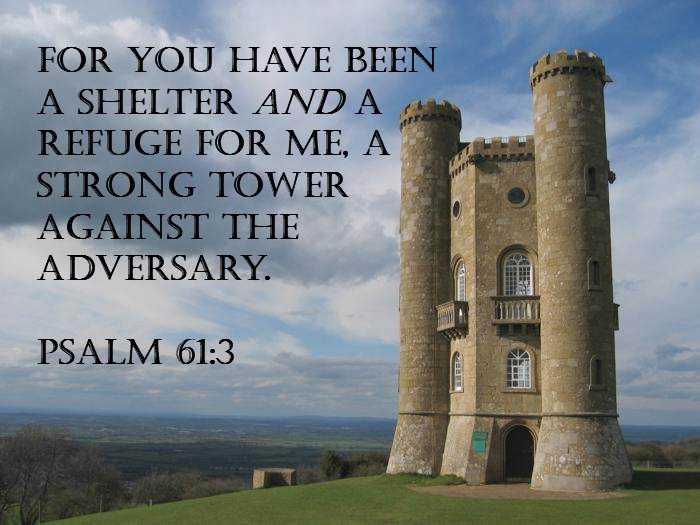
strongtower2

“And he said, “Listen, all Judah and inhabitants of Jerusalem and King Jehoshaphat: Thus says the Lord to you, ‘Do not be afraid and do not be dismayed at this great horde, for the battle is not yours but God’s.”

2 Chronicles 20:15, ESV

flourish10

We certainly don’t face a human army, yet the spiritual battle is just as consuming. Satan and his hordes are working 24/7 to capture our hearts and minds. He wants to enslave our spirits, and to assimilate us into his rebellion against God. For the broken believer, we know where we are weakest. Satanic influence can be fierce. However we are not alone.

Jehoshaphat’s own situation was precarious. Vastly out numbered, his own troops were about to be slaughtered and Jerusalem captured. Jehoshaphat responds by praying. He acknowledges God, and asks for divine help. We find him desperate, and that is how humility grows.

‘Do not be afraid and do not be dismayed at this great horde, for the battle is not yours but God’s.”

When God intervenes, we can only watch (and trust) His deliverance. King Jehoshaphat arranged for his army to be led by singers. There is a confidence here. Praise and worship is the way the enemy is defeated. “The battle belongs to God.” A great victory is won.

Make God your general. Infuse the atmosphere with prayer and praise. Impossible things are about to happen. Victory can be yours if you can only ‘get out of the way.’ This is the wisest and the safest course. (My worst defeats have come when I try my hardest to battle on my own.) When the enemy is pounding at the door, ask Jesus to answer it. He alone will bring you the victory.

P.S. Find a psalm– and then hide yourself in it.


The Sea of Galilee ‘Crash’ Course, 101

A Crash Course in Trust

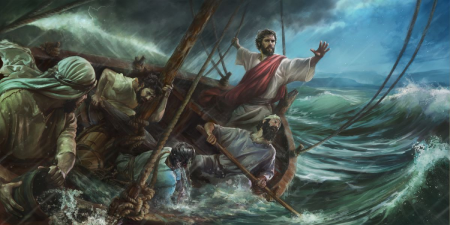
When Jesus woke up, he rebuked the wind and said to the waves, “Silence! Be still!” Suddenly the wind stopped, and there was a great calm. 40 Then he asked them, “Why are you afraid? Do you still have no faith?”

(Mark 4:39-40, NLT)

There He is, sleeping on a pillow, seemingly unaware of the danger that the disciples were facing. They’re suddenly in the middle of a cyclonic fury–a ‘bomb’ of wind and waves that is bursting into their tiny little boat. The twelve had never seen waves so high, or a storm rise up so fast.. At least four were seasoned fisherman, and they knew how to handle a boat. But this storm was way beyond anything they’ve ever faced before.

Maybe it was over crowded; the dimensions of the boat would’ve been around 25-30 feet long, and maybe 7-8 feet wide, more or less, and a single mast. The twelve crowded in, while the four fisherman handled the sail and the rudders. Jesus found His place in the stern. It had been a long full day, and everyone expected a restful crossing. The break would be welcomed.

Why do we doubt? Being unsure and uncertain is a very human quality, especially when everything has gone haywire. Things have turned out really rotten, and now the situation is starting to look even more grim. Our response varies–from mild concern to outright panic. We honestly never know what to expect or how to react. Small things look big. Big things look small.

To put it mildly, the disciples in the storm are scared out of their wits. They’re completely overwhelmed by the possibility of drowning. They are now fighting to stay alive. The waves are getting higher and higher, and the boat ‘groans’ like it wants to fall apart. They pitch up and down, twisting like some wacky ‘roller-coaster’ ride!

“As evening came, Jesus said to his disciples, “Let’s cross to the other side of the lake.” 

(Mark 4:35)

Never do they think that Jesus had declared that their destination was across the lake, and certainly not beneath it! But now where is Jesus? Twenty-eight eyes look to the very back of the boat. “Wake Him up, we’re all going to drown.” Funny how we are sometimes. Things are going nuts and we’re starting to come apart. Yet we wait to the last possible moment and seldom consider that Jesus has been in our “boat” all along.

Important idea: When Jesus stands up, and speaks to the wind and waves, He will use the same word as when He freed the demoniac, just a few verses later!

“Teach these new disciples to obey all the commands I have given you. And be sure of this: I am with you always, even to the end of the age.”

(Matthew 28:20)

I am with you always” is the promise given to each believer. Consider dear one, Jesus has chosen to stay with us and bring His supernatural touch directly into our storm. He will always make an appearance to all who are His. He is “responsible” for you. His intention is to bring you to the other side. His very honor is at stake! (Phil. 1:6). He fully believes He can grow your faith. (Heb. 11:6).

Life can fall apart on us very fast, I know first-hand. And it seems like it’s ‘doubly dangerous’ for those struggling with depression or disability. It’s like we have extra weights put on us, and when you’re barely “treading water,” that really isn’t good. Not only do we have these heavy burdens on us, but we must survive this horrendous storm. (The waves can get massive, and our boat is very small.)

“While I was with them, I protected them and kept them safe by that name you gave me. None has been lost.”

(John 17:12) 

The disciples called out to Jesus, and that is all they had to do. The rest belonged to their Lord. Obviously the disciples had zero ability to ‘halt’ their storm. But when they finally summoned Jesus, they became mere ‘spectators.’ All they did was watch as God move, and they simply sat still in amazement. (1 Samuel 12:16). He did all of the ‘work.’

What is going on in your life? Storms will always come, one way or another. These five should help:

  • He has promised to bring us to the other side, no debate here
  • He is in our boat, and superintends every storm we face
  • He understands our limitations, our weaknesses, our griefs, what saddens us
  • He has all authority and power, He does what He wants, whenever He wants
  • He teaches us to be faithful disciples, and it seems we understand our ‘voyage’ better

We maybe the broken, but perhaps that makes it easier to understand?

With Jesus in my boat,

Bryan

commentsbb@yahoo.com