The Throne of Mega Grace

“Let us then with confidence draw near to the throne of grace, that we may receive mercy and find grace to help in time of need.”

Hebrews 4:16, ESV

As verses go, this is one of the more significant. There are plenty of promises to be found in the scriptures but Hebrews 4:16 has a meaningful spot in my walk. When I think about it, and consider its implications, I have very little to say but “hallelujah!”

Jesus is our great High Priest. That word “great” clearly underscores His value to us. It shouldn’t really surprise us: the word in Greek is “megas” which means preeminent, all intensive and all abundant. (The idea can also mean ‘weight.’)

Some versions of the Bible use “boldness” instead of confidence. I like boldness but confidence is good too. Both words are wonderful. (One version uses “bravely!”).

His absolute power as a Priest is forever and ever.

He is now our precious mediator. Jesus is now our go-between of our ugly sin and His incredible holiness. He has created a spiritual super-highway for those who chose to come to Him through a saving faith. He has done this all by Himself. It was what He wanted.

The throne He sits on is now known as our “throne of grace.”

“Ancient Jewish Rabbis taught that God had two thrones, one of mercy and one of judgment. They said this because they knew that God was both merciful and just, but they could not reconcile these two attributes of God. They thought that perhaps God had two thrones to display the two aspects of His character. On one throne He showed judgment and on the other throne mercy. But here, in light of the finished work of Jesus, we see mercy and judgment reconciled into one throne of grace.”

David Guzik

Mercy and grace. Help in our time of need. If you’re anything like me, my neediness is perpetual. I need Jesus all the time, and He has made it clear through His Word that He’s always available to us. His throne room is never off-limits. He has given us the keys!

“The greatest privilege God gives to you is the freedom to approach Him at any time.”

    Wesley L. Duewel

I have a new site and I hope you visit: alaskabibleteacher.com

Am I Like Peter?

66 After this many of his disciples turned back and no longer walked with him. 67 So Jesus said to the twelve, “Do you want to go away as well?” 68 Simon Peter answered him, “Lord, to whom shall we go? You have the words of eternal life.”

John 6:66-68, ESV

To be an authentic follower of Jesus can be really hard sometimes. There doesn’t seem to be any contingency plan for anyone who is looking to escape. Jesus either is, or He isn’t our Lord. The question is posed daily, “Do you also want to leave?”

That’s a question that will be asked to every disciple–I will hear it every morning for the rest of my life.

These are moments when I must make a decision. Will I take up my cross and go with Him? I’ve looked around and there doesn’t seem to be any room in Jesus’ band for ‘almost’ disciples. But Jesus loves Peter, and Jesus loves me. I believe this.

“And He said to all, If any person wills to come after Me, let him deny himself [disown himself, forget, lose sight of himself and his own interests, refuse and give up himself],

And take up his cross daily and follow Me [cleave steadfastly to Me, conform wholly to My example in living and, if need be, in dying also].

Luke 9:23, Amplified Bible

Being obedient to Jesus is far from easy these days. Today’s cross is waiting for me as my feet hit the floor each morning. I’m afraid at times that I won’t be able to take the next step as a true follower. Am I just fooling myself? Will Jesus keep helping and holding me? (Matthew 11:28-30.)

All of heaven seems to stand on tiptoe to watch and see what I’m going to do next.

“Whom have I in heaven but you? I desire you more than anything on earth.”

Psalm 73:25, NLT

Setting Yourself on Fire

Difficulty and pain sometimes come from others, and challenges to the Lordship of Jesus often come from our unique circumstances.

But what if it was something we’ve done?

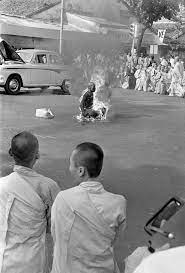
I remember the classic picture of a Buddhist monk who sat in the middle of a street. He was serene as he soaked himself with gasoline, and lit himself on fire as a protest against a war he believed was wrong and evil. He burned himself in front of the cameras.

All too often we’re pretty much responsible for our own self-immolation. It is we (and we alone) that set ourselves ablaze. Sin affects our minds and hearts. We set ourselves on fire.

When we sin– when we walk in ‘known’ disobedience we always put ourselves in an awful place. We love it but learn to hate it too. But we continue to do it regardless of the awful death that ensues.

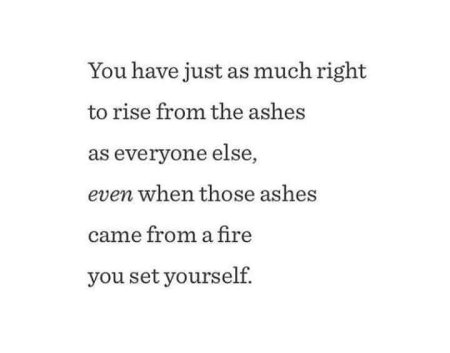
God promises to forgive us. Out of our ashes, He keeps bringing us life and hope.

You can be forgiven. You can find life again, even if you’re fully responsible for the evil we’ve done to yourself. Yes, we all sin, and yes we walk in our own personal rebellion. But Jesus knows it all. These awful things we’ve all done can be forgiven.

As a man and a preacher of the Gospel, I realize that I often choose to sin. In spite of all I know and teach I realize that I can live in the ashes of my own making. As one who also struggles with bipolar, I understand that I’m even more susceptible to doing awful things. I understand that I choose darkness even though others will call me “a man of God.”

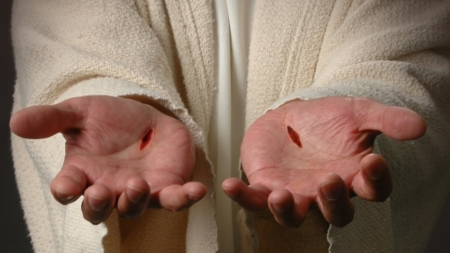
As you read this I’m praying that you find His forgiveness and mercy. You’ve come a long way it seems, but you must see His blood that was ‘released’ from His veins and arteries for you.

He desperately loves you–even if you’ve set yourself on fire, and sit in the ashes of your doing.

“To appoint unto them that mourn in Zion, to give unto them beauty for ashes, the oil of joy for mourning, the garment of praise for the spirit of heaviness; that they might be called trees of righteousness, the planting of the Lord, that he might be glorified.

Isaiah 61:3

Bitter Water

In Exodus 15 there’s an incident that carries weight for today. Israel has come to the springs of Marah. The water is bitter. The people turn to Moses. They challenge him and the complaint voraciously. “Why have you brought us here?” They press Moses to the point of mutiny. They are furious.

Some commentators believe this bitter water was a laxative, and anyone who drank this “bitter” water made many trips to the outhouse!

Moses is shown a branch of a common tree. The Lord speaks a word of ďirection he’s to throw the branchaďirectly into the spring. It’ll cure the water, and make it sweet.

It seems to me that Jesus’ awful cross cures the bitterness we absorb as we make our way through life.