Accommodating Life

the_game_of_life_dreamcast_002

“How do you know what your life will be like tomorrow? Your life is like the morning fog—it’s here a little while, then it’s gone.”

James 4:14

The story is told of a man who went to a toy store to buy something suitable for his young son. He looked high and low for something just right; he wanted a gift that would be perfect. Perhaps an educational toy? The sales girl was helpful. She steered him to many different toys, but nothing was what he was looking for. He didn’t want just any toy– he wanted a memory maker, and something that would last.

Then at last he saw a rather plain-looking box. It wasn’t shiny or glossy like some. But the description on it was interesting, and it said it was suitable for ages 5 through 95. That kind of intrigued him and he read the fine print. It seemed to be a puzzle or game of some kind or another. He shook the box and heard the pieces rattle inside. It seemed to captivate him.

The box said that it came unassembled. Parental help was helpful. There also was a statement that the contents were designed to teach a person how to deal with life, and required some diligence and intelligence to put it together. But there in the smallest fine print, “this toy was never intended to be put together perfectly.”

The man realized that this was the ideal gift for his son. It would teach him that life really never can be assembled quite right. There will always be something missing, or a critical flaw. And there is very little we can do about it. Perhaps the most significant lesson learned is “humility.”

That is why we must turn to God. He alone can make our lives work. The father wanted to teach his son that critical lesson. He wanted to prepare him for failure and frustration. Life never works out the way we want it to, and we should accommodate that idea.

“All have been given a box of tools, a formless rock and a book of rules. And each must make in his life, a stumbling block or a stepping stone.” 

~unknown

Flourish-61

12 “In the few days of our meaningless lives, who knows how our days can best be spent? Our lives are like a shadow. Who can tell what will happen on this earth after we are gone?”

Ecclesiastes 6:12

aabryscript

Two O’ Clock in the Morning Poetry, #3

Collector_Trench

Middle Parts of Fortune, by Frederic Manning

“The air was alive with the rush and flutter of wings; it was ripped by screaming shells, hissing like tons of molten metal plunging suddenly into water, there was the blast and concussion of their explosion, men smashed, obliterated in sudden eruptions of earth, rent and strewn in bloody fragments, shells that were like hell-cats humped and spitting, little sounds, unpleasantly close, lie the plucking of tense strings, and something tangling his feet, tearing at his trousers and puttees as he stumbled over it, and then a face suddenly, an inconceivably distorted face, which raved and sobbed at him as he fell with it into a shell-hole.”

(Accounts of The Great War) 
R
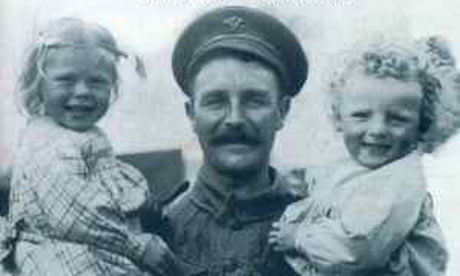
FredricmanningManning was an Australian aspiring intellectual, already in his mid-30s when he enlisted as a private soldier in 1915. His prewar existence in England was dogged by unfulfilled literary hopes and emotional confusions. He served for only a few months in France, and his military career ended in alcoholism and disgrace. But in 1929 he composed a novel, obviously autobiographical, about three soldiers’ experience of the trench nightmare, which is outstanding. Almost certainly the finest work of its kind to emerge from the war. (Penguin)
&

Manning continued to write. In 1917 he published a collection of poems under the title Ediola. This was a mixture of verse predominantly in his former style alongside war poems heavily influenced by the imagism of Pound, which deal introspectively with personal aims and ideals tempered in the crucible of battle. He contributed to anthologies, for example, The Monthly Chapbook which appeared in July 1919 edited by Harold Monro, containing twenty-three poems by writers including John Alford, Herbert ReadWalter De La MareOsbert SitwellSiegfried SassoonD. H. LawrenceEdith SitwellRobert NicholsRose Macaulay and W. H. Davies alongside Manning and Aldington. He wrote for periodicals, including The Criterion, which was produced by T. S. Eliot.

&&&

Poetry did not pay, and so in 1923 Manning took a commission from his publisher John Murray to write The Life of Sir William White, a biography of the man who, as Director of Naval Construction, led the build-up of the Royal Navy in the last years of the nineteenth century. Galton had died in 1921, which not only left Manning effectively homeless, but also lacking a forceful directing influence in his life. He lived for much of the time at the Bull Hotel in Bourne, apart from a short spell when he owned a farmhouse in Surrey. At this time he was friendly with T. E. Lawrence, then serving in the Royal Air Force at RAF Cranwell, some twenty miles (a motorcycle ride) from where Manning was living. In 1926 he contributed the introduction to an edition of Epicurus’s Morals: Collected and faithfully Englished by Walter Charleton, originally published in 1656, published in a limited edition by Peter Davies. — from Wikipedia and Penguin

&

Bonus–

wwi13
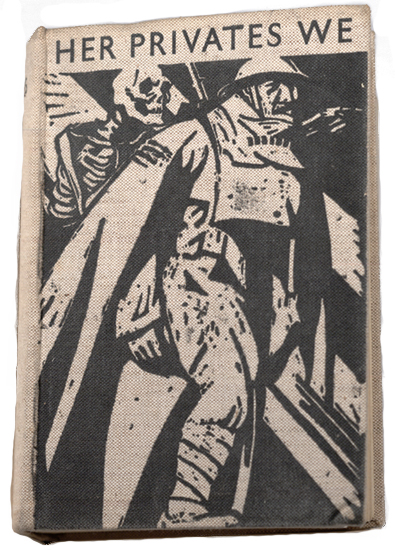
“Her Privates We” 1930, Cover art

*Dis–joint-ed Ideas* Out of Matthew 25:1-13

Ten-virgins-parable
 
KJV—————————->
 
Then shall the kingdom of heaven be likened unto ten virgins, which took their lamps, and went forth to meet the bridegroom.

2 And five of them were wise, and five were foolish.

3 They that were foolish took their lamps, and took no oil with them:

4 But the wise took oil in their vessels with their lamps.

5 While the bridegroom tarried, they all slumbered and slept.

6 And at midnight there was a cry made, Behold, the bridegroom cometh; go ye out to meet him.

7 Then all those virgins arose, and trimmed their lamps.

8 And the foolish said unto the wise, Give us of your oil; for our lamps are gone out.

9 But the wise answered, saying, Not so; lest there be not enough for us and you: but go ye rather to them that sell, and buy for yourselves.

10 And while they went to buy, the bridegroom came; and they that were ready went in with him to the marriage: and the door was shut.

11 Afterward came also the other virgins, saying, Lord, Lord, open to us.

12 But he answered and said, Verily I say unto you, I know you not.

13 Watch therefore, for ye know neither the day nor the hour wherein the Son of man cometh.

King James Version


NLT—————————>
 
“Then the Kingdom of Heaven will be like ten bridesmaids who took their lamps and went to meet the bridegroom. 2 Five of them were foolish, and five were wise. 3 The five who were foolish didn’t take enough olive oil for their lamps, 4 but the other five were wise enough to take along extra oil. 5 When the bridegroom was delayed, they all became drowsy and fell asleep.

6 “At midnight they were roused by the shout, ‘Look, the bridegroom is coming! Come out and meet him!’

7 “All the bridesmaids got up and prepared their lamps. 8 Then the five foolish ones asked the others, ‘Please give us some of your oil because our lamps are going out.’

9 “But the others replied, ‘We don’t have enough for all of us. Go to a shop and buy some for yourselves.’

10 “But while they were gone to buy oil, the bridegroom came. Then those who were ready went in with him to the marriage feast, and the door was locked. 11 Later, when the other five bridesmaids returned, they stood outside, calling, ‘Lord! Lord! Open the door for us!’

12 “But he called back, ‘Believe me, I don’t know you!’

13 “So you, too, must keep watch! For you do not know the day or hour of my return.

 New Living Translation

In recent years I have heard nothing relevant from Matthew 25. Zilch. Why? I honestly don’t know.

The language he uses in this chapter is not only important– but also quite evocative. Even winsome, like the resplendently gorgeous flowers you just have to pick from your neighbors flowerbed. They are the solar plexus kind of trouncingly beautiful.

goldilocks_tarrantWhichever version you like best must carry the authority of the original speaker– his imprimatur if you will– to be real, and valid and even significant. Now Jesus Christ is not speaking out some “weirdy nursery tale” to comfort us. This isn’t “Goldilocks and the Three Bears.” Not even close.

This group of parables, spoke from the mouth and mind of the Lord Jesus Christ (the Creator and Savior and Lord) is meant to connect with us. Try running out in a empty field, with a steel fence post in a the middle of a fierce, lightning storm– you’ll get connected with– real quick! Now back on the farm, you know that you take the needed shelter in a bad storm. One of my great-Aunties was electrocuted in a cast iron bed while sleeping (this led to the conversion of my Uncle Art, who became a prolific evangelist.)

The words of Jesus are not meant to be ignored, or even trifled with. Maybe minimized or entertained or even played with. His words are meant to sizzle, or “crisp us up.” Either way we dare not disregard, or demean them. If we even try, we will end up as very foolish virgins. gotoil

It must be duly noted that 50% missed it completely. But to their credit they really tried to make it work, having the awareness to try to “fix” things, and become available. But the painful part of these 13 verses was the stark-mad fear of not being able to “catch up.”

idea-light-icoBut run this through your “hopper.” MAYBE, I am missing something here? (It wouldn’t be the first time.) Let me know, ok?


*
kyrie eleison, Bryan

(Lord, have mercy)

*

Tobacco Use: Putting Down the Cigarette

By Brendan McLean, NAMI Communications Manager

Studies have shown that individuals living with mental illness die 25 years earlier than the general population. Part of the reason is due to smoking related diseases. At the end of July, the Smoking Cessation Leadership Center held a webinar on the importance of quitting smoking.

“Peers Helping Peers: Ways to Quit Tobacco with Rx for Change” consisted of a panel of experts from around the country, including Ken Duckworth, M.D., medical director of NAMI, and discussed the addictive power of tobacco, ways that will help people quit smoking and the role peer counselors can play.

Individuals living with mental illness are disproportionately represented among those who smoke. Forty-four percent of people who smoke have a mental illness. However, this percentage can be much higher when compared to a specific mental illness. For example, studies have shown that between 62 and 90 percent of individuals living with schizophrenia smoke.

This high rate of smoking means that one-half of the 435,000 tobacco related deaths that occur in the U.S. each year are people who have a mental illness. NAMI Hearts & Minds was created to offer resources on quitting smoking and other healthy lifestyle choices that promote wellness in both mind and body.

So why is smoking common among people who live with mental illness? As Frank Vitale, the National Director of the Pharmacy Partnership for Tobacco Cessation, states in the webinar , smoking was often used as a reward in psychiatric hospitals. “The culture has promoted smoking in a sense,” he said. “I remember working in a psychiatric hospital and we were literally told to tell patients that if you take your medication you can smoke. Or if you go to group you can smoke.”

Helping individuals living with mental illness who smoke can produce a number of benefits. As described by Vitale in the webinar, there are six benefits.

  1. It can improve the overall quality of life.
  2. It can increase the length and number of healthy years of life.
  3. It can improve the effects of medication. Hydrocarbons, which are produced when anything is burned, cause the body to metabolize medications faster than you normally would. As a consequence, many people who smoke often need more medication than if they did not smoke. However, if the individual decides to quit, their clinician should be alerted so they can adjust the amount of medication the individual is receiving.
  4. It can decrease social isolation. Many people who don’t smoke are often hesitant to socialize with those who do.
  5. It can save money—lots of money. Cigarette packs cost nearly $8 in D.C. and upwards of $15 in Manhattan. Over the course of 50 years, if a person were to only smoke one pack of cigarettes a day, at $6 a pack, one would spend nearly $110,000.
  6. It helps promote recovery.

The problem is that there has been lack of focus on smoking cessation by mental health providers. Some providers believed that doing so caused an increased risk of relapse: symptoms would worsen or the individual would return to abusing drugs or alcohol. However, research has shown that there is no truth to either of these claims.

The truth, though, is that people want to quit. Nearly 75 percent of current smokers have said they want to quit and 65 percent have tried to quit in the last year. But sometimes you just need a little help. To learn more about the importance of quitting smoking and how peers can help, listen to a recording of the webinar online.

Thank You, Nami

This is a terrific post dealing with a major issue with those of us who struggle so hard, with mental illness. Think this through and let me know what you think. Pastor Bryan can be reached at,  flash99603@hotmail.com

“How I finally quit smoking!” A Great Blog and a Super Post.

http://wp.me/p1rYch-ZN