How Does It Effect You?

depression-symptoms

There are four areas that chronic depression will effect you.

  1. Emotions
  2. Thoughts
  3. Physical
  4. Behavior

We need to really visualize the areas in order to understand. This grasp of the facts will not change a thing, but will only give you a sense of what depression is doing to you, or your loved ones.

Some will emphasize one or another. But all four areas play a part in this disease. We may think we can twist around these, but we’ll find we are still trapped by the evil ogre of depression. (And he takes all the prisoners he can.)

We are hostages to this sickness. Depression truly destroys lives and hopes. It comes uninvited, and springs its trap on us. It can immobilize us in an instant.

David knew what it was like to be a hostage of depression. In Psalm 32:3-4 he wrote:

“For when I kept silent, my bones wasted away
    through my groaning all day long.
4 For day and night your hand was heavy upon me;
    my strength was dried up[b] as by the heat of summer.”

Many readers will relate. It carries with it an authenticity of a man that is a dear struggler. His experience, and his willingness to write openly provides us with comfort and understanding.

Paul knew all about depression. He wrote in 2 Corinthians 7:6:

 “But God, who comforts the depressed, comforted us by the coming of Titus;”

Ancient writers called it “the Noonday Demon.” Winston Churchill called his depression, “the black dog.” Both definitions seem spot on.

Christians will ask me whether depression is caused by an evil spirit, or is it biological? I usually answer both. There is strong evidence that it is a mental illness; an illness like any other (e.g. diabetes, or migraines). It can be treated, to a degree, with meds. But there is a spiritual dimension as well requiring “spiritual warfare” on an serious level.

My own meds have helped me greatly. But strong prayer and worship have assisted me just as much. Reading the Psalms are really helpful. I have made the personal discovery that the presence of God is a great way to walk free.

When you’re truly desperate, you will find a way. Of that I’m convinced. I leave with Philippians 1:6:

” And I am sure of this, that he who began a good work in you will bring it to completion at the day of Jesus Christ.”

aabryscript

Yearning for Sonship

InnerStruggle

The world is an intensely flawed place. Nothing is as it should be, yet. Our hope is in God”s will to recast it a new heavens and new earth. The Lord has started to redeem it, commencing with us.

Things aren’t in order yet. But they will be very soon. We pray, “thy kingdom come, thy will be done.” This earnest prayer echoes and resounds in heaven. It is the believer’s heart-cry. It is our dream. Soon– but not yet.

22 “We know that the whole creation has been groaning as in the pains of childbirth right up to the present time. 23 Not only so, but we ourselves, who have the firstfruits of the Spirit, groan inwardly as we wait eagerly for our adoption to sonship, the redemption of our bodies. 24 For in this hope we were saved. But hope that is seen is no hope at all. Who hopes for what they already have? 25 But if we hope for what we do not yet have, we wait for it patiently.”

Romans 8:22-25, NIV

We add our groans to a creation already groaning. We lament together with the cry of a woman giving birth. It is a holy agony. But the contractions have started, and soon there will be a new birth.

 “As we wait eagerly for our adoption to sonship” is our passion– it is what we are waiting for. I suppose this is at the core of our faith– sonship. And to walk out of this present darkness as whole men and women, cloaked in the Father’s holy glory.

As a man who struggles with mental illness here I am. I deal with this everyday. The meds, the hopelessness, and the depression. I have to be reminded that this is temporary, and that I will be redeemed completely. I will not be bipolar forever. My shuffling and scootching will get me to my goal eventually. I trust Him implicitly.

Brokenbeliever, don’t lose hope. Hold on to the faith that will fully redeem you. It won’t be long now.

aabryscript

Flourish-61

Accommodating Life

the_game_of_life_dreamcast_002

“How do you know what your life will be like tomorrow? Your life is like the morning fog—it’s here a little while, then it’s gone.”

James 4:14

The story is told of a man who went to a toy store to buy something suitable for his young son. He looked high and low for something just right; he wanted a gift that would be perfect. Perhaps an educational toy? The sales girl was helpful. She steered him to many different toys, but nothing was what he was looking for. He didn’t want just any toy– he wanted a memory maker, and something that would last.

Then at last he saw a rather plain-looking box. It wasn’t shiny or glossy like some. But the description on it was interesting, and it said it was suitable for ages 5 through 95. That kind of intrigued him and he read the fine print. It seemed to be a puzzle or game of some kind or another. He shook the box and heard the pieces rattle inside. It seemed to captivate him.

The box said that it came unassembled. Parental help was helpful. There also was a statement that the contents were designed to teach a person how to deal with life, and required some diligence and intelligence to put it together. But there in the smallest fine print, “this toy was never intended to be put together perfectly.”

The man realized that this was the ideal gift for his son. It would teach him that life really never can be assembled quite right. There will always be something missing, or a critical flaw. And there is very little we can do about it. Perhaps the most significant lesson learned is “humility.”

That is why we must turn to God. He alone can make our lives work. The father wanted to teach his son that critical lesson. He wanted to prepare him for failure and frustration. Life never works out the way we want it to, and we should accommodate that idea.

“All have been given a box of tools, a formless rock and a book of rules. And each must make in his life, a stumbling block or a stepping stone.” 

~unknown

Flourish-61

12 “In the few days of our meaningless lives, who knows how our days can best be spent? Our lives are like a shadow. Who can tell what will happen on this earth after we are gone?”

Ecclesiastes 6:12

aabryscript

Two O’ Clock in the Morning Poetry, #3

Collector_Trench

Middle Parts of Fortune, by Frederic Manning

“The air was alive with the rush and flutter of wings; it was ripped by screaming shells, hissing like tons of molten metal plunging suddenly into water, there was the blast and concussion of their explosion, men smashed, obliterated in sudden eruptions of earth, rent and strewn in bloody fragments, shells that were like hell-cats humped and spitting, little sounds, unpleasantly close, lie the plucking of tense strings, and something tangling his feet, tearing at his trousers and puttees as he stumbled over it, and then a face suddenly, an inconceivably distorted face, which raved and sobbed at him as he fell with it into a shell-hole.”

(Accounts of The Great War) 
R
FredricmanningManning was an Australian aspiring intellectual, already in his mid-30s when he enlisted as a private soldier in 1915. His prewar existence in England was dogged by unfulfilled literary hopes and emotional confusions. He served for only a few months in France, and his military career ended in alcoholism and disgrace. But in 1929 he composed a novel, obviously autobiographical, about three soldiers’ experience of the trench nightmare, which is outstanding. Almost certainly the finest work of its kind to emerge from the war. (Penguin)
&

Manning continued to write. In 1917 he published a collection of poems under the title Ediola. This was a mixture of verse predominantly in his former style alongside war poems heavily influenced by the imagism of Pound, which deal introspectively with personal aims and ideals tempered in the crucible of battle. He contributed to anthologies, for example, The Monthly Chapbook which appeared in July 1919 edited by Harold Monro, containing twenty-three poems by writers including John Alford, Herbert Read, Walter De La Mare, Osbert Sitwell, Siegfried Sassoon, D. H. Lawrence, Edith Sitwell, Robert Nichols, Rose Macaulay and W. H. Davies alongside Manning and Aldington. He wrote for periodicals, including The Criterion, which was produced by T. S. Eliot.

&&&

Poetry did not pay, and so in 1923 Manning took a commission from his publisher John Murray to write The Life of Sir William White, a biography of the man who, as Director of Naval Construction, led the build-up of the Royal Navy in the last years of the nineteenth century. Galton had died in 1921, which not only left Manning effectively homeless, but also lacking a forceful directing influence in his life. He lived for much of the time at the Bull Hotel in Bourne, apart from a short spell when he owned a farmhouse in Surrey. At this time he was friendly with T. E. Lawrence, then serving in the Royal Air Force at RAF Cranwell, some twenty miles (a motorcycle ride) from where Manning was living. In 1926 he contributed the introduction to an edition of Epicurus’s Morals: Collected and faithfully Englished by Walter Charleton, originally published in 1656, published in a limited edition by Peter Davies. — from Wikipedia and Penguin

&

Bonus–

wwi13
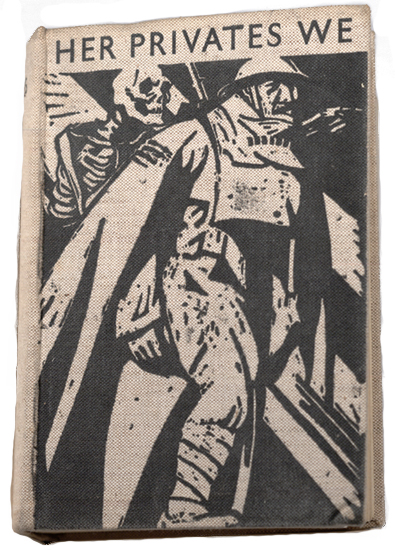
“Her Privates We” 1930, Cover art