The Glory of Gripping Things

Acts 17:33 Artwork | Bible Art

I never had an opportunity to attend a seminary, and only have a three year diploma from a Bible Institute. But I’ve had to rely on the Holy Spirit in ways that a seminary trained pastor will never really understand. I’ve come to see the wisdom in the way God has led me.

“It is the glory of God to conceal things, but the glory of kings is to search things out.”

Proverbs 25:2

Concealing things and searching for things are contrasting actions. God hides things purposefully–they are sort of like a spiritual version of “Where’s Waldo.” Certain things are hidden, but always in plain sight.

Searching for things should definitely be our own response. The word used in Hebrew means to investigate, but with a planned purpose. It’s more than curiosity, rather it’s a passionate curiosity. And the Holy Spirit is always pleased with that.

In the New Testament book of Acts (17:11) we can see this attitude of the Bereans. They were the only ones in Scripture to be called “noble minded” for their serious study and thought. When they heard Paul’s teaching they sat down, opened their Bibles and began to investigate for themselves.

But it will always take humility. Always.

Intellect is important but it’s not enough. The list seen below is something to work through, and the issue is one that has been a challenge for me through 40+ years of following Jesus.

Here’s a study that I’m confident will bless you.

Justification & Sanctification– Gripping the Two
  •  Justification is free (John 4:1)
  • Sanctification is costly (Lk. 14:25-33)
  • Justification is instantaneous (Jn. 3:8)
  • Sanctification is a lifelong process (Jn. 8:31)
  • Justification is by faith (Eph. 2:8)
  • Sanctification is by faithfulness (1 Cor. 4:2)
  • Justification is not of works (Eph. 2:9)
  • Sanctification is of works (Eph. 2:10)
  • Justification involves Christ’s love for me (Jn. 3:16)
  • Sanctification involves my love for Christ (1 Jn. 4:19)
  • Justification concerns Christ’s righteousness (2 Cor. 5:21)
  • Sanctification concerns my righteousness (Lk. 14:25-33)
  • Justification involves my position in Christ (Col. 2:11-14)
  • Sanctification involves my practice (Col. 3:1-11)
  • Justification considers what God has done (1 Cor. 15:3-4)
  • Sanctification considers what I am doing (Lk. 14:25-33)
  • Justification is God’s commitment to me (1 Jn. 5:9-13)
  • Sanctification is my commitment to God (Jn. 14:15)
  • Justification requires obedience to one command: to believe the Gospel (Ac. 6:7)
  • Sanctification requires obedience to all of Christ’s commands (Matt. 28:19-20)
  • Justification focuses on the cross which Jesus took up once and for all (1 Cor. 1:18)
  • Sanctification focuses on the cross which I am to take up daily (Lk. 9:53)
  • Justification is finished at the moment of faith (Jn. 5:24)
  • Sanctification is not finished until I go to be with the Lord (1 Cor. 9:24-27)

Discerning between the two should only be a blessing. In some sense working through the differences between justification and sanctification should energize you, and bring truth to your walk. Now you might disagree, but let it be after you’ve worked through this list.

“I have more understanding than all my teachers, for your testimonies are my meditation.”

Psalm 119:99

The author of the above ‘list’ is unknown. May they be blessed by this if they should read this post.
 
 
cropped-christiangraffiti1 (3)
 

Handling a Diagnosis of Tardive Dyskinesia

Tardive Dyskinesia (TD) is a condition of involuntary, repetitive movements of the jaw, tongue or other body movements. It frequently is a side effect of the long-term use of antipsychotic drugs used to treat schizophrenia or bipolar disorder. It is almost always permanent. I’ve been told Vitamin E might help a bit.  Benzodiazepines have also been used with mixed results on a short-term basis.

Some examples of these types of involuntary movements include:

  • Grimacing
  • Tongue movements
  • Lip smacking
  • Lip puckering
  • Pursing of the lips
  • Excessive eye blinking

(Wikipedia)

I recently was diagnosed as having TD after the use of Zyprexa. My version is my lower jaw moves from side-to-side, unless I concentrate on not doing it. I quickly revert to this involuntary movement when I’m not aware of it. I recently saw a video of myself (with my family) and sure enough there I was, doing the ‘jaw thing.’ It was very obvious. It was also very embarrassing. (I have the ‘lithium jitters’— where my hands always shake, but TD is different.)

There are a couple of things I might mention:
generics7

1) I’ve discovered that there is a real social isolation with this TD stuff. To be doing this in public is “not acceptable.” I have had people come up to me wanting to know what’s my problem. Since I can’t control the movement I just say, “It’s my meds— they affect me this way.” In a way it’s like wearing a neon sign saying, “I’m a fruit cake.” Having a mental illness is stigma enough, but the TD just puts a new edge on it.

2) As a natural introvert the isolation has only deepened. (I avoid crowds and most social engagements.) I guess if the truth be told, I’m uncomfortable when others look at me strangely or whisper to each other. My standard ‘paranoia level’ has taken a new twist. I feel I’m compelled to explain. I guess I’m embarrassed when others are embarrassed.

3) I settle myself down in my faith to cope. I know I’m not alone in this– the Lord Jesus is always with me. He holds me tight through all these twists and turns. Since I isolate myself so much, I savor the connection I have with a few friends who have become inured to my condition. Social media helps out— Facebook is a big help, as well as my two blogs.

4) One of the things I try to remember are the issues of selfishness and pride. I keep reminding myself it’s not about me all the time. One of the significant areas mentally ill people deal with is self-absorbed thinking. It seems it comes with the illness.

5) I try to keep a sense of humor everyday. It breaks down the mental pain to tolerable levels. We can take ourselves too seriously sometimes. Be more patient with yourself. I know I have to.

I ask that you remember me in prayer from time-to-time. I’m in ‘uncharted waters’ (it seems) and I sometimes feel all alone with my mental illness and all its tangents. I want good to come out of this. (An instantaneous healing would be o.k. But, I’m not too finicky.) Sorry for so much.

If you can’t pray, don’t feel at all impinged upon.

I’m More or Less Oblivious

Inspector Clouseau, (Upon discovering stolen artifacts) in The Pink Panther 2

“Ah yes, the Shroud of Turin! We will have to dry clean it before we return it.”

______________________

I honestly think that our bumbling attempts to follow Jesus are entertaining angels who watch our efforts and shake their heads in astonishment. “Did you see what Bryan just did?”

I’m the “Inspector Clouseau” of the spiritual realm.   😁  

Maybe you can relate?

Clumsy and very much oblivious, I bungle my way down the path of discipleship, without a clue. It seems when something right happens, I still end up butchering it. The Holy Spirit has His hands full. Scripture tells me He has no regrets.

We have experienced so much, and been given so much light.

And yet we consistently choose to trade it for a lie. For the most part, I don’t sin automatically, I sometimes choose it deliberately.  People don’t sin because they feel they have to. We sin because we like the pleasure it brings. We sin because it feels nice. It’s often a mask to cover the pain.

It’s a patch for the pain of my twisted up life.

We sin because it brings a thrill to our bodies, and excitement to the boredom of our everyday lives.  We sin because we believe the lie that the pleasure it brings, though passing (Heb. 11:25).

Sin happens when I look at anything or anyone other than God.

The issues I have are both spiritual and medical.  I survived a brain tumor and I need to walk with a cane. I have constant vertigo. My right arm is paralyzed. I struggle hard sometimes. I have some struggles with social anxiety. But God gives me buckets of His grace.  I know first-hand his agape love for me.

But He will not bless my disobedience and rebellion. 

When we announce to the world that “Jesus is Lord” we can expect God will hold our feet to the fire over this.  The Holy Spirit will not negotiate when we suddenly decide we are hungry for sin.  Apprehended by grace, we must fully surrender all claims we have to sample sin’s delights.

Who do we find joy in? It really does matter.

In the middle of my battles to be a believer, I must remember joy.  I cannot imagine being without it.  I’ve been clinically depressed pushed to the point of suicide.  But God gives me joy in my darkness.

“The joy of the Lord is your strength.”

Nehemiah 8:10

“For the Lord takes pleasure in his people; he adorns the humble with salvation.”

Psalm 149:4

1brobry-sig4 (2)

Rembrandt’s Prodigal Son

Rembrandt-The_return_of_the_prodigal_son
Rembrandt, “The Return of the Prodigal Son,” c. 1661

17 “But when he came to himself, he said, ‘How many of my father’s hired servants have more than enough bread, but I perish here with hunger! 18 I will arise and go to my father, and I will say to him, “Father, I have sinned against heaven and before you. 19 I am no longer worthy to be called your son. Treat me as one of your hired servants.”’ 20 And he arose and came to his father. But while he was still a long way off, his father saw him and felt compassion, and ran and embraced him and kissed him. 21 And the son said to him, ‘Father, I have sinned against heaven and before you. I am no longer worthy to be called your son.’ 22 But the father said to his servants, ‘Bring quickly the best robe, and put it on him, and put a ring on his hand, and shoes on his feet. 23 And bring the fattened calf and kill it, and let us eat and celebrate. 24 For this my son was dead, and is alive again; he was lost, and is found.’ And they began to celebrate.

Luke 15:17-24, ESV

Two hundred and eighty-nine words– these describe the life of every man, woman, and child who has ever lived. These 289 words reveal to us a God who loves far too much, way too easy. Perhaps we sort of expect that he will ‘appropriately’ punish his son– at least put him on probation at least. It only makes sense. But we find that is legalism talking.

“Every saint has a past, and every sinner has a future.” 

Many of us have lived as prodigals, and we have spent our inheritance like ‘drunken sailors.’ We really have nothing at all to show for it. The prodigal, completely destitute, takes the only work he can find. (Imagine a good Jewish boy feeding hogs.)

He is so far gone that he starts inspecting the filthy slop buckets for something to eat.

Many of us will understand his despair. Often there comes to us a crystalline moment of simple awareness. The prodigal, sin-crusted and impoverished, still has a lingering memory of the Father’s house.

The servants there had far more than him right now. Sometimes I wonder if in our captivity, we instinctively want to go home, if only in our minds, to be a servant there.

The Father has dreamed of this precise moment.

The parable says, “He saw him–felt compassion–ran out to him–embraced him–and kissed him.” The Father is a whirlwind of agape love. I’ve read the Parable of the Prodigal Son a hundred times or more. It never loses its punch. I simply want to bring some observations: 

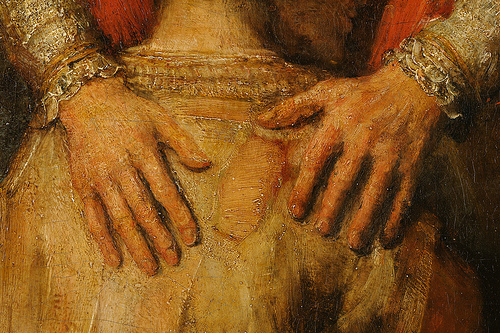
  • We see that his father receives him with a tender gesture. His hands seem to suggest mothering and fathering at once; the left appears larger and more masculine, set on the son’s shoulder, while the right is softer and more receptive in gesture.
  • The son’s head is downy, almost like a newborn’s. We must enter the kingdom like little children. 
  • The Prodigal Son seems to be protected by his father. He snuggles near the Father’s breast. It’s love that holds him there.
  • Consider his sandals. It has taken a long time for him to come home. 
  • Standing at the right is the prodigal son’s older brother, who crosses his hands in stoic judgment; we read in the parable that he objects to the father’s compassion for his brother.
  • We see his mother in the background in the painting, and a seated steward or counselor. One stands in profound joy, the other in sits in stunned perplexity.

But Rembrandt had painted the Prodigal once before, when he was considerably younger. And it is a very good painting. The prodigal is happy and gay; there is absolutely no indication of the consequences of sin.

The Prodigal Son in the Brothel, 1635

He’s a charming young man at the height of his popularity, and we see him at a happy party. He is spending the inheritance of his father.

But Rembrandt chooses at the very end of his life to re-paint it to reflect reality.

This is one of the last paintings he will do, and it is the Prodigal Son–destitute and repenting. I can only imagine; the years have taken a toll and he doesn’t really feel his first painting is enough. He wants to paint what is true.

He now is painting our spiritual condition.

We are given a work that some critics call as the greatest painting ever completed. The painting is now in St. Petersburg, Russia. It is seldom seen by visitors. It is a clear echo of the grace of God for fallen men and women. Like the father in the painting, He’s ready to forgive every sin saturated son and daughter.

The Father’s Prodigal

bry-signat (1)