The Urgency of This Moment

 
“Johnny Quick”

 “We must quickly carry out the tasks assigned us by the one who sent us. The night is coming, and then no one can work.”

John 9:4, NLT

To be quick means that we move very fast; being slow often implies a reluctance or a mental delay.  To hesitate while doing God’s will for us suggests a degree of ignorance or stubbornness.  Our quickness is to be seen while doing “the tasks assigned to us.”

Urgency should be woven into our hearts.  We need to have wings on our feet, a fleetness and an alacrity.  A “double-eagerness” as we carry out His work.  It should be of no surprise that God sets before us an itinerary of work He wants us to do.

So many brothers and sisters sleepwalk through their salvation. They snooze when Jesus desires they “watch and pray” with Him.

Jesus was on a  timetable. He communicated a need of doing.  He is in tune with the work of God, and is involved in the urgency of his present moment.  Jesus knows this, and he clearly communicates the need to do.  We are not called to be manic for Jesus; we are expected to be alert and aware.

This is a cry for urgency to his disciples.

“The night is coming.”  It is getting late.  In response Jesus issues an order.  Work at what the Father has assigned you.  It is almost dark now.  There is a “principle of spiritual velocity” calling us to an alertness and an awareness of needful things to do before “the time is up.”

In Acts 9 the disciples show a holy zeal in their day’s work.  We can’t stop speaking what we have seen and heard.”  The Old Testament prophets carried this urgency–Jeremiah and Amos both declared to us this avidity placed on the believer.  Jesus desires that we factor in this concentrated awareness of the approaching night.

I recently read of an evangelist in the last century.  He had a watch made, and on the dial he had a picture of a setting sun.  And over it, the words, “the night comes.”  Everytime he would look at his watch he would be reminded of the shortness of life and the need of the performance of his duty.  That lesson should be transmitted to each zealous believer.

The key word I guess, in all of this, is zeal.  And often the older we get the more this word becomes diminished, and distant.  (I believe our Father understands this about us.) No matter what we do, He focuses His love on us.  There will never be a condemnation on us.  But we can still waste away our lives in a tragic way, which we will later regret. 

But we have to ask ourselves this, will I just be an admirer, or can I become a zealous disciple of Christ?

bry-signat (1)

cropped-christiangraffiti1.jpg

Going Crossless

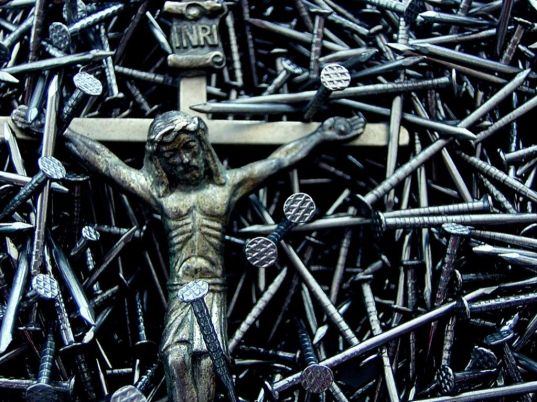
We are a bucket full of nails,

“Whoever does not take up their cross and follow me is not worthy of me.

Matt. 10:38

“Then Jesus said to his disciples, “Whoever wants to be my disciple must deny themselves and take up their cross and follow me.”

Matt. 16:24

We can so easily process our faith to something respectable and somewhat pleasant.  This is a natural tendency. But the cross has a stigma, we might think we can easily defuse it, rendering it as harmless.  Acceptability is a wonderful thing to the modern day believer.  It is easy to turn from all that would make us different, and grasp a crossless faith. It does seem we conform rather than transform.

Effort is being made right now to twist and nullify your belief in Jesus.  It is a force that works on us, relentlessly.  Satan intends to destroy you. He is frightened by the power of the cross, and the spiritual truth it contains. The cross (and resurrection) destroyed the devil’s kingdom of twisted darkness. He will never recover.

Just as Jesus carried the cross He was to die on, you and I are to follow His example.  Jesus had to go to this place of death, and so are we.  My cross is not purely emblematic or abstract symbolism.  It entails a real death.  I pick it up and go to die.  Crucifixion is the end of me, it all comes down to this final point of termination.

Jesus escorts us to the point of death.  This is to become the framework for a sincere discipleship.  The cross, our cross, brings us to an end.  To be worthy of Jesus is to bear it boldly.  The cross develops into our thinking, and its dynamic pounds us into a spiritual reality.  Jesus intensifies the cross, making it the mark of authenticity of a disciple.

We have no options, if we follow it must be with a cross.  There is absolutely no room for us if we approach Him without it.  The cross transmutes our lives, and transmits a signal that we have complied with Jesus’ wishes.  If we advance at all, it will be through the cross only.

We must deny ourselves.  That denial is an intense working. “I do not know the man” was Peter’s statement against Jesus.  If we deny ourselves, we will take a stand against our own selves, turning against ourselves.  We will be pinned to the mat.

Our focus should be on the cross.  We must infuse it into our lives.  A tea bag will flavor an entire cup.  It turns a cup of boiling water into a wonderful beverage.  The cross that belongs to us will have the same effect.  It will make something where there was nothing.

“All heaven is interested in the cross of Christ, all hell terribly afraid of it, while men are the only beings who more or less ignore its meaning.” 

 Oswald Chambers

aabryscript


He Has Come For Us

“I am the good shepherd. I know my own and my own know me, just as the Father knows me and I know the Father; and I lay down my life for the sheep.” 

John 10:14-15 ESV

Jesus declares and reveals something substantial here.  He is the “good shepherd.”  If we split this statement apart, we get “good.”  We also get “shepherd.”  And we simply must insist on both.  Somehow, deep down, these two ‘particulars’ take on the most definite positions in our lives.  We are desperate for anything good; and we know our need for a shepherd.  We struggle so hard, and this understanding will carry us a very long way.

This verse tells us– He knows us!

He is fully aware of you in this present moment.  This is amazing, to be aware that He engages us on the level were we are now at.  Think about, its like He has our ‘x-ray’  in front of Him.  He knows and understands us completely and fully.

The remainder of this verse goes on to suggest that we (yes, we) know Him. Now I have a multitude of issues, but when I sift them out, there is a deep awareness of His presence.  I completely understand (as much as I’m able) of who He is, and I can’t shake Him.  Once touched we’ll never be satisfied with anything else (and Lord knows we will try.)

While visiting this planet, Jesus maintained His connection with the Father.  He would take this sense of intimacy with His Father down ‘into the stretch.’  And that pattern of love would take place in our hearts and minds.  And now we have finally found our place– with him, with the Father.

The very last part, v. 15, places itself right in the middle of our understanding.  He will definitely die for us.  He wants to, and is eager to lay down His life to make us His own.  It all seems foolish, I know.  But He very much wants to bring us into His deep presence.

The idea that we are sheep is factored in.  He dies for us.  The Shepherd will now face crucifixion in order to claim His sheep. He will go to a painful and ugly death to give us life that is eternal.

aabryscript

A Finder’s Fee of Joy

New Testament 3 Production Still Photography Tax collectors and other notorious sinners often came to listen to Jesus teach. This made the Pharisees and teachers of religious law complain that he was associating with such sinful people—even eating with them!” (Luke 15:1)

“If a man has a hundred sheep and one of them gets lost, what will he do? ” (v. 4)

“Or suppose a woman has ten silver coins and loses one.” (v. 8)

“For this son of mine was dead and has now returned to life. He was lost, but now he is found.’ So the party began.” (v. 24)

flourish10

The lost sheep, the lost coin, and the ‘lost son’ tell us that this is a time for recovery. This is a unique period for the Church. It is a season of special grace that allows us to seek and find things that are valuable to us. It is a time of finding out things about ourselves as well.

What is precious to you? With the woman, it was a lost coin (probably a part of her dowry) and she made a substantial effort to get it back. With the shepherd, what was valuable was a lost sheep, and he would take a calculated risk to find it, and rejoin the flock. And the father lost his son, and he had to wait for him to return to his senses.

These three parables were directed to the different issues that effected the “notorious sinners.” But they also spoke to the pharisees who were present. Both groups understood and there were plenty of implications for everyone.

It’s a funny thing, Jesus never minced words. No one could be neutral around him. That is still the case today. I think God is seeking His lost children. This is what He is up to, this is His passion. Understanding this salient fact should enlighten us,

  1. to His will,
  2. to know His passion and love, (His pleasure in finding what was lost)
  3. and the true purpose of His Church.

As the Parable of the Prodigal Son develops, we see the pharisees equated to the ‘grouchy’ older brother. He begrudges his newly returned brother, and he really can’t see what is happening all around him. The idea of grace eludes him. Perhaps that is far more common than we think. Whenever ‘religion’ exerts control over a person or group, duty is almost always elevated over joy.

The Church is only as relevant as when it’s seeking out the lost.

The Church is meant to extend to the lost ‘sons’ of Adam, and the ‘daughters’ of Eve. This is God’s passion, and we must find out what He wants us to do to share His heart. It’s almost as if He wants to give us a chance to taste His joy.

aabryplain