Job’s Friends, They Want to Help!

By John Piper
(The following is an edited transcript of the audio.)

Can we learn something from Job’s friends about how to help the hurting?

Absolutely. Those first seven days were their golden hour. If they had stopped there they would have been heroes, I think, because they would have shown compassion and patience. And that’s what we should learn.

When you walk into a horrific calamity you should be really slow to speak and quick to listen. You should be quick to cry, quick to hold, and quick to meet needs, bring meals, and wait upon the Lord. The theological wrestling comes later, probably. It’s different with different people.

But I think the lesson we learn from the progress of the book of Job is that while those three friends—Eliphaz, Bildad, and Zophar—were sitting in dust and ashes, aching with their friend Job, he was helped by them. And many people are helped just by the loving presence of another.

I don’t think this nullifies the importance of truth. Let me give you an example.

I’m a colleague here with Tom Steller, who has been with me for 24 years. And Tom and I have sometimes said to each other, “It would be great to stay together long enough to die together, Tom.” And depending upon which one of us comes to visit the other in the hospital at our dying moment, we know, because of 24 or (perhaps by then) 54 years together, we don’t have to say a word. It’s all been said.

We have a common theology.

Neither of us will have to preach to the other in order to fix their ideas. We will all know that God reigns, God is good, God is loving, and God is wise. We’re perplexed, but you don’t need to preach. Let’s just take each other’s hands and pray and fight this fight of faith together.

© Desiring God, Permissions: You are permitted and encouraged to reproduce and distribute this material in any format provided that you do not alter the wording in any way and do not charge a fee beyond the cost of reproduction. For web posting, a link to this document on our website is preferred. Any exceptions to the above must be approved by Desiring God.
Please include the following statement on any distributed copy: By John Piper. © Desiring God. Website: desiringGod.org
 
Related articles


The Shepherd’s Oil

I have to admit, I always wondered what this verse in Psalm 23 meant. I thought He anoints my head with oilwas a nice poetic phrase for God blessing David. But as I delved deeper into the context and explored different interpretations, a beautiful and profound meaning unfolded before my eyes.

First of all the act of anointing with oil holds significant cultural and spiritual symbolism in biblical times. It was a practice to anoint guests as a sign of honor and welcome, especially in lavish feasts and celebrations.

Anointing with oil also had medicinal purposes, as it could soothe and heal various ailments. (Now that’s interesting, I thought.)

In the context of Psalm 23, the phrase “He anoints my head with oil” takes on a deeper metaphorical meaning. It signifies God’s abundant blessings, His provision, and His care for His people. Just as a host anoints the head of a guest as an act of honor and hospitality, God lovingly anoints us with blessings and favor.

Moreover, the act of anointing with oil has spiritual connotations. In ancient religious rituals, anointing with oil was a sign of consecration, setting apart someone or something for a holy purpose.

This verse also portrays a practical picture of medicinal shepherding.

In biblical times, shepherds used oil to treat and protect the sheep’s wounds and keep insects away from their heads. By anointing our heads with oil, God brings healing and comfort to our brokenness, soothing our hurts and protecting us from the turmoil of life.

Sheep often can do harmful things to themselves as they try to find relief from flies and ticks.

Their ears and eyes can be targets for tormenting insects as well.

Sheep have been known to bash their heads against rock walls to dislodge flies from their ears, noses, and eyes. A good shepherd watches closely over his flock. He watches over them carefully.

A good shepherd knows that poured out oil forms a barrier of protection against these things that would try to destroy the sheep.

Have you ever asked God to anoint your head with oil?

Psalm 23 as a whole beautifully paints a picture of God as our loving and caring Shepherd, guiding us, providing for us, and protecting us. The imagery of anointing with oil further illuminates the depth of His love and the extent of His care. It reminds us that we are chosen and cherished by God, and that His blessings are abundant and unending.

But ask yourself these questions. Do you have times of mental torment? Do the worrisome thoughts invade your mind over and over? Do you beat your head against a wall trying to stop them?

The Holy Spirit can come with His endless supply of oil!

“You prepare a table before me
    in the presence of my enemies;
you anoint my head with oil;
    my cup overflows.”

Psalm 23:5, ESV

Oh how He loves you!

Comprehensive Protection

daniel3

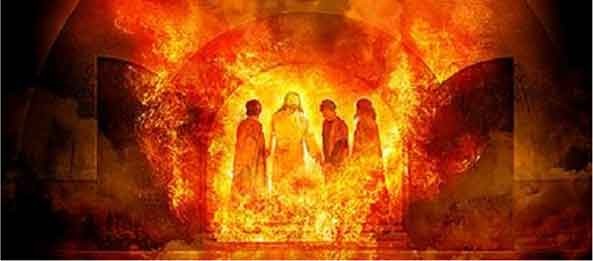
The Book of Daniel contains the acts and welfare of the Jewish people in Babylon. They are captives and so many of the stories shared here are accounts of spirituality under duress. King Nebuchadnezzar, in an attempt to unify his kingdom, proclaims himself to be a god. He commissions a 90-foot statue to be erected; he orders that, on a prearranged moment, all would fall down and worship.

Thgold statueere are three Jewish men: Shadrach, Meshach, and Abednego who are brought to the king with the charge of ‘failure to worship.’ They refused to bow at the statue at the signal. They were observed standing when everyone else was kneeling. Non-compliance to the king meant the death penalty, but that doesn’t deter the three.


Their faith will not allow them to sin in this way.

They are resolute. The first, second, and third commandments clearly forbid the worship of all idols. There were no other options. Perhaps they valued their souls more than they valued their lives. In some things, there can be no accommodation– no compromise. Standing before the king and threatened with death, they declare their allegiance to the living God.

Dan. 3:16-18:

 “Shadrach, Meshach, and Abednego answered and said to the king, “O Nebuchadnezzar, we have no need to answer you in this matter. 17 If this be so, our God whom we serve is able to deliver us from the burning fiery furnace, and he will deliver us out of your hand, O king. 18 But if not, be it known to you, O king, that we will not serve your gods or worship the golden image that you have set up.”

The king is enraged.

Few have ever spoken and defied him like this (and lived). He orders the furnace to be heated up like never before.  Here the king is making a statement. He will not tolerate this kind of ‘rebellion’ in his kingdom. All of his governing leaders will witness what he does to ‘traitors.’ These Hebrews must be made an example.

Then King Nebuchadnezzar was astonished and rose up in haste. He declared to his counselors, “Did we not cast three men bound into the fire?” They answered and said to the king, “True, O king.” 25 He answered and said, “But I see four men unbound, walking in the midst of the fire, and they are not hurt; and the appearance of the fourth is like a son of the gods”

(v.v. 24-25)

Shadrach, Meshach, and Abednego are thrown into the fire. The men who escorted them are killed by the heat. Ironically, Nebuchadnezzer can’t protect his own men from death while the three Jews are not touched, not even a little.

They are joined by a fourth man and they walk around in the midst of the flames.

Suddenly, Nebuchadnezzer realizes that the God of Israel is not only a real God, but a force to be reckoned with. The men’s faith has saved them. (And his men are dead.)

The complete story is quite compelling. The king orders all that the real God be worshipped. Henceforth, no one shall ever speak against this God. Shadrach, Meshach, and Abednego are promoted in the kingdom.

The lessons for today are many,

  1. God’s Word is to be obeyed no matter what it costs.

  2. When confronted, we must never hedge over our beliefs.

  3. God is present with us in our furnace, we’re never alone.

  4. In the fire, our faith will ultimately triumph. One way or another.

We may be standing in similar times. Faith will be tested. The Word must be believed and trusted. It is ‘comprehensive protection’ for our lives. Obedience to God will lead us into difficult places, but faith will triumph.

“When you have no helpers, see your helpers in God. When you have many helpers, see God in all your helpers. When you have nothing but God, see all in God. When you have everything, see God in everything. Under all conditions, stay thy heart only on the Lord.”

    Charles Spurgeon

Has God Given Up on You?

If we are unfaithful,
    he remains faithful,
    for he cannot deny who he is.” 

2 Timothy 2:13

There are often times of great despair; when sin or sickness is definitely front and center. Losing hope is an easy response for mere mortals like us. There can be a place where the darkness won’t lift; and it’s at that point you realize that you’re simply in over your head.

I know that feeling quite well.

I have depressive disorder and because of that I tend to camp out at the margins where it seems like the grace of God evaporates. Whether it is my sin or circumstances, I occasionally feel pretty much abandoned, and it usually is something self-inflicted. (Or is it? I’m not always sure.)

We have this glaring tendency to put ourselves in where we should not have been. And condemnation means no comfort can get through to us.

We wonder if God has finally given up on us, throwing us in the trash heap of lost souls. We might feel that’s what we deserve. He simply gives up on us.

“Many are saying about me, “God won’t rescue him.” 

Psalm 3:2

In Psalm 3, David has come to the realization that his sins have “tainted” him. He talks of many enemies that have suddenly gathered, and they are claiming that David had now gone outside of God’s grace and favor. Forever.

The theology of this seemed logical. David had sinned greatly. And he had. David’s sin of adultery and murder was heinous and depraved. His enemies suggested that God would now abandon him. It seems logical, doesn’t it.

Our own sin may be excessive, but God’s faithfulness is to the uttermost.

”Lord, your love reaches to the heavens, your loyalty to the skies.’

Psalm 36:5

The grace of God is limitless. It is beyond human comprehension or reasoning. When He committed Himself it was for forever. King David understood this, and would survive the devastating fall-out from his sins. Indeed he would reap all that he sowed (Gal. 6:7-8). But God still loved him, no matter what.

You see, Jesus has taken every ounce of your sin upon Himself.  

That includes your faithlessness. He has done this astonishing thing out of the deep depths of His love and mercy. We don’t deserve it and we can’t pretend it is something else. A heart that’s been welded to His knows this. We are “saved by grace through faith.”

Do you still feel God has abandoned you forever?

“The Lord appeared to us in the past, saying:“I have loved you with an everlasting love; I have drawn you with unfailing kindness.”

Jeremiah 31:3

Take a look at my other site: alaskabibleteacher.com. Thanks.