David Wilkerson’s Last Message

WHEN ALL MEANS FAIL

by David Wilkerson | April 27, 2011

To believe when all means fail is exceedingly pleasing to God and is most acceptable. Jesus said to Thomas, “You have believed because you have seen, but blessed are those that do believe and have not seen” (John 20:29).

Blessed are those who believe when there is no evidence of an answer to prayer—who trust beyond hope when all means have failed.

Someone has come to the place of hopelessness—the end of hope—the end of all means. A loved one is facing death and doctors give no hope. Death seems inevitable. Hope is gone. The miracle prayed for is not happening.

That is when Satan’s hordes come to attack your mind with fear, anger, overwhelming questions: “Where is your God now? You prayed until you had no tears left. You fasted. You stood on promises. You trusted.”

Blasphemous thoughts will be injected into your mind: “Prayer failed. Faith failed. Don’t quit on God—just do not trust him anymore. It doesn’t pay!”

Even questioning God’s existence will be injected into your mind. These have been the devices of Satan for centuries. Some of the godliest men and women who ever lived were under such demonic attacks.

To those going through the valley and shadow of death, hear this word: Weeping will last through some dark, awful nights—and in that darkness you will soon hear the Father whisper, “I am with you. I cannot tell you why right now, but one day it will all make sense. You will see it was all part of my plan. It was no accident. It was no failure on your part. Hold fast. Let me embrace you in your hour of pain.”

Beloved, God has never failed to act but in goodness and love. When all means fail—his love prevails. Hold fast to your faith. Stand fast in his Word. There is no other hope in this world.

cropped-christiangraffiti1 (2)


About David Wilkerson

Rev. David Wilkerson
David Wilkerson was the Founding Pastor of Times Square Church in New York City. He was called to New York in 1958 to minister to gang members and drug addicts, as told in the best-selling book, The Cross and the Switchblade.
In 1987, David Wilkerson returned to “the crossroads of the world” to establish Times Square Church. Since then, he has faithfully led this congregation, delivering powerful biblical messages that encourage righteous living and complete reliance on God.
David Wilkerson has a strong burden to encourage and strengthen pastors throughout the world. Since 1999, he has been traveling around the globe holding conferences for Christian ministers.

Websites to ponder:

http://www.worldchallenge.org/en/node

http://en.wikipedia.org/wiki/David_Wilkerson

http://davidwilkersontoday.blogspot.com/

http://www.bereanpublishers.com/Deception_in_the_Church/wilkerson_blasts_faith_pre.htm


An Armored Response

tank-wallpapers-8

When the Holy Spirit talks we listen. What He shares is usually pretty relevant, and typically mandates our action. He is into change, and guides us into Christlikeness.

In my prayer time I saw a man climbing into the turret of a tank. He was sheltered there, protected by the tank’s armor. He seemed to be discovering the capabilities of the tank. He slowly began to grasp the potential of it, and soon began to turn the massive gun. He played around, not so much as a soldier, but as a child would. It was fun to spin the turret around. He could go places on its tracks. He could run over trees.

But slowly he realized that this was much more than a shelter, but it was an offense weapon as well. The tank could be quite formidable, as well as safe and secure. Surrounded by the armor, he at last began to understand exactly what this tank was capable of, and his role as driver/gunner. Using the gun, he could go up against enemy strongholds.

We come into a certain maturity when we begin to obey. God-given tasks become a joy. We start to see not just the defensive perspective, but the offensive as well. God’s ability is given to anyone who asks. His power can’t be diminished. He alone is the force to be reckoned with.

We are often stunted by our vision, we simply don’t grasp the enormity of what has been given to us.

I also pray that you will understand the incredible greatness of God’s power for us who believe him. This is the same mighty power that raised Christ from the dead,”

Ephesians 1:18-19

“For the Kingdom of God is not just a lot of talk; it is living by God’s power.”

1 Corinthians 4:20
1brobry-sig4

cropped-christiangraffiti1 (1)

The Melancholy of Edvard Munch

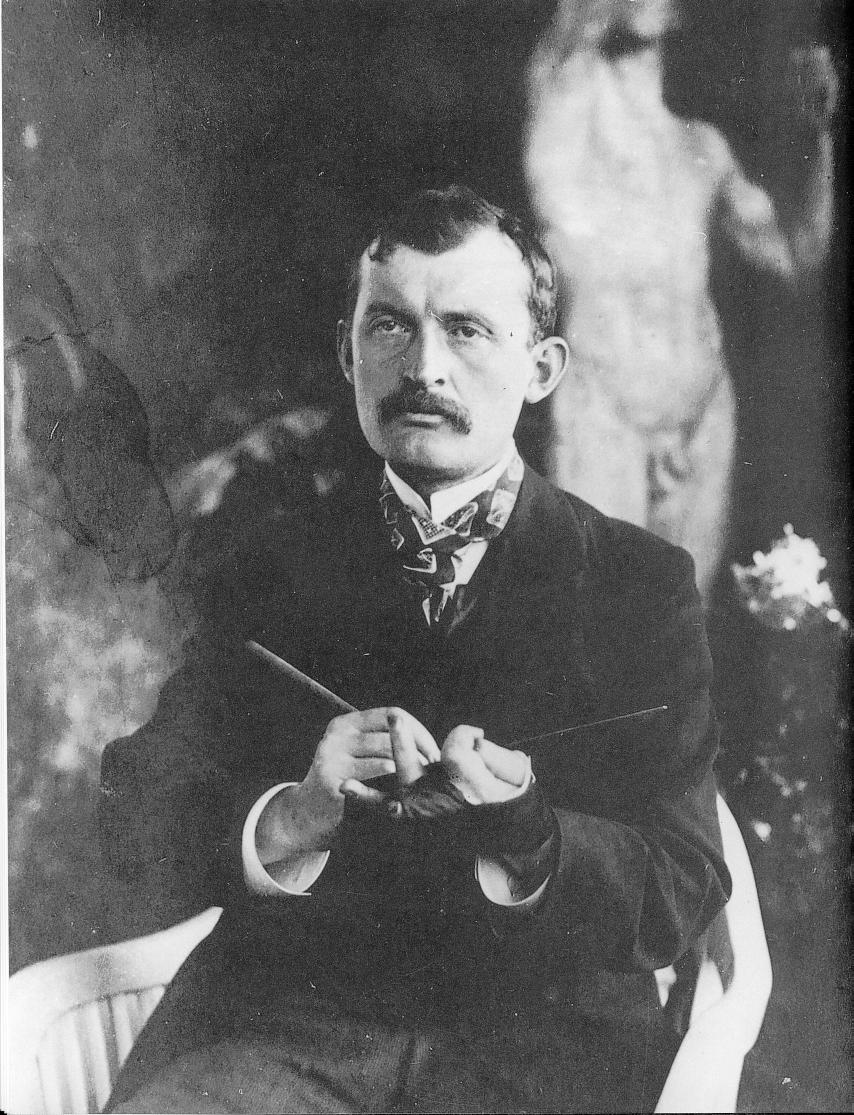
munchDecember 2, 1863 – January 23, 1944, he was a Norwegian painter. He is regarded as a Symbolist and a forerunner of expressionism. He focused on themes of fear, anxiety, melancholy, and death. He did not believe in heaven, or other Christian themes or doctrines, as far as I know.

My intention is to reintroduce you to an artist that I highly esteem.  The challenge I suppose is to understand the issues that Munch discovers in his work. He clearly taps into the ‘angst’ of the modern man, and what he does perpetuates a mindset for our generation.

Obviously these paintings are just an introduction, and I understand that they are selective. I have refrained from any kind of interpretation, other than laying down a general principle–  to Munch, color is everything.

Munch was probably not a cheery person. He essentially was driven by anxiety through his whole life. It seems that he could be very ambitious. His classic work was “The Scream” which he made several versions to sell. He used different mediums to do this– tempera, lithograph and pastel. Interestingly, “The Scream” is a favorite target for art thefts. It captures the minds of every modern thinker.

Within our culture, “The Scream” is iconic. Warhol, Gary Larson, Dr. Who and even “The Simpsons” have cashed in on a parody of it.

Quotes

“I painted the picture, and in the colors the rhythm of the music quivers. I painted the colors I saw.”

“Painting picture by picture, I followed the impressions my eye took in at heightened moments. I painted only memories, adding nothing, no details that I did not see. Hence the simplicity of the paintings, their emptiness.”

“For as long as I can remember I have suffered from a deep feeling of anxiety which I have tried to express in my art.”

“Disease, insanity, and death were the angels that attended my cradle, and since then have followed me throughout my life.”

munch-thescream
The Scream, 1893
Munch’s best known painting ^


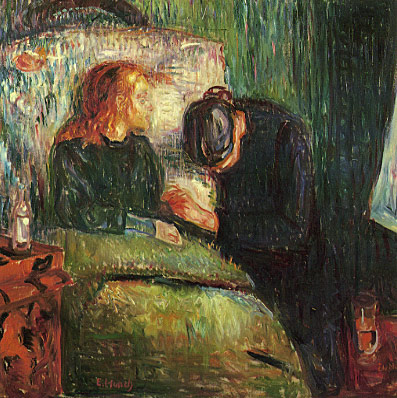
The Sick Child (1885)
Melancholy, 1894
Melancholy, 1894
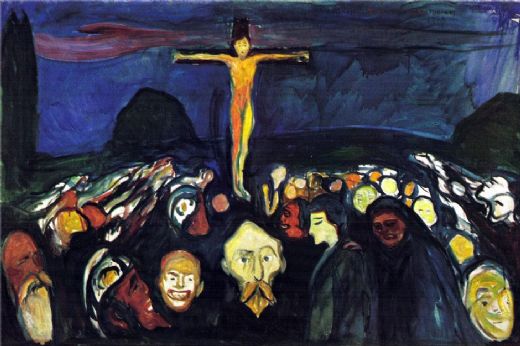
Golgotha, 1900
Golgotha