Notice Her Eyes, [Handicaps]

Stuck in the wonders of scripture we read about Leah and her sister Rachel. We see the two daughters of Laban have become Jacob’s wives. We must step into Genesis 29 to see more.

Jacob longs for Rachel. She is his “soul mate” and because he’s in love, the customs and technicalities of the day somehow get by him. Because of this, he will have to take on Laban’s subtle trickery, where daughters get exchanged, and we must sort out who is who.

Laban’s deception creates a huge crisis for everyone. 

But it seems Jacob just rolls with it. I suppose deception has always been Jacob’s strong suit. (But when we see a deceiver like Jacob gets deceived, that can’t be all bad).

But it’s Leah that I tend to think about. Her own issues are unique. Genesis 29 explains it a bit cryptically,

“Leah’s eyes were weak, but Rachel was beautiful in form and appearance.” 

Genesis 29:17

You must know that there is confusion by commentators about the “weak eyes.” Some take it literally (as in, she is very “near-sighted,”) while others who look at the original Hebrew find the words to be a bit looser and vague. They tend to think that this is a polite way of saying she really wasn’t pretty.

The text also states that Leah was “hated.”

Genesis 29:30-31.

She is wounded, and life requires that she live as unwanted. She is a woman of tragedy and broken hopes and dreams. She will always live as a reject. At best, she will always be a distant second, and perhaps a bit scorned and neglected for this.

I conclude that Leah is the champion for the challenged.

I love Leah and I think I understand her. Her life is a long tragedy and very full of sadness. For the next 30-40 years she will always be a cast-off, someone who has been broken on life’s bitter vagaries. She’s a fellow struggler, and a survivor.

Her sad life is comparable to us who have to fight so hard over our own illness or handicaps.

She must’ve been challenged by her terrible weakness. I understand this. My own life has been “topsy-turvy” and a really hard struggle. Somehow it seems we must work through these things way too much.

It doesn’t seem fair. 

For those of you who are confined to a wheelchair, or must use a cane, or who deal with a physical or mental illness. Leah should be our hero. For those who have been betrayed by addiction, or who have felt rejected through a bitter divorce– Leah speaks to us.

She is for every loser and for failures of all stripes. But through all of our setbacks and messes, we must realize that God does love us– even as we weep.

We may have Leah’s eyes, but we also have His grace.

I have a new site at alaskabibleteacher.com.

Under Quarantine

quarantine

Quarantines are a real possibility, even to this day. A quarantine is imposed when a disease is contagious enough that it would harm a society: Measles, Smallpox, and the recent COVID-19 are just a few physical diseases where isolation must be imposed.

It can be severe— an epidemic, with desperate consequences if not adhered to; in some rare cases, the use of deadly force has been authorized to maintain a quarantine until the disease is no longer communicable.

This may surprise you, but there are examples of ‘quarantines’ in the Bible.

The term ‘unclean’ was used for ‘leprosy.’ Those afflicted had to isolate themselves; they had to ‘announce’ their presence when in contact with society. Lepers lived in groups away from the general populace, as a result of their disease.

In Paul’s epistle to the Corinthians, he addresses another kind of ‘quarantine.’ The situation was dire; the church had advocated a Christian living with his father’s wife.

“I have already passed judgment on this man in the name of the Lord Jesus. You must call a meeting of the church. I will be present with you in spirit, and so will the power of our Lord Jesus. Then you must throw this man out and hand him over to Satan so that his sinful nature will be destroyed and he himself will be saved on the day the Lord returns.”

1 Corinthians 5:3-5, NLT

Understanding the Principle of Usefulness

Now in a large house, there are not only gold and silver vessels, but also vessels of wood and of earthenware, and some to honor and some to dishonor.”

2 Timothy 2:20, NASB

Found in God’s pantry are lots of pots and pans of various uses.  Paul writes Timothy about the ‘large house’ which is the Church inclusive. Look around Timothy, there are gold ones, and there are silver ones. They have a noble purpose fitting for such a great house. These are the ones the guests will use; they befit the significance of the Lord himself. These vessels have great value for they are made of precious metals.

There are vessels of different categories. These are the ones made of wood, and of clay. These are part of the household, make no mistake about it. But their use is one of function, they’re utilized in common and ignoble ways. (A clay ‘bed-pan’ perhaps?!)

21 “Therefore, if anyone cleanses himself from these things, he will be a vessel for honor, sanctified, useful to the Master, prepared for every good work.”

2 Timothy 2:21

Paul, the author of the New Testament doctrine of grace emphasizes the place of personal holiness. We are to ‘cleanse’ ourselves to become a vessel of honor. There is good news here:

  • All are vessels in the Father’s house. Each of us belongs to Him. He alone determines their use.
  • Things are not yet in their final state. Changes in status can be experienced. In God’s economy, clay pots can become ‘golden.’ Silver can become ‘wood.’

Some sin is contagious.

It affects believers, and the Church becomes compromised by what we’ve done. And then sometimes we are quarantined by the Holy Spirit–until the contagion passes. This spiritual disease must not be permitted.

I have experienced this several times in my own discipleship. These are not pleasant times, but there is no condemnation. I’m still His servant, His love for me stays outrageously constant. He has never turned away a sinning child who repents of their sin.

“Yes, I am His servant, but I must wait out in the hall. I haven’t been faithful. So I sit in His waiting room, waiting for His call. This is for my good. And my Father knows what is best.” 

Taking Your Next Step

J.R. Miller
(1840 – 1912)

“At some point in the Alps, the guides warn tourists not to talk nor sing, nor even to whisper, lest the reverberation of their words in the air may start an avalanche from its poise on the mountain, and bring it down upon the villages and homes in the valley. There are men and women who are carrying such loads of duty, anxiety, or sorrow—that the slightest addition to the weight would crush them. They are battling bravely against odds.

They are holding out under great pressure, sustained by a trembling hope of getting through, at last, successfully. They are bearing up under a burden of difficulty or trouble, comforted by the expectation that in the end—their darkness will turn to light. But everything is “in the balance”.

Then along comes one of these gloomy discouragers.

He has no perception of the fitness of things. He lacks that delicate, sympathetic feeling which enables men of a finer grain and a nobler quality—to enter into the experience of others and put strength into their hearts. He discovers the trouble through which his friends are passing. But instead of speaking a word of cheer to help them to be victorious, he talks in a pessimistic or disheartening way which makes their difficulties seem greater, their burdens heavier, and their sorrows altogether hopeless!

It is hard to be patient with such people, for they are really enemies of human happiness!

They make life immeasurably harder for everyone they meet. They take the brightness out of the sunniest day; the blue out of the clearest sky; and something of the gladness out of the happiest heart. Then they make work harder for every toiler—and pain keener for every sufferer! There ought to be a law making it a crime—for one man to discourage another, and affixing severe penalties to every violation of this law!

How much better it would be—if instead of being discouragers, we would all learn to be encouragers of others! The value of words of cheer is incalculable!

There is an old story of a fireman who was climbing up a ladder amid smoke and flame, trying to reach a high window—to rescue a child from a burning building! The man had almost gained the window—but the heat was so intense, and the smoke so blinding, that he staggered on the ladder and seemed about to turn back. The great crowd below was watching him with breathless interest and, seeing him waver and hesitate, began to “cheer” him! This nerved the fireman anew for his heroic task, and in a moment the brave fellow had entered the house and soon returned, saving the child. It is ‘cheer’ that people need, not discouragement, when they are fighting a hard battle!

Men who give us only their doubts and fears, are misanthropists. True philanthropy brings us hope and heartening. The truest helpers of others—are those who always have words of exhortation and inspiration to speak, who always are encouragers.”

“I would go to the deeps a hundred times to cheer a downcast spirit. It is good for me to have been afflicted, that I might know how to speak a word in season to one that is weary.”

 Charles Spurgeon


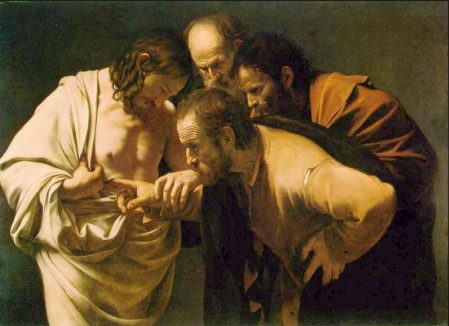
OMG! He Just Walked Through the Wall

Luke 24:36-43

Sometimes in a story, you get a vivid sense of what is really happening.  Luke’s account ignites that in me.  With the flair of the dramatic– Jesus, freshly resurrected from the dead, bursts into the room and he scares the bejeezus out of everyone. 

I guess it was one of those times when you just had to be there in order to really get it.

“Frightened” and “terrified”–it takes two words to describe this unearthly experience. 

Not only that, but they got real freaky, after all, He had to be a ghost!  I can only imagine their fear at that moment. I think everyone present bolted to the door.  But wait for a second!  “The door is still locked?! OMG, what has just happened?”

We see Jesus [I think he was lovingly amused] point out that he was still a human being–look at me!  Think for a second, have you ever tried to get a pet dog, who is so scared he’s peeing on the floor, to come to you?  I see the disciples kind of half crawling, stooped, and very unsure about this. 

They slowly encircle Jesus and as they come, I have to believe He’s laughing. He has returned from the dead. And they have no idea!

He is laughing from the pure joy of one who has endured the worst of a very real hell.

Jesus has come out on the other side, intact and fully real. I suspect Jesus is reveling at the moment, and he is among friends whom he loves and vice versa.  He is alive, he has done the impossible, and I can only imagine everyone is laughing and crying at the same time!

I believe each of us has walls. 

These borders give us security and protection. We feel we have to have them, or else. They protect us. The disciples feel like there’s security in numbers and safety in their walls that protect them. I can relate.

But Jesus insists on penetrating our walls.  

Suddenly we come face-to-face with the dead one who’s now alive. The crucified man now lives! Everything has changed.

It is the resurrection power–the most powerful force in the universe, more intense than the sun, or a nuclear reactor. It’s funny, when Moses prostrated himself before the Lord’s glory, he changed.  Not only that, but he had to take precautions to cover his face when he returned to camp. These disciples however have just seen the glory of God first-hand.

As broken believers, we must be prepared for any eventuality.  Jesus can and will burst into our homes, and into our very lives.  Can you hear him laugh? Can you see His joy?

When he comes, nothing really is the same again. He loves his disciples too much to leave them in a dark stuffy room. The resurrected Jesus is coming for you!