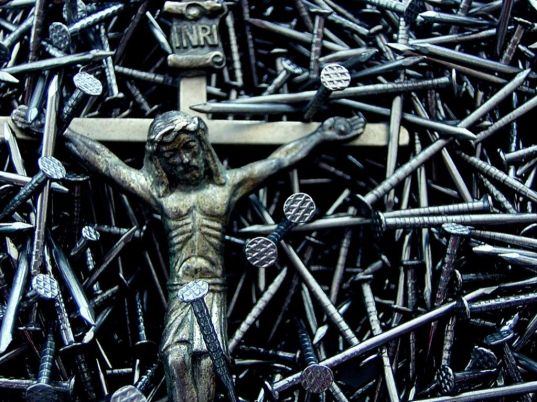
Going Crossless

We are a bucket full of nails,

“Whoever does not take up their cross and follow me is not worthy of me.

Matt. 10:38

“Then Jesus said to his disciples, “Whoever wants to be my disciple must deny themselves and take up their cross and follow me.”

Matt. 16:24

We can so easily process our faith to something respectable and somewhat pleasant.  This is a natural tendency. But the cross has a stigma, we might think we can easily defuse it, rendering it as harmless.  Acceptability is a wonderful thing to the modern day believer.  It is easy to turn from all that would make us different, and grasp a crossless faith. It does seem we conform rather than transform.

Effort is being made right now to twist and nullify your belief in Jesus.  It is a force that works on us, relentlessly.  Satan intends to destroy you. He is frightened by the power of the cross, and the spiritual truth it contains. The cross (and resurrection) destroyed the devil’s kingdom of twisted darkness. He will never recover.

Just as Jesus carried the cross He was to die on, you and I are to follow His example.  Jesus had to go to this place of death, and so are we.  My cross is not purely emblematic or abstract symbolism.  It entails a real death.  I pick it up and go to die.  Crucifixion is the end of me, it all comes down to this final point of termination.

Jesus escorts us to the point of death.  This is to become the framework for a sincere discipleship.  The cross, our cross, brings us to an end.  To be worthy of Jesus is to bear it boldly.  The cross develops into our thinking, and its dynamic pounds us into a spiritual reality.  Jesus intensifies the cross, making it the mark of authenticity of a disciple.

We have no options, if we follow it must be with a cross.  There is absolutely no room for us if we approach Him without it.  The cross transmutes our lives, and transmits a signal that we have complied with Jesus’ wishes.  If we advance at all, it will be through the cross only.

We must deny ourselves.  That denial is an intense working. “I do not know the man” was Peter’s statement against Jesus.  If we deny ourselves, we will take a stand against our own selves, turning against ourselves.  We will be pinned to the mat.

Our focus should be on the cross.  We must infuse it into our lives.  A tea bag will flavor an entire cup.  It turns a cup of boiling water into a wonderful beverage.  The cross that belongs to us will have the same effect.  It will make something where there was nothing.

“All heaven is interested in the cross of Christ, all hell terribly afraid of it, while men are the only beings who more or less ignore its meaning.” 

 Oswald Chambers

aabryscript


A Finder’s Fee of Joy

New Testament 3 Production Still Photography Tax collectors and other notorious sinners often came to listen to Jesus teach. This made the Pharisees and teachers of religious law complain that he was associating with such sinful people—even eating with them!” (Luke 15:1)

“If a man has a hundred sheep and one of them gets lost, what will he do? ” (v. 4)

“Or suppose a woman has ten silver coins and loses one.” (v. 8)

“For this son of mine was dead and has now returned to life. He was lost, but now he is found.’ So the party began.” (v. 24)

flourish10

The lost sheep, the lost coin, and the ‘lost son’ tell us that this is a time for recovery. This is a unique period for the Church. It is a season of special grace that allows us to seek and find things that are valuable to us. It is a time of finding out things about ourselves as well.

What is precious to you? With the woman, it was a lost coin (probably a part of her dowry) and she made a substantial effort to get it back. With the shepherd, what was valuable was a lost sheep, and he would take a calculated risk to find it, and rejoin the flock. And the father lost his son, and he had to wait for him to return to his senses.

These three parables were directed to the different issues that effected the “notorious sinners.” But they also spoke to the pharisees who were present. Both groups understood and there were plenty of implications for everyone.

It’s a funny thing, Jesus never minced words. No one could be neutral around him. That is still the case today. I think God is seeking His lost children. This is what He is up to, this is His passion. Understanding this salient fact should enlighten us,

  1. to His will,
  2. to know His passion and love, (His pleasure in finding what was lost)
  3. and the true purpose of His Church.

As the Parable of the Prodigal Son develops, we see the pharisees equated to the ‘grouchy’ older brother. He begrudges his newly returned brother, and he really can’t see what is happening all around him. The idea of grace eludes him. Perhaps that is far more common than we think. Whenever ‘religion’ exerts control over a person or group, duty is almost always elevated over joy.

The Church is only as relevant as when it’s seeking out the lost.

The Church is meant to extend to the lost ‘sons’ of Adam, and the ‘daughters’ of Eve. This is God’s passion, and we must find out what He wants us to do to share His heart. It’s almost as if He wants to give us a chance to taste His joy.

aabryplain


The Intensity of God’s Glory

When Moses went up on the mountain, the cloud covered it.16 The glory of the Lord came down on Mount Sinai, and the cloud covered it for six days. On the seventh day the Lord called to Moses from inside the cloud.17 To the Israelites the glory of the Lord looked like a fire burning on top of the mountain.18 Then Moses went into the cloud and went higher up the mountain. He was on the mountain for forty days and forty nights.

Exodus 24:15-18

flourish20

When we think real hard about ‘glory’ we end up gravitating to something that is invisible.  We work it out and it becomes something like honor, prestige, fame or respect.  This is a good start for us, and we do benefit from this sort of mental gymnastics.

Moses gets an invite from God to join Him on top of Sinai.  I can see Moses trembling with excitement as he climbs up into the Glory of God.  I’m willing to guess that the concept of just mere ‘invisible’ attributes was about to go through a major overhaul.  Moses entered the glory.  And nothing would ever be the same again.

Glory is a repeated experience that touched the children of Israel. 

  • First of all, during the Exodus they were led by a pillar of cloud and fire.  It protected and provided all that they needed.  All they had to do is look up.
  • Secondly, God’s glory took residence on Mt. Sinai.  There was much to do.  The Israelites commented that this glory altered the mountain top to ‘a consuming fire’.  I have been in a forest fire and it was quite intimidating; frightening is a very good description.
  • Thirdly, we see the glory of God is at the dedication of Solomon’s Temple.  We are told that the presence of God was so powerful that it temporary incapacitated the priests that were present.  It totally undid them and it laid them out on the floor (1 Kings 8:11).
  • The fourth time we see the Glory of God was at the Transfiguration in Luke 9:29-31.  Three disciples were present, and inexplicably Moses and Elijah.  But it was Jesus that took center-stage.  He seems to be the ‘focal point’ of lots and lots of glory.

I’m coming to see that glory is a whole lot more than esteem or honor.  Glory has a bolder and more intense quality about it.  Yes, it is respect and honor.  But it goes beyond this–it seems to be turbocharged with the supernatural.  I have been in revival meetings that were quite glorious. Perhaps we need to seriously look for or anticipate more of these “disturbances of glory.” (I’ve been saving this verse for the end.)

Our faces, then, are not covered. We all show the Lord’s glory, and we are being changed to be like him. This change in us brings ever greater glory, which comes from the Lord, who is the Spirit.

2 Cor. 3:18, NCV

We are simply ‘display cases’ that take in His glory and magnify it through our humanity.  It changes us to become more Christlike, and this verse seems to suggest that this keeps increasing, it doesn’t fizzle out.  And I’m thinking that this is tremendous!

aabryscript

The Pruning Knife

“He cuts off every branch of mine that doesn’t produce fruit, and he prunes the branches that do bear fruit so they will produce even more.”

John 15:2, NLT

In order to become fruitful we must accept the knife. 

It takes a sharp eye and a sharper knife to do the Father’s work of cutting.  He slices to the quick, and all that is not useful falls to the ground.  The vine will produce grapes, and every bit of “grape-energy” will be used productively. Fruitlessness will be cursed, and sterility is condemned.  It takes a decisive heart, as well as a wise hand to prune God’s own vineyard.

Fruitless believers may become fruitful ones.  Understand, the vine dresser does not attack the vine.  He is not malicious or vengeful.  All that He does is for the good of the vine.  He is motivated to produce fruit.  That is what He thinks about; you could say that He is preoccupied with that singular end.

Pruning and fruit are concepts that we vacillate over, some days we understand and other days we blow it off.  After over 30 years, I’ve heard every “John 15 sermon”.  And most of the time I turn down my spiritual hearing aid. That is tragic, and shows my heart has become hardened.

I need to come on board with this particular imagery.  For years I have asked God to “show me His ways”.  I’d like to believe that this understanding of pruning has changed me.  I would like to think that I have attained a clearer view of wisdom.  This pruning business is all well and good.  But being sanctified by the knife is decidedly unattractive and uncomfortable.

You must be pruned; pieces of your life are earmarked to be lopped off.  (I always wonder if the trees that are spray painted are curious over the why and the when they are to be cut?)  In regards to being fruitful we must accept the knife.  If we want to be holy and conform to the image of Christ we will be cut.  There is simply no other way.

aabryscript