A Sound Mind

2-Timothy_1-7

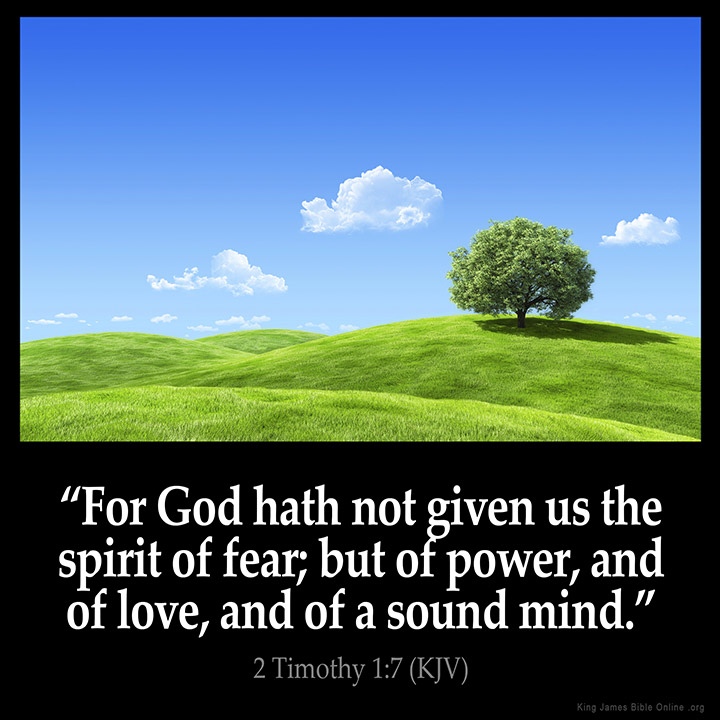
“A sound mind.” For some of us that doesn’t seem remotely possible. We’ve come to believe this is only true for others, maybe, but not me. As mentally ill people we seem to think that we shouldn’t be this way. Given enough time our illness becomes fused to our spirit and soul. We buy the lie and choose to live defeated. Only the Lord Jesus can break this chain.

Healthy thinking is a wonderful gift. That’s important to note. I can’t earn it; nor can I fabricate it. It must be simply acknowledged and received as a bonus. We must come humbly and broken. I suppose that is where we become the happiest and healthiest.

In 1 Timothy 1:7 we’re told that we have a salvation that includes:

  • incredible power,
  • love,
  • and a sound (healthy) mind.

These three are a gift from God. You don’t buy a gift, nor do you earn it. Rather it comes from Someone who loves you (!) and only wants to restore you. We may have issues, but the Spirit is sound and lucid. He speaks so we understand.

Afflicted people will find what they need from the Holy Spirit of God. Mental illness isn’t a death sentence. Rather it’s a grand opportunity for God to teach us about His power in the middle of our pain.

The healthy mind is one that is clear and life-giving. It is without any sick or crippling deficiencies. It’s a mind that is vigorous and robust. Those of us who struggle with a mental illness this is fantastically good news. And it maybe that you’re certainly impaired but even then you’re given a strength to use in service in the body. Everyone has a gift and calling.

There is nothing worse than fighting through muddled thinking when you’re having mental issues. Names, dates and memories disappear in the fog. It can be frightening. I know what it’s like to be afraid of one’s own mind. It seems like it’s trying its best to kill me. (Some of you can ‘read-between-the-lines’ and understand exactly what I am saying.)

My own experience is that the Holy Spirit is working, with my meds, to hold me in a good place. Just as a diabetic must take insulin, so I need to take my antidepressants. The brain is an organ that can get sick also. We live in a fallen and broken world. We are human and therefore vulnerable just like anyone else. (Somehow, we imagine better.)

Grace does heal many, but there are some who will find ‘weakness’ becoming their real strength.

The very presence of the Holy Spirit is what enables. Broken believers are coming to see that their illnesses are helping them to be weak enough for God to use. It’s not how strong you are, but it’s how weak. “It is not that we think we are qualified to do anything on our own. Our qualification comes from God,” 2 Cor. 3:5, NLT.

bizen-kintsukuroi-tea-cup-1 (1)

“When the Japanese mend broken objects, they aggrandize the damage by filling the cracks with gold [‘kintsukuroi’]. They believe that when something’s suffered damage and has a history it becomes more beautiful.”

–Barbara Bloom


Walking This Broken Road by Faith

credit: www.internetmonk.com

     David Wilkerson

In one of my early blog posts at lindakruschke.wordpress.com, I was lamenting that remembering my past made me a little blue, because I had regrets and things have happened to me that were less than wonderful. But I have been reminded that I am who I am because of my history.

A week later I was listening to the CD  Stay by Jeremy Camp in my car alot. One of the songs on that CD is called Walk by Faith, but all week I really haven’t tuned into that song even though it is the one I really needed to hear. Then one night I was listening to my iPod while I was making dinner, and had it on shuffle of my Christian Music playlist. This is something I hadn’t done for awhile – I had listening to the Oldies playlist or the Sad Heartache Songs playlist instead. I started out that night listening to the Grunge playlist, but it wasn’t helping my mood at all (now that’s a big surprise, not).

It just so happened that the third song to play on the Christian music playlist while I was chopping veggies for homemade chicken noodle soup was Walk by Faith. The chorus goes like this:

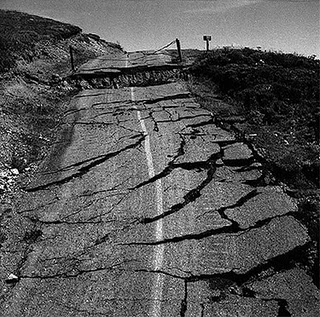
As I heard those words, I realized that the broken road I have traveled (and don’t we all travel a broken road of some kind?) has made me who I am. It has taught me love, compassion, empathy, and, most importantly, faith.

If my life had been perfect and easy, with no pain and heartache, first of all I wouldn’t be human. But secondly, I would be a different, perhaps shallower person. I might not even be happy.

So I have decided not to lament or regret my past.

I needed to see it for what it is: the broken road that has prepared me to be the person God wants me to be to those around me. Because ultimately, those around me have traveled a broken road too. And sometimes it is a very similar broken road so that we can relate to each other’s journey. Maybe, as I walk that road by faith, I can help others to walk by faith, too.

Besides, without the lessons learned on my broken road I would have nothing but fluff to write and my blogging would have no purpose.

Have you been walking on a broken road?

Have faith that God will use your experiences to make you the person He has planned for you to be so that you can be a blessing to others walking that broken road with you.

Linda K.
anotherfearlessyear.net

Straining at Your Oars

“He saw the disciples straining at the oars because the wind was against them.”

Mark 6:48

It’s good to know that Jesus sees our labor.  He truly understands all that concerns us, and he understands every issue that concerns us.  Attentive and keenly aware He comes to our boat.  It’s quite common for us to think that he isn’t aware, and we may feel that He’ll pass us by without a word.

Jesus watches over us all the time. 

He knows all about our battles, the fight we have with our flesh, the difficulty we have with the challenging people in our lives. I often struggle to steer my boat. Jesus knows when and why I labor like I do.  And He doesn’t condemn me.

The disciples were straining hard to keep the boat afloat. 

Every oar was being used and every man had his seat.  They must work together.  Some were frantically bailing, and a couple gripped the tiller. A lot of effort was being expended but nothing was working.  The wind continued to push harder against them. 

This is really quite perplexing.  If you remember, they’re simply trying to obey the command of Jesus to cross the sea. They were being obedient, and yet they were starting to sink.

Why do things have to be so difficult?

I’m intrigued by believers who expect sunshine, blue sky, and red roses just because they are doing God’s will.  They don’t seem to think through the issues of conflict and challenge, weakness and humility. That’s not how it’s suppose to work.

“It is necessary to go through many hardships to enter the kingdom of God.”

Acts 14:22

Doing the will of God will often mean that there will be a headwind directly at us.
 

The seas will become impossible, and we may even be driven back.  But special comfort comes when we realize we’re being watched.  Jesus is doing constant surveillance on us, and He sees our toil on the oars. And then He comes to us, walking on the water.

Even in our storm, our hearts should trust and rejoice.

“Lo, I am with you always, even to the end of the age”

Matthew 28:20

Defining Depression

There seems to be three distinct varieties of depression. 

I’ve thought about this for some time now, and I’m coming to the point where I want to share.

1)  There is a depression that comes from guilt

There’s a corrosive place that eats us up, it’s where we sin, and continue to sin.  We fully understand our guilt and our sin.  Sin, will always will stain us.  Banks will often place “dye packets” into stacks of money.  A robber grabs the money, only to find that something explodes on him.  He then, is marked indelibly.  There isn’t anything he can do; he has been stained.  The following verses explain this dynamic.

“When I kept things to myself,
       I felt weak deep inside me.
       I moaned all day long.
4 Day and night you punished me.
My strength was gone as in the summer heat. 

5 Then I confessed my sins to you
       and didn’t hide my guilt.
    I said, “I will confess my sins to the Lord,”
       and you forgave my guilt. “

Psalm 32, NCV

2)  There is a depression that is organic. 

It simply resides in us as if it were eye color, or a talent to play music.  This type of depression is hard wired in us.  It is just a natural inclination, or propensity toward melancholy.  We typically gravitate toward a negative outlook.  We are not ‘a cheery lot.’  The glass is always half empty, and that is our certain perspective.

Some have diabetes, and others are deaf.  We have been saddled with certain issues.  We did nothing to warrant such challenges.  They are just the part and parcel of the human condition.  We need to see our depression as sort of diabetes of the emotional world.  Very often we will need to take meds to restore our sense of balance and wholeness. Sometimes all we need is to rest, as fatigue can become a serious issue.

3)  There is a depression that is reactionary. 

We find ourselves responding to trials and difficulties, and they just overwhelm us.  Persecution and attacks slam into us, and our reaction is to hide, or shut down.  Paul had to endure major attacks. This ‘depression’ is found in situations and issues. It can come about by Satan or ungodly authorities.

We will respond to the death of someone close, loss of a job, bankruptcy or whatever–you can fill in the blank:_________________________. But we must remember, if there is a way in, there must be a way out. If we can only put some trust in God, we can believe he will lead us out. Eccl. 3:1-8 describes “seasons” that every person goes through. Perhaps, this is just a time?

“So we do not give up. Our physical body is becoming older and weaker, but our spirit inside us is made new every day.17 We have small troubles for a while now, but they are helping us gain an eternal glory that is much greater than the troubles.18 We set our eyes not on what we see but on what we cannot see. What we see will last only a short time, but what we cannot see will last forever.”

2 Cor. 4:16, 18, NCV

Summary

As we look at ourselves, we can determine which of the three kinds of depression that we’re facing.  It seems we can have all three working in our lives.  But it’s very helpful to find our particular variety, or our certain inclination.   Seldom will we identify with just one ‘type’, as all three can be working at once. Understanding the three will hopefully give us a definite advantage.

We can ask ourselves: Is this depression coming from sin or guilt?  Is this something organic or ‘hardwired’ in me?  Could it be that I’m reacting to the evil that is coming at me so fast?  Distinguishing between these three can be very useful, and direct us as we build our discipleship.