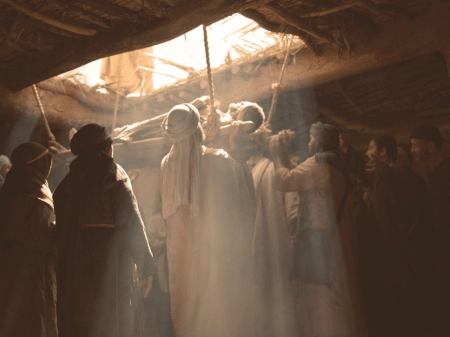
“They came, bringing to him a paralytic carried by four men.4 And when they could not get near him because of the crowd, they removed the roof above him, and when they had made an opening, they let down the bed on which the paralytic lay.”
Mark 2:3-4
In this Gospel story recorded in Mark 2:1-12 we read of the four friends who brought the paralyzed man to Jesus. What a privilege it is to carry those we love to our Lord for His healing presence to surround them.
Their simple faith is what we are called to. “Paralyzed” people are waiting for us to only act. If God gives us eyes to see, we will see them.
I was inspired to write this simple poem as I thought about this man and his friends. I hope it blesses you.
Let Me Carry You
You lie alone broken and weak Unsure if you will make it through Seeing a future dark and bleak To Jesus let me carry you
Your daily troubles set in stone Seem heavy with unchanging hue And though you think you’re all alone To Jesus, I will carry you
You struggle to remember love Ev’ry feeling painfully blue I will bring God’s grace from above To Jesus let me carry you
“Thank you for making me so wonderfully complex! Your workmanship is marvelous—how well I know it.”
Psalm 139:14
“God is not a duplicator, He is a Creator. You are an original.”
-Reinhard Bonnke
The Bible states many wonderful things. One of them is that we are created in the image of God, and I’m quite certain that each of us are shaped completely different. I recently read that an estimated 117 billion people have lived on earth. That’s amazing; and to think we are all unique.
Sometime ago I found my Grandmother’s Bible.
I was somewhat intrigued, and I supposed that it might just ‘impart’ some special spiritual blessing to me. I sat down on the couch, and reverently opened it up. It was filled with wonderful handwritten notes.
As I sat down to read it though, I slowly began to realize that it was exactly like my own! The verses and the promises were the same, they had not changed. What was true for my grandma was true for me. That amazed me, and it kind of sent me spinning. But I suddenly started thinking.
Each of us struggles differently.
We endure depression, PTSD, schizophrenia, even suicidal thoughts. We struggle with different addictions and lonely divorces. There are those believers who are epileptics or disabled. There are some of us who have been raped or molested. I have a paralyzed right arm, and am typing this with my left hand. I also struggle with depression and anger.
Each of us are the same in a basic sense, and yet we are all distinctly different. We all have gone through things, some good, some quite awful. These issues are uniquely our own. Our “personal” testimony with God is unlike someone else’s. We respond to our different circumstances in different ways.
We are “snowflakes’ that have been artistically crafted. Our circumstances are individually tailored by God, who is the ultimate Artist. I opened this post with the idea that God creates “snowflakes,” and I’ve been told that every one of them is unique.
I do believe that when we stand before God we will all have these fantastically different stories. Each of us have found forgiveness, mercy and grace that the Lord freely gives us. As “grace-walkers” our life can be mixed with His love, filtered through a myriad of circumstances.
And they mix exceedingly well.
Reading the Word we must realize that each man or woman who walked with God had a different story to tell. We rightly consider them in amazement. And yet none of them knew they were special at the time, all they understood was “the daily grind.”
We can trust Him. We slowly begin to see, and understand, that there are implications of being ‘snowflakes.’ God took Joseph and ‘molded’ him by His unique circumstances, he went from prison to the Prime Minister overnight. Each of us has testimony of His incredible care.
“People are special, and human life is sacred, whether of not we admit it. Every person is worth fighting for, regardless of whether he is young or old, sick or well, child or adult, born or unborn, or brown, red, yellow, black or white.”
“As they pass through the Valley of Baka, they make it a place of springs; the autumn rains also cover it with pools.”
Psalm 84:6 (NIV).
“When they walk through the Valley of Weeping, it will become a place of refreshing springs. The autumn rains will clothe it with blessings.”
Psalm 84:6, (NLT).
In Hebrew, the word “baka” means tears.
In Psalm 84, the sons of Korah write their praises of God and note that those whose strength is in the Lord will travel through the Valley of Baka and find His peace there. For some of us that Valley of Tears seems never-ending, but we must remember we are not alone in it.
I wrote this poem to remind myself of that truth. I hope it blesses you as you pass through the valley of tears, too.
My Valley of Tears
My Savior will dry all my tears The Lord God knows all my fears As I trudge onward many years I pass through the Valley of Baka
Great pain and agony oppress I feel heavy weights of duress Praying for dear Jesus to bless I pass through the Valley of Baka
I see that this valley is long I need You to make my faith strong That Lord I might sing a praise song As I pass through the Valley of Baka
God’s people have always had to wrestle with the things from the dark. As believers, the Bible tells us that we’re in a permanent state of war against Satan. There has never been an armistice or treaty signed to my knowledge. Each one of us is on the front lines. The devil has been practicing with a deadly form of “spiritual terrorism.”
The Holy Spirit allows us to experience a small portion of the battle to strengthen our faith and dependence on Him.
Satan’s lies are hollow. Jesus has completely defeated him. Yet the enemy terrorizes many withhis posturing and manipulation.
The promises found in the Word are our weapon against the devil’s lies.
Unquestionably, life can get quite dark and desperately bleak. No one needs to educate us about the dark nightmare that is now active. Over a couple of millennia, God’s covenant people have been harmed and harassed. Enemies are constantly manipulating and twisting God’s Word. As disciples, we’re under steady surveillance by the dragon.
Sometimes heaven is silent. But I believe it is never, ever disinterested or unaware.
And He certainly has not overlooked us. As we read our Bible, our faith becomes like strong Teflon. Nothing can stick–even though so much is thrown at us. When life is really dark or terribly bleak, we can protect ourselves and others. There will be times when we can sense nothing.
“Therefore, since we are surrounded by so great a cloud of witnesses, let us also lay aside every weight, and sin which clings so closely, and let us run with endurance the race that is set before us.”
Hebrews 12:1
We’re not theologians, we are just simple disciples. The Lord knows this. I believe He simplifies things in order to help us understand. God has little reason to complicate things for us.
“We are afflicted in every way, but not crushed; perplexed, but not driven to despair; persecuted, but not forsaken; struck down, but not destroyed;“
2 Corinthians 4:8-9
There is genealogy of the Spirit. If you’re a believer you have a spiritual lineage that includes Joseph and David and Esther. There is a real connection with the faithful. Your spiritual ancestry is now godly and victorious.
I believe that I’m “surrounded” by saints of all ages. And I must admit, that helps me. I am part of a continuum. My faith in Jesus has given me a definite link to all the saints that have gone before me. I’m part of God’s chain of faithful believers. (Hebrews 11:4-38.)
But now the torch has now been passed, and now I must run with it faithfully and honestly. And when all is so dark, and things seem far too quiet, I still intend to hold up that torch and carry it all the way to my Father’s house.
“Consequently, heisabletosavetotheuttermostthosewhodrawneartoGodthrough him, since he always livesto make intercessionfor them.“