
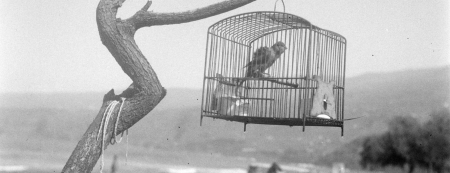
Christians in Cages

Psalm 124

We can play “the what if game.” We can think backwards, and hit replay, and pretend alternate realities. What if, I didn’t join the army? What if I died on that last drunken binge, choking on my own vomit? What if I would’ve died on that last suicide attempt?

David asks an enormous “what if” in Psalm 124:1-2

He poses this question. He wants Israel to understand what he is saying. He asks the people to repeat after him. He then re-frames the question in verse 2. “What if God had not stepped into the situation?

David insists that his listeners think this through.

And this trip down ‘memory lane’ examines what would of (or could have) happened if God would have simply taken His hand off Israel as a nation.

I truly believe that we should do the very same today. Just pause to reflect on His grace and care. Simply try to understand that it was God’s hand holding you in place all along. All that He does for us is very good.

There is also can be a sense of being overwhelmed by your enemies.

The malevolent forces of the enemy have a ministry. And that ministry is to ‘steamroll’ and crush out the light. Satan hates the truth and he hates you.

David is a very vivid writer, he had a fantastic gift–a great flair of choosing the best words and images. He weaves a song and we see God intervening, protecting, and preventing Israel from becoming a Satan’s snack.

Psalm 124:6-7

I love these 2 verses. “Escaped” is emphasized twice–the bird catchers have collected many small birds, snared by a little food and a strong net. They keep them in a cage. But wait! Something has just happened, and the birds have somehow escaped!

Have you been wounded inside? Do you struggle hard with depression and loneliness?

There is so much ugliness. The enemy can throw so much at us. Many of us lack the strength to resist him. We can fight and flap and throw ourselves at the bars, but we are trapped. But then Jesus comes, He smashes cages, and frees birds like us.

Verse 8 is the final thought of this psalm.

It sums up everything so wonderfully. There is help. Our Creator deeply cares for us. He has ultimate strength. Put your heart in His hands. We read the last verse…

“Our help is in the name of the Lord,
Who made heaven and earth.”

Psalm 124:8

brokenbelievers.com


Repeat Offenders

“Father, every family has a rascal someone who breaks the rules a juvenile delinquent of untold frustrations and sleepless nights a repeated offender and bearer of sad woe the problem child who needs the most discipline.

Is this why you love me most persistently? When you correct me, is it because I’m the one most contrary?

Or is it that you love me so much?”

 I wrote this thinking about Hebrews 12 and God’s purpose of chastening. I don’t pretend to understand this dynamic completely–all I can say is that my childhood was punctuated by much difficulty. But now, as a father (my two children are now grown), fatherhood has become far easier than my dad had with me.

7 “As you endure this divine discipline, remember that God is treating you as his own children. Who ever heard of a child who is never disciplined by its father? 10 For our earthly fathers disciplined us for a few years, doing the best they knew how.

But God’s discipline is always good for us, so that we might share in his holiness. 11 No discipline is enjoyable while it is happening—it’s painful! But afterward there will be a peaceful harvest of right living for those who are trained in this way.”

Hebrews 12:7, 10-11

I really think we understand our Heavenly Father when we spend quality time with Hebrews 12. We are given insight into His care and into our own issues. It is a good thing He gives us— it enriches our spiritual lives.

It’s never nice to be corrected.

It’s not pleasant. Part of being corrected is being reminded that we’re not as righteous as we think we are. To be corrected strikes us to a reprimand, an admonition that something isn’t right inside of us.

The Father corrects His children–in many ways through a myriad of circumstances. He loves us far too much to allow us to continue in our sin. He’s making us into the image of Christ.

We should welcome His correction. He has a plan for you.

When He disciplines you, it only proves that He is your Father. It’s critical to remember: God’s correction is always for our good. It may be painful yes, but it comes with real hope. It’s not to harm or punish you.

“Father, I’m so sorry that I grieve you as often as I do. I promise to behave. Thank you for being a faithful Father who cares deeply for my soul. Amen.”

 Hannah Whitall Smith.

Make the Decision to Be Weak


Our society has pretty much embraced the American cultural icon of the cowboy.  We revere those who ride alone and hard. We are rugged individualists and hardened men making our own way.  Our society reflects this in subdued ways.  No matter what happens, we are fiercely free and independent.  We are ‘desperadoes’–we do whatever we think is best.

John Wayne, the ‘Alamo,’ and the biker with his Harley-Davidson on Route 66 have been our inspiration.  Each are distinctly heroic and carry our hopes and dreams.

We must understand that the Bible is not an American book.

It belongs to every tribe, race, and nation. 

A cowboy did not die for our sins (which are countless).  The way of discipleship does not take us through Luckenbach, Texas. We’re not desperados. We are Jesus’ disciples.

His Words to us are bold and entirely challenging in an amazingly fresh and different direction.  We are told to wash feet, to repeatedly turn the other cheek, to surrender all our rights, and then take the lowest place there is in every situation.

Our lives truly begin when we come under the Lordship of Jesus Christ.

Humility is to become the way we think and how we act, we have become slaves to righteousness.  Our vaunted independence has been toppled. This selfish crown has slipped. My willfulness still wants to stand instead of kneeling. We discover this has been the truth all along.  We have never ever been in control. 

He has been the King since before time, and will always be, for an eternity.

“Many Christians have what we might call a “cultural holiness”. They adapt to the character and behavior pattern of Christians around them. As the Christian culture around them is more or less holy, so these Christians are more or less holy. But God has not called us to be like those around us.

He has called us to be like Himself. Holiness is nothing less than conformity to the character of God”.

Jerry Bridges

Our churches often struggle over our personal issues of pride and stubbornness. 

I pose the following questions.  Are we honestly in a condition of being weak?  Can you serve with a basin and towel?  Is your heart that of a child? Do we see the world through the ‘lens’ of a soft and broken spirit?

I write these things surveying my own life. 

Self will and my hard heart fit ‘hand-and-glove’ with being that desperado.  I ride alone, making my own way, and I don’t make any disciples. I jettison my cross— my cross of discipleship.  I serve no one, unless it suits me.  Am I His disciple, or am I a man of my own?  Is He my Lord, or have I decided to claim that right for myself?

I only hope I have spoken the truth today. Forgive me if I offended.

“Lord, I am willing to receive what You give, to lack what You withhold, to relinquish what You take, to suffer what You inflict, to be what You require.”  Amen.


Love is an Action Verb

When I first started writing this post in my head, before I had posted it on my blog, Linda Kruschke’s Blog, back in 2009, in my head the title was “Love Is an Action Verb.” But as I thought more about it I realized there is more than one kind of love, and that love AS as an action verb was just one – and in my opinion the best – form of love.

In our impoverished English language, we use the word love in many different ways. I love my spouse, I love my dog, I love chocolate, I love my new shoes, I loved that movie I watched last night, and I love God.

Surely we don’t have the same feelings about all of these things, yet we use the same word. In the parts of the Bible that were originally written in Greek, there are four different Greek words that we translate as love:

  • Storge – refers to the love that is felt between family members and close relatives.
  • Philia – refers to the love that is between friends.
  • Eros – refers to deep emotion or passion that is felt between lovers and spouses.
  • Agape – refers to the kind of love that God has for us and is what I mean by love as an action verb.

Agape is a kind of love that is about giving, not about getting.

God showed us what agape is by His incarnation as Jesus Christ and by His death on the cross to pay for our sins. Agape is not just a feeling, it is what God is. He acts towards us in the way that He does not because of how He feels about us, but because of who He is; because He chooses to love us with agape love.

Agape is a type of love that we can, if we choose, combine with any one of the other three kinds of love. We can go beyond how we feel about others and truly love them in the way that God loves us. C.S. Lewis put it this way in his wonderful book Mere Christianity:

“The rule for all of us is perfectly simple. Do not waste time bothering whether you love your neighbor; act as if you did. As soon as we do this we find out one of the great secrets. When you are behaving as if you loved someone, you will presently come to love him.”

Agape and Philia

A couple of years ago, I went to the beach with some old friends and had an opportunity to practice agape with someone towards whom I feel philia. Before I left home for the weekend, I received an email from one of my friends saying it would be really great if the house we were renting was all warmed up, with the water turned on and 7-layer bars baking in the oven, when they arrived. These friends had a much longer drive than I did, and she knew I would arrive at the house several hours before they did.

I can tell you that I did not feel like driving by myself at night in the pouring rain to Cannon Beach, I did not feel like hunting around outside in the wind and rain for the water valve to turn on the water, and I really did not feel like baking cookies in the gas oven in a kitchen I am unfamiliar with. But I chose to do all of those things anyway because I love my friends and wanted to make them happy. I combined the philia I felt with agape I have learned from God and received blessings in return.

Agape and Eros

In our society today a high percentage of marriages end in divorce. Often the reason cited is that one spouse doesn’t love the other anymore; that feeling they had when they met is gone. The type of love that can disappear in a relationship is eros.

Now eros is important for couples to be attracted to each other and get married, but it cannot, by itself, sustain a lifelong commitment. To create a lasting marriage, a couple must combine eros with agape. Each spouse must act as if they love the other even when they don’t feel like it or are angry or annoyed by the other spouse. A simple text to say “I love you,” a special dinner that your spouse likes, doing housework to lighten the other’s load, a hug and a kiss at the beginning and end of each day – all of these actions are examples of agape.

Who do you need to love (agape) today?

Each day we need to make a conscious effort to incorporate agape love into our interactions with those around us. Who is God calling you to love today? Don’t feel like it? As Nike would say, “Just do it.” After all, love as an action verb can be a blessing to others that is returned to you in an even greater measure than you give.

Romans 12:10

I Agape You,

Linda K

anotherfearlessyear.net