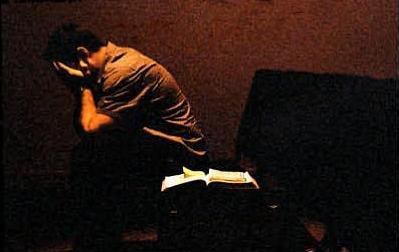
How Does Your Church See Mental Illness?

Going my way?
This should give direction and dialogue on the issues faced by every church member. It is a great opportunity we have been given— to minister to every person in the Body of Christ. —Bryan
by Ken Camp, Associated Baptist Press  —

Living with depression — or any other form of mental illness — is like viewing life “through a glass darkly,” according to Jessy Grondin, a student in Vanderbilt University’s Divinity School. “It distorts how you see things.”

Like one in four Americans, (25%), wrestles significantly with a mental illness.

Depression is one of the most common types of mental illness, along with bipolar disorder, another mood-altering malady. Other forms of mental illness include schizophrenia and disorders related to anxiety, eating, substance abuse and attention deficit/hyperactivity.

Like many Americans with mental illness, Grondin and her family looked to the church for help. And she found the response generally less-than-helpful. “When I was in the ninth grade and hospitalized for depression, only a couple of people even visited me, and that was kind of awkward. I guess they didn’t know what to say,” said Grondin, who grew up in a Southern Baptist church in Alabama.

Generally, most Christians she knew dealt with her mood disorder by ignoring it, she said. “It was just nonexistent, like it never happened,” she said. “They never acknowledged it.” When she was an adolescent, many church members just thought of her as a troublemaker, not a person dealing with an illness, she recalled.

Mental Illness that affects believers must be accepted by the Church.

A few who acknowledged her diagnosed mood disorder responded with comments Grondin still finds hurtful. “When dealing with people in the church … some see mental illness as a weakness — a sign you don’t have enough faith,” she said. “They said: ‘It’s a problem of the heart. You need to straighten things out with God.’ They make depression out to be a sin, because you don’t have the joy in your life a Christian is supposed to have.”

A Baylor University study revealed that among Christians who approached their local church for help in response to a personal or family member’s diagnosed mental illness, more than 30 percent were told by a minister that they or their loved one did not really have a mental illness. And 57 percent of the Christians who were told by a minister that they were not mentally ill quit taking their medication.

It’s not a sin to be sick.

That troubles neuroscientist Matthew Stanford. “It’s not a sin to be sick,” he insists. Stanford, professor of psychology and neuroscience and director of the doctoral program in psychology at Baylor, acknowledges religion’s longstanding tense relationship with behavioral science. And he believes that conflict destroys lives. “Men and women with diagnosed mental illness are told they need to pray more and turn from their sin. Mental illness is equated with demon possession, weak faith and generational sin,”

Stanford writes in his recently released book, Grace for the Afflicted. “The underlying cause of this stain on the church is a lack of knowledge, both of basic brain function and of scriptural truth.” As an evangelical Christian who attends Antioch Community Church in Waco, Texas, Stanford understands underlying reasons why many Christians view psychology and psychiatry with suspicion. “When it comes to the behavioral sciences, many of the early fathers were no friends of religion. That’s certainly true of Freud and Jung,” he noted in an interview.

Often sin is not the main issue.

Many conservative Christians also believe the behavioral sciences tend to justify sin, he added, pointing particularly to homosexual behavior. In 1973, the American Psychiatric Association famously removed homosexuality from its revised edition of its Diagnostic and Statistical Manual of Mental Disorders. As a theologically conservative Christian, Stanford stressed that scripture, not the Diagnostic and Statistical Manual, constitutes the highest authority.

But that doesn’t mean the Bible is an encyclopedia of knowledge in all areas, and all people benefit from scientific insights into brain chemistry and the interplay of biological and environmental factors that shape personality. Furthermore, while he does not presume to diagnose with certainty cases of mental illness millennia after the fact, Stanford believes biblical figures — Job, King Saul of Israel and King Nebuchadnezzar of Babylon, among others — demonstrated symptoms of some types of mental illness. “Mental disorders do not discriminate according to faith,” he said.

Regardless of their feelings about some psychological or psychiatric approaches, Christians need to recognize mental illnesses are genuine disorders that originate in faulty biological processes, Stanford insisted. “It’s appropriate for Christians to be careful about approaches to treatment, but they need to understand these are real people dealing with real suffering,” he said. Richard Brake, director of counseling and psychological services for Texas Baptist Child & Family Services, agrees. “The personal connection is important. Church leaders need to be open to the idea that there are some real mental-health issues in their congregation,” Brake said.

Pastors much carefully reach out to the mentally ill.

Ministers often have training in pastoral counseling to help people successfully work through normal grief after a loss, but may lack the expertise to recognize persistent mental-health problems stemming from deeper life issues or biochemical imbalances, he noted. Internet resources are available through national mental-health organizations and associations of Christian mental-health providers. But the best way to learn about available mental health treatment — and to determine whether ministers would be comfortable referring people to them — is through personal contact, Brake and Stanford agreed. “Get to know counselors in the community,” Brake suggested. “Find out how they work, what their belief systems are and how they integrate them into their practices.”

Mental-health providers include school counselors and case managers with state agencies, as well as psychiatrists and psychologists in private practice or associated with secular or faith-related treatment facilities, he noted. Stanford and Brake emphasized the vital importance of making referrals to qualified mental-health professionals, but they also stressed the role of churches in creating a supportive and spiritually nurturing environment for people with mental-health disorders. Mental illness does not illustrate lack of faith, but it does have spiritual effects, they agreed. “Research indicates people with an active faith life who are involved in congregational life get through these problems more smoothly,” Brake said.

You can’t fix the issues, but you can love them.

Churches cannot “fix” people with mental illness, but they can offer support to help them cope. “The church has a tremendous role to play. Research shows the benefits of a religious social support system,” Stanford said. They stressed the importance of creating a climate of unconditional love and acceptance for mentally ill people in church — a need Grondin echoed. “There needs to be an unconditional sense of community and relationships,” she said. She emphasized the importance of establishing relationships that may not be reciprocally satisfying all the time.

People with mental-health issues may not be as responsive or appreciative as some Christians would like them to be, she noted. “Others need to take the initiative and keep the relationship established. People don’t realize how hard it can be (for a person with a mood disorder) to summon the courage just to get out of bed,” Grondin said. Christians who seek to reach out to people with mental illness need to recognize “they are not able to see things clearly, and it’s not their fault,” Grondin added.

Mostly, Christians need to offer acceptance to people with mental illness — even if they don’t fully understand, she insisted. “Just be present. Offer support and love,” Grondin concluded. “You won’t always know what to say. Just speak words of support into a life of serious struggles. That means more than anything.”

(EDITOR’S NOTE — Camp is managing editor of the Texas Baptist Standard.)
 

A great book:

“Grace for the Afflicted: A Clinical and Biblical Perspective on Mental Illness” [Paperback] can be found at www.Amazon.com, by Matthew S. Stanford Ph.D

*******

For more information: National Alliance on Mental Illness (800) 950-6264 Anxiety Disorders Association of America (240) 485-1001  Depression & Bipolar Support Alliance (800) 826-3632  American Association of Christian Counselors (800) 526-8673 Stephen Ministries (314) 428-2600

To Be Unseen

“Sit ye here while I go and pray yonder.”   

Matthew 26:36, KJV

by J.R. Miller

You and I have often felt that experience, that disappointment. There has arisen, mayhap [‘perhaps’] a great opportunity for Christian service. Some are sent to the front; some are sent to the middle. But WE are made to lie down in the rear.

Perhaps sickness has come; perhaps poverty has come; perhaps obloquy [‘censure, blame’] has come; in any case we are hindered and we feel sore. We do not see why we should be excluded from a part in the Christian life. It seems like an unjust thing that, seeing we have been allowed to enter the garden, no path should be assigned to us there.

It is a hard thing to be kept in the background at a time of crisis. In the Garden of Gethsemane eight of the eleven disciples were left to do nothing. Jesus went to the front to pray; Peter, James and John went to the middle to watch; the rest sat down in the rear to wait.

Methinks that party in the rear must have murmured. They were IN the garden, but that was all; they had no share in the cultivation of its flowers. It was a time of crisis, a time of storm and stress; and yet they were not suffered to work.

Be still, my soul, it is not as thou deemest! Thou art NOT excluded from a part of the Christian life. Thinkest thou that the garden of the Lord has only a place for those who walk and for those who stand! Nay, it has a spot consecrated to those who are compelled to SIT…….

When that experience comes to thee, remember, thou art not shunted. Remember it is CHRIST that say ‘Sit ye here.’ THY spot in the garden has ALSO been consecrated. It has a special name. It is not ‘the spot of wrestling,’ not ‘the place of watching’, but ‘the place of waiting.’

There are lives that come into this world neither to do great work, nor to bear great burdens, but simply to be; …….they are the flowers of the garden which have had no active mission. They have wreathed no chaplet; they have graced no table; they have gladdened the sight of JESUS. By their mere perfume, by their mere beauty, they have brought Him joy; by the very preservation of their loveliness in the valley they have lifted the Master’s heart. Thou needst not murmur shouldst thou be one of these flowers!”

flourish2

o

J. R. Miller (1840 – 1912) James Russell Miller was born on March 20, 1840 at Frankfort Springs, Pennsylvania and died on July 2, 1912. Besides authoring over 80 books, booklets, and pamphlets, Dr. J.R. Miller was the Editorial Superintendent of the Presbyterian Board of Publication, and a very active pastor in a succession of churches. He had a strong popularity among that generation of believers.

______________________

This was sent to me from a dear friend; she had taken it from a very old devotional, published in 1925.  However, the truths are not dated.  They speak to us, long after the writer has gone to heaven. 

These principles come to us, especially with our disabilities– mental, emotional and physical. Perhaps they meet us in a hard place, but they can lead us into hope and purpose. 


cropped-christiangraffiti1 (2)


Choosing a Christian Counselor

 
counselor-lucy
Why Educate Yourself about Christian Counseling?

Perhaps you do not suffer from depression, have a great marriage, kids seem to be doing okay, everything is fine. Why should you look into various types of Christian counsel?
If you are a believing Christian, I MUST recommend seeking a Christian counselor.

1) Think of a Christian counselor as an invaluable resource, much like the family lawyer, pediatrician, or accountant. When problems arise, wouldn’t it be nice to already have the information you need regarding local counseling services?

2) It’s always a good idea to have information at hand so that you can guide distraught friends and family members to a trusted counselor who can offer biblical guidance and support.

“Consequently, you are no longer foreigners and aliens, but fellow citizens with God’s people and members of God’s household.”

Ephesians 2:19

There can be a problem with secular counsel.

Many secular counselors will take your faith into consideration when treating you. However, as citizens of heaven, seeking counsel from a non-Christian is much like seeking counsel from someone who doesn’t speak your language…and he or she does not speak yours. Progress and inroads could be made, but in the long run, little will be accomplished.

There’s seldom wisdom and truth apart from godly counsel:

“The godly offer good counsel; they know what is right from wrong.”

Psalm 37:30

Please try to find a Christian who is a professional counselor. There are a number of directories on the internet. Each individual counselor is different from the next, however, and you will need to interview any counselor before you decide to use his or her services.

If possible, find a specialist.

You may wish to choose a counselor who specializes in a specific area. There a number of issues for which people seek counsel, including:

  • Abuse
  • Addiction
  • Anger Management
  • Anxiety
  • Coping with Stress
  • Depression
  • Divorce
  • Eating disorders
  • Emotional trauma
  • Financial difficulties
  • Grief
  • Loss
  • Major life changes
  • Marital issues
  • Mental illness
  • Pain management
  • Parenting issues
  • Post-traumatic stress
  • Pre-marital counseling
  • Relationship conflict
  • Religious doubt/ confusion
  • Sexual/ intimacy difficulties

The first thing to consider when choosing a Christian counselor is whether or not they are capable or qualified to handle the particular issue you seek counsel for. A marriage counselor may not be the best person to go to if your thirteen-year-old daughter is battling anorexia. This seems like a given; however, be sure your counselor has experience handling your specific issue.

Decide whether or not you would feel more comfortable seeing a man or a woman for your particular problem.

Seek out a Licensed Professional
Also, if you seek counsel outside of your church, make sure your counselor is a licensed professional. I suggest finding a professional who holds a minimum of a master’s degree in their field of study, who have completed the required number of supervised hours, and who has passed your state’s examination to become a licensed counselor.

Remember that most counselors employed by churches are professional counselors, but some are not. A church counselor should be qualified through their educational experience, and have some sort of license or certification that enables them to counsel (generally they have a Christian counseling certification awarded from various Christian counseling training programs or colleges.)

Interview your prospective counselor BEFORE your first session.

Before your first session, make sure the counselor shares your faith and concerns about the issue at hand. If possible, bring a trusted companion along to get their opinion about the practice you are considering.

Some questions to ask your potential counselor are:
  • What is your Christian counseling approach?
  • Do they adhere strictly to biblical counseling or do they consider psychological approaches as well?
  • Will they work with your psychiatrist and or doctor?
  • What license or certification do you have? Is it from an accredited college? A Christian college? A training program?
  • Are you affiliated with any particular Christian counseling organization?
  • How do you integrate the Bible into your counseling sessions?
  • How do you incorporate prayer into your counseling practice?
  • Do you have experience counseling people with (insert the issue for which you seek counsel)?
  • What is your payment structure?
  • Will my insurance cover my sessions with you?
  • What is your view on psychoanalysis, medication treatments for psychological ailments, and other scientific approaches to mental illness?

If you have an opportunity to interview your potential counselor in his or her office, take a good look at the books on their bookshelves. The types of books displayed might give you an excellent indication of the types of counsel you will receive.

Before you make your final decision, pray on it, consult your Bible, and if possible, talk to your trusted general practitioner before seeking therapy.

Recap:

Educate yourself about the various types of Christian Counselors. When finding a Christian counselor, remember to find a licensed, experienced CHRISTIAN professional capable of addressing your specific issue. Interview your prospective counselor before attending your first session. Go prepared with a series of questions that will help you gain knowledge about the kind of counsel you will be receiving. Prayerfully consider whether or not you and the counselor are a good fit.

I unearthed this from somewhere. Thought it might help someone. I apologize for not being able to attribute the article.

Misfits

Broken-Fresco-Assisi-Italy-1999-1024x750 (1)
Broken Fresco– Assisi, Italy

Many voices tell me that there must be distinct lines between sinners (like, me) and Church people. These borders keep order and provide security to those on the ‘inside’ of our Faith. This seems more from a reaction to control than actual sin.

But there are so many people with mental illness: Depression, anxiety, bipolar disorder, schizophrenia, addictions, PTSD, and many others. We are truly an afflicted people.

donkey_boat-300x245
Fitting in isn’t always easy

–Joni Eareckson Tada

There needs to be an adjustment to the status quo. Room must be made for the ‘losers’ and the misfits. These are people for whom Christ died. They are special to God.

According to federal  law, buildings must be accessible to the handicapped. Special signs are placed in the parking lots, for special parking and wheelchair ramps need to be installed. This is well and good. But let’s extend this ‘deliberateness’ to those with other needs as well.

“The power of the Church is not a parade of flawless people, but of a flawless Christ who embraces our flaws. The Church is not made up of whole people, rather of the broken people who find wholeness in a Christ who was broken for us.”

–Mike Yaconelli

I encourage you to become proactive when it comes to “opening up” the Church to include ‘the brokenness of the other.’ Even a smile can make the difference to the down-trodden soul.

Love the unlovely,  just like Jesus.