When Teachability Rides a Chariot

I think this post will wander around a bit, we’ll see if the Father will speak to us somehow.

I really think our lives are made up of the decisions we’re making. At least, it sometimes sees that way.

Some decisions are like ‘forks’ in the road.  They’re made and then they shunt us in another direction. Most are minor–(will it be McDonalds or Pizza Hut?) But the biggies really alter us–very quickly we see that the road is going to take us in a radically different path.

Sometimes, if we’re honest, we will admit to backtracking; retracing our route back to the point we turned.  A lot of time it’s too late, and the moment has past. But we will sometimes learn that sometimes even our detours are part of the journey. (Amazing, isn’t? But He controls it all, and that’s comforting.)

I think I’m starting to learn how to receive correction from others. 

I’ve been mulling over the decision of the Ethiopian eunuch in Acts 8:30-31, he wanted to understand the truth:

“So when Philip ran toward the chariot, he heard the man reading from Isaiah the prophet [on his Kindle]. Philip asked, “Do you understand what you are reading?”
 31 He answered, “How can I understand unless someone explains it to me?” Then he invited Philip to climb in and sit with him.”

We see here such a very ‘thoughtful humbleness’– a teachableness of the heart that this eunuch seems to have learned.  He is confident enough in himself to acknowledge that he just doesn’t know. He invites Philip to a Bible study in the chariot.

We are responsible for our receptivity to truth. 

It’s our personal decision to either seek or not seek, to learn, or not to learn.  No one else can do this for us.  We come to a decision point and we go the way things seem to direct us, or we don’t. Again, we must choose.

Sometimes to not make a decision, is a decision.

The book of Proverbs is saturated with ideas on being guided by our humility when it comes in contact with truth.  Furthermore, there are many warnings about receiving correction and reproof gracefully.  For me, I’m learning slowly to receive hard counsel.

When my wife and I made the decision to work in the migrant camps in Mexico there was one elder who kept saying “no!” At first it was a real issue for us. We sort of resented it. But we began to see the blessing of his resistance. It caused us to really analyze our decision, and “count the cost.” We were stepping into a very hard place, and we needed that voice. We were being called to break in “new ground.” It was to be a challenge.

It seems that scriptural truth is almost always negative when it’s first encountered. It often irritates more than it comforts.

It often will not sit well, and I will try to shake it off.  But truth can be remarkably persistent.  ‘Forgive your brother’, the Holy Spirit says.  And you say right away, ‘Not a chance!’  But, give it time, and the Word will soften rock.  If you respond properly, humbly, you be able to make the right decision.

One more thing, Jesus told us in Matthew 18:3,

“I promise you this. If you don’t change and become like a child, you will never get into the kingdom of heaven.”

We’ll need to be a complete alteration in our hearts if we are to accommodate His command.  Becoming a child is more difficult as an adult– then becoming an adult is for a child.  Becoming small again takes a great amount of brokenness and it’s never really mastered.

God fully intends to work with you in this. 

God wants you to learn teachableness. He brings others to direct you. The Holy Spirit ignites the Word that’ll light your path. He doesn’t seem to ever give up.  He is wonderfully persistent–He never really does give up.

“The intelligent man is always open to new ideas. In fact, he looks for them.”

Proverbs 18:15, LB

The Prayer of a Minor Prophet

A prayer by A.W. Tozer

Every now and then, I come across something that will not fit into the scope of Brokenbelievers. This is one of those times. I share it with my brothers and sisters who serve Jesus in any leadership capacity in the Church. I think it’s fitting that this be shared as we step into 2022. These are challenging times to serve him; but not dangerous–at least not yet.

The Prayer of a Minor Prophet was originally written on August 18, 1920. It still means a lot to ordained/non-ordained serving in the ministry. I suppose it still speaks to every leader in every Church. You may want to copy and keep this for those hard times that will come to each of us. Could it be that you might want to share this word with the leaders of your local fellowship?

The article was written on the day of Tozer’s ordination into the ministry.

O Lord, I have heard Thy voice and was afraid. Thou has called me to an awesome task in a grave and perilous hour. Thou art about to shake all nations and the earth and also heaven, that the things that cannot be shaken may remain. O Lord, my Lord, Thou has stooped to honor me to be Thy servant. No man taketh this honor upon himself save he that is called of God as was Aaron. Thou has ordained me Thy messenger to them that are stubborn of heart and hard of hearing. They have rejected Thee, the Master, and it is not to be expected that they will receive me, the servant.

1897-1963

My God, I shall not waste time deploring my weakness nor my unfittedness for the work. The responsibility is not mine, but Thine. Thou has said, “I knew thee – I ordained thee – I sanctified thee,” and Thou hast also said, “Thou shalt go to all that I shall send thee, and whatsoever I command thee thou shalt speak.” Who am I to argue with Thee or to call into question Thy sovereign choice? The decision is not mine but Thine. So be it, Lord. Thy will, not mine, be done.

Well do I know, Thou God of the prophets and the apostles, that as long as I honor Thee Thou will honor me. Help me therefore to take this solemn vow to honor Thee in all my future life and labors, whether by gain or by loss, by life or by death, and then to keep that vow unbroken while I live.

It is time, O God, for Thee to work, for the enemy has entered into Thy pastures and the sheep are torn and scattered. And false shepherds abound who deny the danger and laugh at the perils which surround Thy flock. The sheep are deceived by these hirelings and follow them with touching loyalty while the wolf closes in to kill and destroy. I beseech Thee, give me sharp eyes to detect the presence of the enemy; give me understanding to see and courage to report what I see faithfully. Make my voice so like Thine own that even the sick sheep will recognize it and follow Thee.

Lord Jesus, I come to Thee for spiritual preparation. Lay Thy hand upon me. Anoint me with the oil of the New Testament prophet. Forbid that I should be come a religious scribe and thus lose my prophetic calling. Save me from the curse that lies dark across the modern clergy, the curse of compromise, of imitation, of professionalism. Save me from the error of judging a church by its size, its popularity or the amount of its yearly offering. Help me to remember that I am a prophet – not a promoter, not a religious manager, but a prophet. Let me never become a slave to crowds. Heal my soul of carnal ambitions and deliver me from the itch for publicity. Save me from bondage to things. Let me not waste my days puttering around the house. Lay Thy terror upon me, O God, and drive me to the place of prayer where I may wrestle with principalities and powers and the rulers of the darkness of this world. Deliver me from overeating and late sleeping. Teach me self-discipline that I may be a good soldier of Jesus Christ.

I accept hard work and small rewards in this life. I ask for no easy place. I shall try to be blind to the little ways that could make life easier. If others seek the smoother path I shall try to take the hard way without judging them too harshly. I shall expect opposition and try to take it quietly when it comes. Or if, as sometimes it falleth out to Thy servants, I should have grateful gifts pressed upon me by Thy kindly people, stand by me then and save me from the blight that often follows. Teach me to use whatever I receive in such manner that will not injure my soul nor diminish my spiritual power. And if in Thy permissive providence honor should come to me from Thy church, let me not forget in that hour that I am unworthy of the least of Thy mercies, and that if men knew me as intimately as I know myself they would withhold their honors or bestow them upon others more worthy to receive them.

And now, O Lord of heaven and earth, I consecrate my remaining days to Thee; let them be many or few, as Thou wilt. Let me stand before the great or minister to the poor and lowly; that choice is not mine, and I would not influence it if I could. I am Thy servant to do Thy will, and that will is sweeter to me than position or riches or fame and I choose it above all things on earth or in heaven.

Though I am chosen of Thee and honored by a high and holy calling, let me never forget that I am but a man of dust and ashes, a man with all the natural faults and passions that plague the race of men. I pray Thee, therefore, my Lord and Redeemer, save me from myself and from all the injuries I may do myself while trying to be a blessing to others. Fill me with Thy power by the Holy Spirit, and I will go in Thy strength and tell of Thy righteousness, even Thine only. I will spread abroad the message of redeeming love while my normal powers endure.

Then, dear Lord, when I am old and weary and too tired to go on, have a place ready for me above, and make me to be numbered with Thy saints in glory everlasting. Amen.

AMEN.

Written in 1950, Aiden Wilson Tozer was 23 years old when he was called to pastor a new church in Clarksburg, West Virginia. On August 18, 1920 at a campground a few miles outside Cleveland, Ohio, leaders of the Christian and Missionary Alliance scheduled an ordination service.

After the formal ceremony, Tozer slipped away from the crowd and found a quiet place to be alone with God. He never forgot what he prayed that evening and years later as the new editor for the Alliance Weekly, Tozer published his prayer in an article “For Pastors Only: Prayer of a Minor Prophet” (May 6, 1950).

To Give Beyond Giving

“Calling his followers to him, Jesus said, “I tell you the truth, this poor widow gave more than all those rich people.”

Mark 12:43, NCV

Heaven uses scales that earth knows nothing about.  Jesus calls out to His disciples, and they gather up close.  Life has a way of teaching us incredible things.  Circumstances usually make the best instructors.  These disciples did not need a didactic lecture.  They needed an authentic example of how of giving was processed through the economy of heaven.

The widow’s desperate poverty becomes the prime matrix of giving to the Father.  Her deposit was miniscule, hardly even enough for Jesus to even acknowledge.   Two pennies– laughable at best.  Many would give thousands more that day.  The widow gave everything she had.  The big ticket guys gave a very small precentage from their bank account.

The money box was a place of worship. 

Jesus acknowledged what this very poor widow did.  Some stood close to money box, and they would evaluate the giving of each one.  The text tells us that many came “with large sums of money.”  But Jesus declared the “widow’s mite” to be supreme.  Her pathetic gift was of a utmost value.

Upside down.  The view of heaven has turned everything on it’s head. 

Our first impression is almost always wrong.  This poor widow has been exalted to a place of example.  She now takes the spotlight as the model for us. Jesus makes her his Director of the Treasury for the KoG.  Two pathetic pennies!  And she becomes an astonishing pattern for us.


The Equation of Discipleship

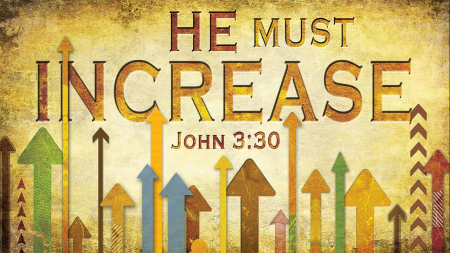
He must become greater and greater, and I must become less and less.

John 3:30, NLT

Before our Lord appeared, John the Baptist had incredible popularity.  Thousands and thousands came to him as he preached in the wilderness of Judea.  However, when Jesus initiated His own ministry, people left in droves to follow Him.  Imagine having a wildly successful thing going, and the next day having it fizzle.

I have discovered that it is one thing to be the center of attention, and quite another to be a minor player.  John the Baptist was the MVP, but overnight he was sent to the farm team (baseball metaphor).  Men and women reach for center stage, to be in the limelight.  But very few can move in the other direction gracefully.

A conductor was asked what the hardest instrument to play.  The interviewer expected that it would be a saxophone or trombone or some other.  The conductor just smiled,  and said, “The hardest is the second violin”.

How great victory was that which Jonathan must have gained over himself, when he rejoiced to see David raised above him! He discerned the mind of God in David, and had so learned to delight in God, that he did not see in David one who was to outshine him, but another faithful man raised up for God and Israel.”   

 
–Robert C. Chapman
 
Jonathan understood who David really was.  He had a sense of who was to be the new king. He had a conviction that understood David’s destiny and giftings.  Jonathan turned his back decisively on being made king.  Ambition was not in his vocabulary.  He could rejoice with David. Knowing this, Jonathan became a free man.

We must not aspire to being a leader as much as learning to become a true follower.

The need at the moment isn’t so much better leaders, but stronger followers. Often we struggle with this, somehow we believe, we’ll become “second class” disciples if we submit to another’s vision or giftings. The way of true servanthood is difficult for many. But to be a real follower will often mean not to strive or assert, but to surrender. That’s the way of Jesus.
 
Thomas a Kempis counseled,

“Be desirous, my son, to do the will of another rather than thine own.”

  
That is an interesting place to find yourself.  But that is the need of the moment.  He must increase, become greater, and I must decrease, become lesser.  There can be no room for personal aggrandizement. 

We need people who know how to play second fiddle.