Disciples Who Can Stay Afloat

22 “Immediately Jesus told his followers to get into the boat and go ahead of him across the lake. He stayed there to send the people home.23 After he had sent them away, he went by himself up into the hills to pray. It was late, and Jesus was there alone.24 By this time, the boat was already far away from land. It was being hit by waves, because the wind was blowing against it. 25 Between three and six o’clock in the morning, Jesus came to them, walking on the water.26 When his followers saw him walking on the water, they were afraid. They said, “It’s a ghost!” and cried out in fear.

27 But Jesus quickly spoke to them, “Have courage! It is I. Do not be afraid.”28 Peter said, “Lord, if it is really you, then command me to come to you on the water.” 29 Jesus said, “Come.” And Peter left the boat and walked on the water to Jesus. 30 But when Peter saw the wind and the waves, he became afraid and began to sink. He shouted, “Lord, save me!”

31 Immediately Jesus reached out his hand and caught Peter. Jesus said, “Your faith is small. Why did you doubt?” 32 After they got into the boat, the wind became calm.33 Then those who were in the boat worshiped Jesus and said, “Truly you are the Son of God!”

Matthew 14:22-33, New Century Version

flourish15

When I am in the storm, when the waves are breaking into my boat, my faith is shaky, and I feel abandoned, I turn to Matthew 14.

Jesus sees his disciples in mortal danger.  The overloaded boat has been caught in a ferocious storm.  It is 3 a.m., and the darkness just makes their situation that more desperate. The idea of imminent drowning has passed through their thoughts. They are terribly afraid.

Suddenly Jesus comes near, he is walking on the water!  Their fear turns to stark terror, they want to bolt but there is no place to go.  They are thinking that Jesus is a ghost, and that he is coming to escort them to the grave.  So Jesus calls out through the raging storm, “It is just me.  Do not fear!  Have courage.”

Brash Peter (bless him, Lord) yells to Jesus, “If it is you, really you, let me come to you, on the water!”  The word ‘if’ is very telling, and it explains much. Peter is soon on the edge of frantic hysteria when he begins to sink while walking to Jesus.

If it was me, I would have let Peter drown.  (What an object lesson to teach the 11 sitting in the boat.  “See what happens when you have weak faith, you drown!”)

But Jesus is not teaching here, He is loving.  He grabs Peter and pulls him out.  I find it interesting that the rock on whom Jesus is to build his Church upon sinks like a stone. Peter shows his faith for a brief shining moment, and when he falters and sinks, Jesus catches him.

aabryscript

Charred Cinders

fire1
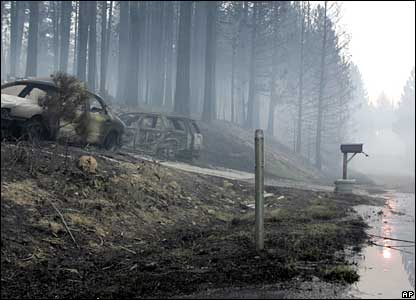
Aftermath of a forest fire in California

“When you pass through the waters, I will be with you;
And through the rivers, they will not overflow you.
When you walk through the fire, you will not be scorched,
Nor will the flame burn you.”

Isaiah 43:2, NASB

This will not be a typical commentary on this verse. (But it will be brief.)

The word I emphasize is “through.” I feel it is the salient point of the whole thought. Through implies a temporary state of being. We “pass through.” In a sense it is the state of being ‘between,’ and it is rarely, or ever comfortable.

Life is all about transitions– a job, children, marriage, health. We’re fine when things are steady and sure. However we feel the strain when things suddenly change. We are compelled to go through some things. Plain and simple. There are three simple things to think about.

  1. God is very present in those moments.
  2. Seldom do they vanish.
  3. They are never welcome.

The One who made the intricacies of our hearts stands by. Floods rage, trees float by. Fires get hot, and all becomes a blackened and charred cinder. Still God holds you. You will pass through this, and come out to the other side. Wiser and more compassionate.

recite-4295-45802551-tvf8xa (1)

Rolling Stones Theology

I was time travelling today.  I journeyed back to Christmas, 1972.  I had told my parents that life could only have meaning, if I could have just one thing.  I held out in hope that on Christmas morning, that I would open up a “rock tumbler.”

I was an 11 year old boy, and I imagined that I could turn gravel from the driveway into polished gems.  I would make jewelry for my mom, and then I would go on to know the thrill of turning ugly stones into precious jewels.  Somehow, doing this would give me a profound purpose. I guess I wanted to become a alchemist– turning gravel into gems.

This is all I wanted.  I dreamed of having my polisher– a rock tumbler that would be all and everything I wanted.  I was fixated, and just knew this was my destiny.  I would become a lapidarist! Today, I haven’t changed, I am always looking for the right stone.

Opening up our gifts, I had eyes only for my new rock tumbler.  I ripped open my present and tore into the box.  Within 10 minutes I had it up and going.

The principle was simple:

  • Step 1— Add the stones, and the “grit.” Resist putting in too many stones.
  • Step 2— Measure out the water.  The idea is to make a “slurry.”
  • Step 3— Let the machine run, don’t open the drum every 30 minutes. This takes time, and patience.
  • Step 4— A trick– add a tablespoon of sugar to the final polishing stage. It adds an extra gleam.

The Church is a lot like a rock tumbler.  The Holy Spirit places us in a fellowship with others.  We are rough and drab, we show nothing that would suggest a polish or gleam.  There is nothing beautiful about us.  We really understand this.

We join others who have been picked up.  Different grit is then added.  There are special types– some are very coarse and others are quite fine.  Water is added.  (The whole process is to parallel what happens at the beach, but purposefully accelerating it in your drum.)

As the drum rotates, things are constantly changing as they move.  The water and grit roll between the stones.  The stones themselves move with each other, sometime counter, but they smooth out all roughness and coarseness.  Some rocks are harder, and not easily polished.  Sometimes, the grit will need to be changed to speed up the process.  Whatever happens, we need to trust Him to do the right thing.

I really don’t want to bore you with all the different details.  But each step has a connection to authentically spiritual things.  We are a mixture of stones with different shapes and angles. There are a lot of variables, and it gets tedious.  The polishing takes a lot of time. There is the need for patience.  We often bring ‘a thirst for the instant,’ and for the quick work.  Polishing a rock takes a lot of time– months.  And we take years– maybe sometimes even decades.

“And you are living stones that God is building into his spiritual temple. What’s more, you are his holy priests. Through the mediation of Jesus Christ, you offer spiritual sacrifices that please God.”  1Peter 2:5, NLT

We are all in this process, what is hidden is being revealed.  We may bounce off each other, (here comes that ‘flinty’ sister again!)  But the Spirit is the superintendent of the process.  He will change the grit, add more water, or add others to the tumbler. He knows exactly what He is doing. No one will get overlooked.

Related articles

Nothing New Under the Sun

sun1This post is one that I posted at my own blog over three years ago, but watching Pr. Lowe share his story so honestly here reminded me of it, and so I decided to share it. I know his story is one that has blessed others; I know because I am one of those people who have been blessed by his honesty and faith.

What’s your story? I know you have one; we all do. But a more important question is: Have you shared your story with anyone? So often we don’t. Even when someone asks, “How are you?” or “What’s going on with you?”, we answer with platitudes like, “I’m fine” or “Not much.” We do this even when it is not true, even when we are not fine or a multitude of stressful situations are plaguing us.

A Facebook friend posted as her status one day that everyone lies, and the biggest lie we tell is “I’m fine.” But why do we do that? Why don’t we share our story with others? I believe there are two reasons, both rooted in fear to some extent.

First, we think our story is ordinary. We are afraid that others will be bored by what we have to say about what’s going on in our lives. Sometimes this might be true, sometimes the person we are speaking with won’t really care enough to truly listen or will be bored. Dwight Yoakam sings a song called “Sorry You Asked” that exemplifies this concern:

You’ll be sorry you asked
me the reason
That she’s not here with
me tonight
And I know you were
probably just acting polite
But you’ll be sorry you
ever asked why

We think people are just acting polite when they ask how we are, and don’t really want to know the truth. But often that is not the case, at least not if you are hanging out with people who care about you.

Second, we think we are the only ones going through whatever difficulty we are experiencing. We are afraid that others will look down on us for the situation we are in or the trial we are experiencing. We are afraid they will think we are weird or worse. But seldom are we the only ones who have experienced the trial we are currently experiencing or have gone through in the past. “What has been will be again, what has been done will be done again; there is nothing new under the sun.” Ecclesiastes 1:9.

The truth is our shared stories are what bring us together in community. I believe God allows us to experience trials that He knows we can handle so that we can then be an encouragement to others in a similar situation. If you have had a miscarriage, chances are at least one of the other women in your circle of friends has had one, too, and could use some support and encouragement. If you have suffered from depression and recovered, odds are you will encounter someone else who is struggling with this problem who could benefit from your understanding. If you have lost a loved one, I would venture that many of the people you know have lost someone, too, and could find hope in the fact that you have survived this ordeal. (As a side note, all three of these circumstances are part of my story.)

I could go on and on with examples, but the specific examples are not the point. It is the fact that we are all the same in so many ways. We are not alone and need not feel alone. In Ecclesiastes 4:9-12, Solomon wrote:

9 Two are better than one,
because they have a good return for their work:

10 If one falls down,
his friend can help him up.
But pity the man who falls
and has no one to help him up!

11 Also, if two lie down together, they will keep warm.
But how can one keep warm alone?

12 Though one may be overpowered,
two can defend themselves.
A cord of three strands is not quickly broken.

So go ahead, just like the character in Dwight’s song, share your story. Tell your friends how you really are, the genuine struggles you are facing, and the frustrations you are dealing with. Who knows, you just might help them feel less afraid and alone about their own trials, or you might encounter someone who is willing to share with you their story of hope and healing that you desperately need to hear.

aasignLinda

88