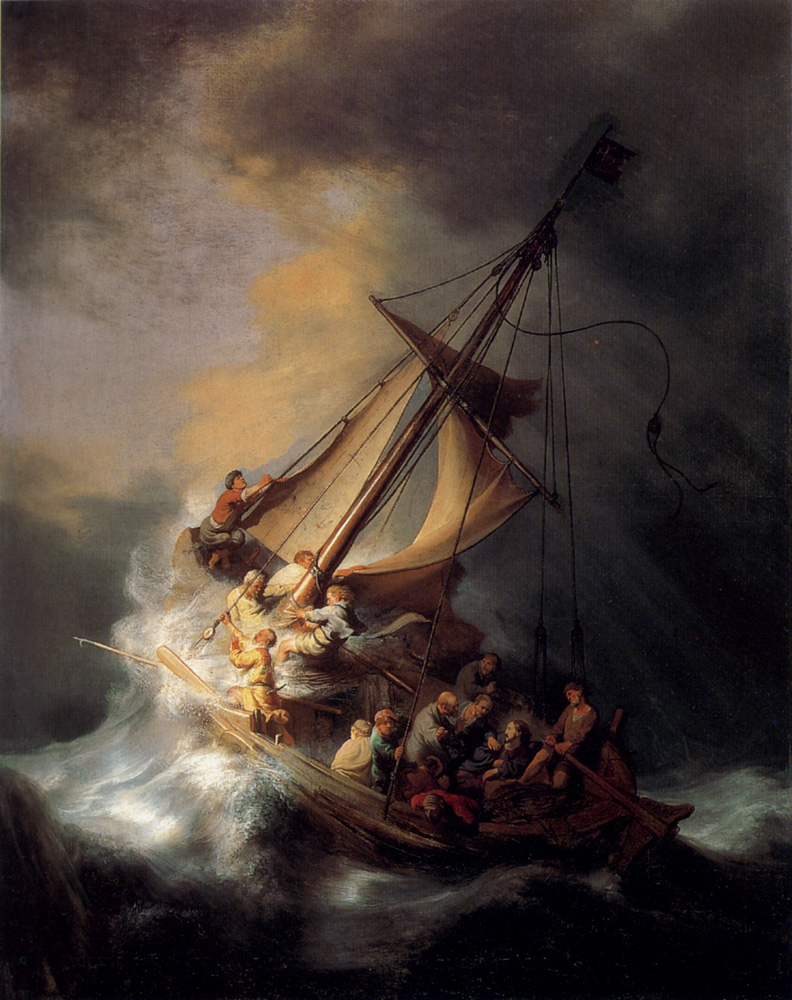
Straining at Your Oars

“He saw the disciples straining at the oars because the wind was against them.”

Mark 6:48

It’s good to know that Jesus sees our labor.  He truly understands all that concerns us, and he understands every issue that concerns us.  Attentive and keenly aware He comes to our boat.  It’s quite common for us to think that he isn’t aware, and we may feel that He’ll pass us by without a word.

Jesus watches over us all the time. 

He knows all about our battles, the fight we have with our flesh, the difficulty we have with the challenging people in our lives. I often struggle to steer my boat. Jesus knows when and why I labor like I do.  And He doesn’t condemn me.

The disciples were straining hard to keep the boat afloat. 

Every oar was being used and every man had his seat.  They must work together.  Some were frantically bailing, and a couple gripped the tiller. A lot of effort was being expended but nothing was working.  The wind continued to push harder against them. 

This is really quite perplexing.  If you remember, they’re simply trying to obey the command of Jesus to cross the sea. They were being obedient, and yet they were starting to sink.

Why do things have to be so difficult?

I’m intrigued by believers who expect sunshine, blue sky, and red roses just because they are doing God’s will.  They don’t seem to think through the issues of conflict and challenge, weakness and humility. That’s not how it’s suppose to work.

“It is necessary to go through many hardships to enter the kingdom of God.”

Acts 14:22

Doing the will of God will often mean that there will be a headwind directly at us.
 

The seas will become impossible, and we may even be driven back.  But special comfort comes when we realize we’re being watched.  Jesus is doing constant surveillance on us, and He sees our toil on the oars. And then He comes to us, walking on the water.

Even in our storm, our hearts should trust and rejoice.

“Lo, I am with you always, even to the end of the age”

Matthew 28:20

Notice Her Eyes, [Handicaps]

Stuck in the wonders of scripture we read about Leah and her sister Rachel. We see the two daughters of Laban have become Jacob’s wives. We must step into Genesis 29 to see more.

Jacob longs for Rachel. She is his “soul mate” and because he’s in love, the customs and technicalities of the day somehow get by him. Because of this, he will have to take on Laban’s subtle trickery, where daughters get exchanged, and we must sort out who is who.

Laban’s deception creates a huge crisis for everyone. 

But it seems Jacob just rolls with it. I suppose deception has always been Jacob’s strong suit. (But when we see a deceiver like Jacob gets deceived, that can’t be all bad).

But it’s Leah that I tend to think about. Her own issues are unique. Genesis 29 explains it a bit cryptically,

“Leah’s eyes were weak, but Rachel was beautiful in form and appearance.” 

Genesis 29:17

You must know that there is confusion by commentators about the “weak eyes.” Some take it literally (as in, she is very “near-sighted,”) while others who look at the original Hebrew find the words to be a bit looser and vague. They tend to think that this is a polite way of saying she really wasn’t pretty.

The text also states that Leah was “hated.”

Genesis 29:30-31.

She is wounded, and life requires that she live as unwanted. She is a woman of tragedy and broken hopes and dreams. She will always live as a reject. At best, she will always be a distant second, and perhaps a bit scorned and neglected for this.

I conclude that Leah is the champion for the challenged.

I love Leah and I think I understand her. Her life is a long tragedy and very full of sadness. For the next 30-40 years she will always be a cast-off, someone who has been broken on life’s bitter vagaries. She’s a fellow struggler, and a survivor.

Her sad life is comparable to us who have to fight so hard over our own illness or handicaps.

She must’ve been challenged by her terrible weakness. I understand this. My own life has been “topsy-turvy” and a really hard struggle. Somehow it seems we must work through these things way too much.

It doesn’t seem fair. 

For those of you who are confined to a wheelchair, or must use a cane, or who deal with a physical or mental illness. Leah should be our hero. For those who have been betrayed by addiction, or who have felt rejected through a bitter divorce– Leah speaks to us.

She is for every loser and for failures of all stripes. But through all of our setbacks and messes, we must realize that God does love us– even as we weep.

We may have Leah’s eyes, but we also have His grace.

I have a new site at alaskabibleteacher.com.

The Deep Pit

“I waited patiently for the Lord to help me,
    and he turned to me and heard my cry.
He lifted me out of the pit of despair,
    out of the mud and the mire.
He set my feet on solid ground
    and steadied me as I walked along.”

3″He has given me a new song to sing,
    a hymn of praise to our God.
Many will see what he has done and be amazed.
    They will put their trust in the Lord.”

Psalms 40:1-3, NLT

Psalm 40 is jam packed with great and wonderful truth. It contains freedom for the Christian– a way out for the broken believer. We do well when we use it, and that’s what it’s there for. The deep pit has been used over many centuries as the way God teaches us to sing certain songs. But that doesn’t make it easier, does it?

Verse 1

I waited patiently for the Lord to help me, and he turned to me and heard my cry.

Waiting is a critical word, it should not be regarded as trivial. In our daily walk we must be patiently seeking the Lord, that comes first. Admitting you need help is the first step. And guess what? You need help. 😁

The word ‘wait’ is special, it’s kawvah in Hebrew. It can mean ‘to bind together by twisting.‘ It can be used with the idea of braiding strands of rope together. It is never a passive act that just happens. Waiting on God is to be done with intentional purpose.

Remember that the Lord is not some distant deity on a hill far away.

He’s not hiding from you. It’s really quite the opposite.

He is closer to you than you think. He is responsive and aware. He hears your cries and wants to act; He is not deaf, but our patience is critical. Waiting on Him is crucial to being free. We must bind and twist our hearts and live our life to His desires.

Verse 2

He lifted me out of the pit of despair, out of the mud and the mire. He set my feet on solid ground and steadied me as I walked along.

The seeable terrain can be awful, with muddy paths and mucky pits. Things that pull you down and suck you in. They’ll trap the traveler. But the Holy Spirit is quite able to lift us out. He picks us up and secures us. He uses the rope of God’s Word.

He is way more willing to save us, than we are to being saved.

Solid ground is where we are meant to be. It’s become a place of firm standing and secure footing. He makes us steady and He keeps us safe. The Holy Spirit now has intimate care over your soul.

Verse 3-4

“He has given me a new song to sing, a hymn of praise to our God.

Many will see what he has done and be amazed. They will put their trust in the Lord.

Some of the greatest songs are the ones that come from those just delivered from the pit.

These are ‘pit songs,’ offered to God from sincere and true hearts that have once been trapped. There’s something solid heard from the hearts of those redeemed from disaster.

These songs no longer sound religious or contrived.

“YOU CAN SEE GOD FROM ANYWHERE IF YOUR MIND IS SET TO LOVE AND OBEY HIM.”

A.W. Tozer

From our deepest pits come our greatest praises.

There is a passionate quality that saturates these ‘pit praises’ that is highly treasured by God, and esteemed and valued by the Church– a sense of authenticity starts to be finally heard. We can finally start to see that our pits become ‘launching pads’ of true songs of deliverance.

An Injured Oyster

“A pearl is a beautiful thing that is produced by an injured life. It is the tear [that results] from the injury of the oyster.”

“The treasure of our being in this world is also produced by an injured life. If we had not been wounded, if we had not been injured, then we will not produce the pearl.”

 –Stephan Hoeller

God’s business is pearl-planting. He’s simply looking for a soft heart that can be cultivated.

His intention is never to harm but to only enrich us. When Lynn and I lost our daughter, Elizabeth, the pain was incredible. We looked and saw healthy families all around us. I began to accuse God and compare us with them. We hurt, they did not, and it seemed so unfair. It’s been awfully hard. But as time moved on, I slowly felt the growth inside.

A pearl of great price, because it came to us as a result of our daughter’s tragic death.

Our lives have been injured, and perhaps my illness has exacerbated things. Maybe physical issues or pain are a definite part of your life. There is a myriad of ways we can hurt. At times we are angry. But remember, God has a plan and He also understands completely. When Jesus meets you in heaven–he will do so with nail-pierced hands.

Jesus understands you. He sees the pain.

“I wish, brothers and sisters, that we could all imitate the pearl oyster–A hurtful particle intrudes itself into its shell, and this vexes and grieves it. It cannot reject the evil, but what does it do but “cover” it with a precious substance extracted out of its own life, by which it turns the intruder into a pearl!”

Oh, that we could do so with the provocations we receive from our fellow Christians, so that pearls of patience, gentleness, and forgiveness might be bred within us by that which otherwise would have harmed us.

     Charles Spurgeon

#