The Invisible Pain of Fibromyalgia

I posted this recently on my blog, Linda Kruschke’s Blog.

This post was inspired by a flare-up of my fibromyalgia. One of my fellow bloggers who has bipolar commented that the pain of bipolar is also a form of invisible pain. It occurred to me then that this is a perfect post for the encouragement of broken believers, many of whom struggle with some form of invisible pain, whether physical or mental pain.

flourish20

I didn’t want to write about fibromyalgia, but then I realized that sharing my struggles with this syndrome might help someone who also struggles with invisible pain.

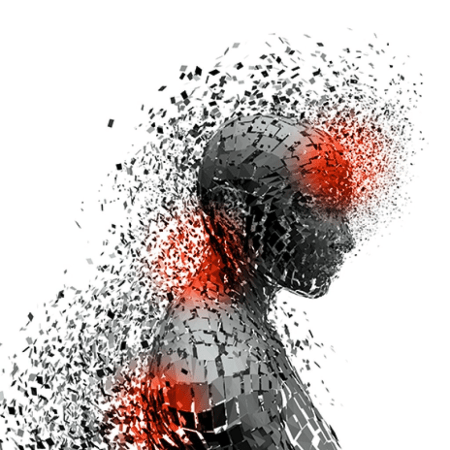
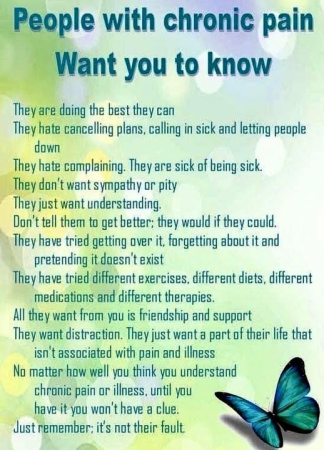
When someone breaks a leg, suffers a severe burn, or is covered with cuts and bruises it is easy for people to see what is wrong and to sympathize. But the pain of fibromyalgia is invisible pain. From the outside, the person suffering from the pain of fibromyalgia looks just fine, and so people don’t understand what they are going through.

It is also an unpredictable pain with no easily determinable cause or trigger.

One day you feel just fine and you wake up the next day feeling like you got run over by a freight train. I’ve gone for months feeling fine, with very little pain, then suddenly every muscle in my body aches, and certain movements cause sharp pains in my legs, arms, and neck.

I try to figure out why.

I’ve had doctors give me conflicting theories of what causes this pain, and I have read conflicting theories as well. One doctor told me it is a chemical imbalance in the brain. Another has told me it is caused by what I eat, by an inability of my muscles to process sugar that results in toxins in my muscles.

Another suggested it is a symptom of Post-Traumatic Stress Disorder that stems from some early trauma. I had also read that there was a strong link between fibromyalgia and Epstein Bar Virus (or mononucleosis), which I had when I was in junior high. Finally, I have read that it is simply hereditary.

The pain of fibromyalgia is truly invisible.

There is no medical test that shows whether someone has fibromyalgia. There is a “tender point” test in which the doctor checks 18 designated tender points on the body and if 11 or more are tender to the touch a diagnosis of fibromyalgia can be made. But even that test is somewhat subjective.

All my life I have felt pain in circumstances where someone else thought I shouldn’t have felt pain. I can remember saying something hurt when I was a kid only to be told, “That didn’t hurt.” This summer I experienced pain from something that didn’t seem like it should hurt.

I was at my cousin’s house in Houston and his granddaughter was playing with three pine cones. She kept handing them to me to play with, but the sharp points started to really hurt my hands. I said I didn’t want to play anymore because it made my hands hurt. My sister looked at me and asked, “Does that really hurt?”

But I know that Jesus knows how I feel, and that gives me a great deal of comfort. Although the pain Jesus experienced when He was scourged, beaten, and crucified was quite visible, He experienced an invisible pain, too. He experienced the pain of having the sin of the world laid upon Him and of His Father turning away as He cried out:

“My God, My God, why have You forsaken me?”

Matthew 27:46 (NIV).

If you struggle under the weight of invisible pain, take heart that you are not alone. Christ understands your suffering and your pain. You also have fellow Christians who understand what you are going through. The apostle Peter provided for us who suffer a wonderful encouragement in his first epistle:

Humble yourselves, therefore, under God’s mighty hand, that he may lift you up in due time. Cast all your anxiety on him because he cares for you.

Be self-controlled and alert. Your enemy the devil prowls around like a roaring lion looking for someone to devour. Resist him, standing firm in the faith, because you know that your brothers throughout the world are undergoing the same kind of sufferings.

And the God of all grace, who called you to his eternal glory in Christ, after you have suffered a little while, will himself restore you and make you strong, firm and steadfast. To him be the power for ever and ever. Amen. 

1 Peter 5:6-11 (NIV).

Satan would love to devour us in our pain.

He wants to make us fall and cease to be of use in God’s kingdom. But if we cling to Jesus, and cast all of our fears and anxiety on Him, He will help us to defeat Satan’s plans.

If you are struggling with invisible pain and feeling like you are at your wit’s end, leave me a comment and I would love to pray for you. It would be a blessing to me to be able to ask our Lord to strengthen you and give you peace and comfort so that you might be enabled to stand firm in your faith. Would you do the same for me?

My site is anotherfearlessyear.net, Please visit me.


Admitting I Need Jesus

When I was in the sixth grade, a friend invited me to her church. My parents didn’t go to church, but said I could go with Clarissa if I wanted to. Before long, I was spending at least three days a week with my church friends. I learned who Jesus was and that if I believed in Him I would be saved.

I believed, though I didn’t fully understand my need for a Savior.

It would be many years and much wayward living later before I would realize the importance of the Apostle Paul’s words to the church in Rome. “For I am not ashamed of the gospel, for it is the power of God for salvation to everyone who believes, to the Jew first and also to the Greek. For in it the righteousness of God is revealed from faith to faith; as it is written, ‘But the righteous man shall live by faith.’” (Romans 1:16–17 NASB).

It’s easy to think “of course I’m not ashamed of the gospel.” Why would anyone be ashamed of the good news that Jesus died for our sins so that we might be reconciled to Him?

But at its core, faith in the gospel requires the believer to say “I can’t do this myself.”

Well, let me tell you a little secret that believers and nonbelievers often forget. We humans, with all our self-importance, like to think we’re the kings and queens of the universe. We strut around like peacocks, patting ourselves on the back for our so-called brilliance. And you know what? We even pass that audacity onto our poor children, encouraging them to be little independent dynamos. But hey, who needs divine intervention when we’ve got our fabulous human ego, right? wink

I remember a time when my son was in high school and because of a snow day his class schedule was changed. As a result, he took the wrong books. He called to ask me to bring the right books to the school office on my way to work, which I happily agreed to do. When I got to the office to drop them off, the school secretary chided me for bailing him out. “These kids need to learn to be responsible or suffer the consequences,” she said.

I’ve thought of that encounter often, being thankful that Jesus didn’t say the same to the Father when the plan of salvation was put into place. What if Jesus had said, “You know Dad, these humans need to be more responsible or suffer the consequences.” We’d all be doomed.

And so, although it requires me to admit I can’t do it alone, I choose to live by faith in the One who gives me His righteousness.

For the broken believer (which is all of us, if we’re honest), it is all the more important to be okay with something less than full independence. We were created to be dependent on God and on one another. We were created to live in community and relationship with others.

Note: A version of this article was originally published in the January 2020 issue of The Christian Journal, a publication I highly recommend, and not just because they publish some of my writing.

Do You Have an Anchor?

“Then fearing lest we should have fallen upon rocks, they cast four anchors out of the stern, and wished for the day.”

Paul’s voyage, Acts 27:29

“This hope is a strong and trustworthy anchor for our souls. It leads us through the curtain into God’s inner sanctuary.”

Hebrews 6:19

An anchor is used when a boat needs to connect to the sea floor. It’s typically used to moor the ship or used in a bad storm.

“A boat anchor helps keep a boat attached to one place on the ocean floor so that it does not go adrift in the sea. Likewise, a “spiritual anchor” is something that helps keep us grounded, connected to what matters most, and able to cope with the challenges that life brings.”

Hopefulness is necessary for walking through the present circumstances we must face.

It also is for our future. To live without hope can be spiritually destructive. If there is no hope for us our hearts will break into pieces.

Hopelessness comes from living without an anchor. You must have an anchor as a believer. You must.

Despair will destroy you.

 A Christian may for many days together see neither sun nor star, neither light in God’s countenance, nor light in his own heart, though even at that time God darts some beams through those clouds upon the soul; the soul again by a spirit of faith sees some light through those thickest clouds, enough to keep it from utter despair, though not to settle it in peace. In this dark condition, if they do as Paul and his company did, cast an anchor even in the dark night of temptation, and pray still for day, God will appear, and all shall clear up, we shall see light without and light within; the day-star will arise in their hearts.

     Richard Sibbes

Walking This Broken Road by Faith

credit: www.internetmonk.com

     David Wilkerson

In one of my early blog posts at lindakruschke.wordpress.com, I was lamenting that remembering my past made me a little blue, because I had regrets and things have happened to me that were less than wonderful. But I have been reminded that I am who I am because of my history.

A week later I was listening to the CD  Stay by Jeremy Camp in my car alot. One of the songs on that CD is called Walk by Faith, but all week I really haven’t tuned into that song even though it is the one I really needed to hear. Then one night I was listening to my iPod while I was making dinner, and had it on shuffle of my Christian Music playlist. This is something I hadn’t done for awhile – I had listening to the Oldies playlist or the Sad Heartache Songs playlist instead. I started out that night listening to the Grunge playlist, but it wasn’t helping my mood at all (now that’s a big surprise, not).

It just so happened that the third song to play on the Christian music playlist while I was chopping veggies for homemade chicken noodle soup was Walk by Faith. The chorus goes like this:

As I heard those words, I realized that the broken road I have traveled (and don’t we all travel a broken road of some kind?) has made me who I am. It has taught me love, compassion, empathy, and, most importantly, faith.

If my life had been perfect and easy, with no pain and heartache, first of all I wouldn’t be human. But secondly, I would be a different, perhaps shallower person. I might not even be happy.

So I have decided not to lament or regret my past.

I needed to see it for what it is: the broken road that has prepared me to be the person God wants me to be to those around me. Because ultimately, those around me have traveled a broken road too. And sometimes it is a very similar broken road so that we can relate to each other’s journey. Maybe, as I walk that road by faith, I can help others to walk by faith, too.

Besides, without the lessons learned on my broken road I would have nothing but fluff to write and my blogging would have no purpose.

Have you been walking on a broken road?

Have faith that God will use your experiences to make you the person He has planned for you to be so that you can be a blessing to others walking that broken road with you.

Linda K.
anotherfearlessyear.net