Restrain Them: Psalms 141:8-10

8″ I look to you for help, O Sovereign Lord.
    You are my refuge; don’t let them kill me.
Keep me from the traps they have set for me,
    from the snares of those who do wrong.
10 Let the wicked fall into their own nets,
    but let me escape.”

 Psalms 141:8-10, NLT

Spoken like a man who knows and has experienced a whole lot of trouble. David speaks from the matrix of his heart. In this day of cool indifference and sterile objectivity, you rarely see a passionate life being lived.

Perhaps we need a baptism of trouble and woe. I like softness, and love comfort. I am easily taken in by a menu at my favorite diner, and I adore Starbucks. I seem to have an “instant Christian” mentality. I want patience, and I want it now!

Commentary

V. 8, “I look to you for help, O Sovereign Lord.
    You are my refuge; don’t let them kill me.”

This is one of those deep, “rock-bottom” prayers. There is no flowery elegance in this verse. I can smell the sweat, and see the grime. There is dirt under the fingernails of David. It is a cry of somebody in trouble.

But David’s vision is full of God. He chooses to call on the Lord for the help he must have. People want to kill him, and David needs a temporary restraining order desperately.

As I read these verses, there is an absence of anxiety. This man has taken his refuge in the cave of God’s heart. David will be kept securely and safely in that place. He is aware, but he also trusts.

V. 9, “Keep me from the traps they have set for me,
    from the snares of those who do wrong.”

The nature of traps and snares is that they must be hidden. A snare only works by surprise. They must be stealthy. The psalmist doesn’t rely on his own abilities to detect and escape these traps. Rather he reaches out to his Father, and he relies on God’s abilities.

V. 10,  “Let the wicked fall into their own nets,
    but let me escape.”

What we see around us must be (and will be) reversed. The righteous and the wicked will switch places. We need to believe this. Those who have buried themselves in darkness are the ones caught. We must understand this transforming “swap.” It happens when embattled hearts seek the Lord, just like David has done.

 1brobry-sig4 (2)


cropped-christiangraffiti1-3-1


There is Nothing at All [Not a Thing]

“Yes, I am sure that neither death, nor life, nor angels, nor ruling spirits, nothing now, nothing in the future, no powers,  nothing above us, nothing below us, nor anything else in the whole world will ever be able to separate us from the love of God that is in Christ Jesus our Lord.”

Romans 8:38-39, NCV

Paul has an incredible confidence in the words of these two verses.  He is in a place where he has an exceptionally deep certitude in a profoundly deeper God.  In the history of the Crusades, men would fanatically charge into battle. Not only did they carry their sword and shield, many carried holy relics.  They believed that a special magic covered them, keeping away all harm and every evil.

But this is not how we are to understand and embrace these promises. They aren’t magical.  When soldiers put a copy of the New Testament in his breast pocket he will be quite disappointed when the bullet just whizzes right through.  He will end up dead. Honestly, there is nothing magical about our Bibles, but they are spiritual. And mixed with faith they are powerful.

The promises in Romans 8 won’t make you bulletproof.  But they are certainly trustworthy to all who believe them.  Paul declares, with no hesitation, exactly what has happened through our faith.  In the strongest sense possible he works through a catalog of things which, (in the past especially) which are all very strong and intensely powerful.

“…neither death, nor life, nor angels, nor ruling spirits, nothing now, nothing in the future, no powers, nothing above us, nothing below us, nor anything else in the whole world…” 8:39

This pretty much covers everything (including IRS audits, and jury duty.)  Nothing can move me from His love.  It seems to me that this very love very aggressively penetrates everything.  Love seems to be the way He works with humankind. He loves people.

As believers who struggle deeply, we would do well to think about these two verses (vv 38-39.)  Perhaps even commit them to memory.  They have carried the faith of generations. As we trust in these we will find “no magic.”  But they are truly spirit, and they are life. These promises are wonderful, and the One who makes them is true.  Your confidence in these two verses alone will make you ‘invincible.’

“God’s way is perfect.
    All the Lord’s promises prove true.
    He is a shield for all who look to him for protection.”

Psalm 18:30, NLT


bry-signat (1)

cropped-christiangraffiti1.jpg


The Ransom Note

depression-note

“We collapse in the dust,
    lying face down in the dirt.
26 Rise up! Help us!
    Ransom us because of your unfailing love.”

Psalm 44:25-26, NLT

“For even the Son of Man came not to be served but to serve others and to give his life as a ransom for many.”

Mark 10:45

“God chose him as your ransom long before the world began, but he has now revealed him to you in these last days.”

1 Peter 1:20

I think that God has more or less ransacked the human language in His effort to get through to us the critical nature of what exactly has been done just for us. When it comes to our salvation and what that means to the universe, the word, “ransom” is used.

The connection for us, as we consider the implications, has mainly a connection with the crime of “kidnapping.” This is when someone is captured by other men, and held in captivity until certain terms are met. When the kidnapper feels his needs are fully met, then the hostage is released.

In the Bible sense, we should work through several verses. There are at least three Hebrew words. In the N.T. Greek just a single word to explain “ransom” is seen. And yet we can say, each word is linked back to the idea of being “helpless.” And helpless is far more than a definition, rather it is a description of a “state of being.”

We come to understand that helplessness is the natural state of human beings. We each have been captured, taken away and are being held, until terms are met for our release. I suppose that some see this helplessness easier than others. (And I’m sure a few will never acknowledge it at all). But nevertheless, it is real and it describes every single person that has ever lived.

Being completely helpless is hardly a situation we would ever choose. Having ransom demands being made to set us free is mostly awkward. And it’s an affront. Perhaps, we feel we are worth more? But the issues here are eternal, and currency concepts are never the consideration.

But there is a present need, to purchase back those who are being held as captives. The absolute clear position is that the Lord Jesus Christ, died in our place. Choosing to die for us, he was essentially tortured before his cruel death. In this decision, he himself paid my ransom. In doing this, I was set free and fully able to return home.

There are many who have been free. But there is a thing called “the Stockholm Syndrome.” This refers to those in captivity who somehow “connect” with their kidnappers through a prolonged captivity. This is to the point where they begin to act less than the victims, and more like the captor. It is confusing. They seem to go out of their way to act “pro-kidnapper”. This can get very disturbing.

We must look to our children, and closest family and our friends. They are toiling for Satan, the captor of our souls (past-tense). Many different tactics are being used– depression, addictions, lust, greed, anger, gluttony, pride, guilt and many other deceitful things. They are being held, until faith (the key) “springs” them out of their prison.

Thank you Jesus, for coming to free us. Thank you for forgiving us. We have been released, and now walk away free. You died, so we might live. We desperately want to see the others we love set free.

*

ybic, Bryan


cropped-christiangraffiti1 (3)

*

Two O’ Clock in the Morning Poetry, #3

Collector_Trench

Middle Parts of Fortune, by Frederic Manning

“The air was alive with the rush and flutter of wings; it was ripped by screaming shells, hissing like tons of molten metal plunging suddenly into water, there was the blast and concussion of their explosion, men smashed, obliterated in sudden eruptions of earth, rent and strewn in bloody fragments, shells that were like hell-cats humped and spitting, little sounds, unpleasantly close, lie the plucking of tense strings, and something tangling his feet, tearing at his trousers and puttees as he stumbled over it, and then a face suddenly, an inconceivably distorted face, which raved and sobbed at him as he fell with it into a shell-hole.”

(Accounts of The Great War) 
R
FredricmanningManning was an Australian aspiring intellectual, already in his mid-30s when he enlisted as a private soldier in 1915. His prewar existence in England was dogged by unfulfilled literary hopes and emotional confusions. He served for only a few months in France, and his military career ended in alcoholism and disgrace. But in 1929 he composed a novel, obviously autobiographical, about three soldiers’ experience of the trench nightmare, which is outstanding. Almost certainly the finest work of its kind to emerge from the war. (Penguin)
&

Manning continued to write. In 1917 he published a collection of poems under the title Ediola. This was a mixture of verse predominantly in his former style alongside war poems heavily influenced by the imagism of Pound, which deal introspectively with personal aims and ideals tempered in the crucible of battle. He contributed to anthologies, for example, The Monthly Chapbook which appeared in July 1919 edited by Harold Monro, containing twenty-three poems by writers including John Alford, Herbert ReadWalter De La MareOsbert SitwellSiegfried SassoonD. H. LawrenceEdith SitwellRobert NicholsRose Macaulay and W. H. Davies alongside Manning and Aldington. He wrote for periodicals, including The Criterion, which was produced by T. S. Eliot.

&&&

Poetry did not pay, and so in 1923 Manning took a commission from his publisher John Murray to write The Life of Sir William White, a biography of the man who, as Director of Naval Construction, led the build-up of the Royal Navy in the last years of the nineteenth century. Galton had died in 1921, which not only left Manning effectively homeless, but also lacking a forceful directing influence in his life. He lived for much of the time at the Bull Hotel in Bourne, apart from a short spell when he owned a farmhouse in Surrey. At this time he was friendly with T. E. Lawrence, then serving in the Royal Air Force at RAF Cranwell, some twenty miles (a motorcycle ride) from where Manning was living. In 1926 he contributed the introduction to an edition of Epicurus’s Morals: Collected and faithfully Englished by Walter Charleton, originally published in 1656, published in a limited edition by Peter Davies. — from Wikipedia and Penguin

&

Bonus–

wwi13
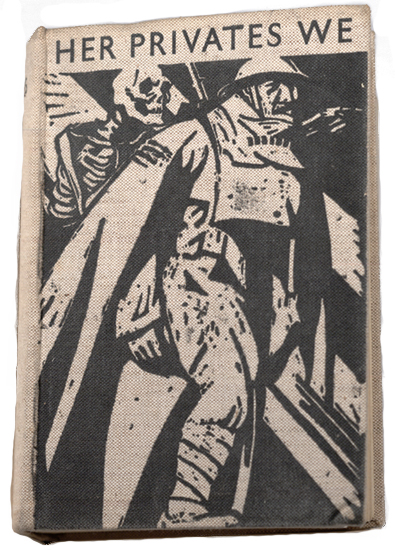
“Her Privates We” 1930, Cover art