Making Your Prayer Real

“I urge you, first of all, to pray for all people. Ask God to help them; intercede on their behalf, and give thanks for them. Pray this way for kings and all who are in authority so that we can live peaceful and quiet lives marked by godliness and dignity. This is good and pleases God our Savior.”

1 Timothy 2:1-3, NLT

“The Church has not yet touched the fringe of the possibilities of intercessory prayer. Her largest victories will be witnessed when individual Christians everywhere come to recognize their priesthood unto God and day by day give themselves unto prayer.”

–John R. Mott

You are a priest without a collar. Your work is called “intercession.” It isn’t for cowards or the spiritual lazy. It needs to be ‘hidden’ in order to really work. No one should see, there will be no adulation or recognition. You may not even feel special. But God sees and hears you. Jesus told each one of us,

“But when you pray, go away by yourself, shut the door behind you, and pray to your Father in private. Then your Father, who sees everything, will reward you.”

Mathew 6:6

When we ignite in prayer, we will see things as Jesus sees them. We will share His view and take part in His high priestly ministry. Jesus isn’t complacent, sitting on His throne, waiting for time to run out. I suppose that is the view of some, but it honestly isn’t real.

“So then, since we have a great High Priest who has entered heaven, Jesus the Son of God, let us hold firmly to what we believe. 15 This High Priest of ours understands our weaknesses, for he faced all of the same testings we do, yet he did not sin. 16 So let us come boldly to the throne of our gracious God. There we will receive his mercy, and we will find grace to help us when we need it most

Hebrews 4:14-16, NLT

Who then is the one who condemns? No one. Christ Jesus who died—more than that, who was raised to life—is at the right hand of God and is also interceding for us.

When we start to really intercede we become a sort of a “sub-priest.” We serve under the Lord Jesus the High Priest’s direction. We engage our work under the Holy Spirit’s oversight, and we start to plead for those who need Him most. We are the one’s who make things happen when we stand with Jesus.

So who and what do we pray for?

  1. Family and friends
  2. the sick, those in distress
  3. the stranger, the one who bags our groceries
  4. the church we attend, the pastor and elders, the congregation
  5. missions, or missionaries in a certain country, or in general
  6. for ministries working under God’s direction
  7. finances, supplies, for more workers in the ‘vineyard’
  8. safety and protection from the evil one, cults and businesses that ‘traffic’ in evil
  9. more wisdom and grace for all who are ministering God’s Word, for other intercessors
  10. our government, police, soldiers–from the ‘dog catcher’ to the president

These ten are just a start to get you going, this list is not complete by no means, but it’s a beginning. As you start praying you will add and expand these things. Remember that faith is a key component in the work of intercession. You must come in harmony with His present ministry. You do this through:

  1. praise and worship
  2. Bible reading and thinking about the Word
  3. listening and discerning what is happening around you
  4. asking questions that really matter
  5. being humble and broken, not haughty or proud as you pray
  6. becoming alert to all of the needs around you, be sneaky but holy
  7. instill in your heart the Kingdom of God and the supreme ministry of the King
  8. exercise His authority over the earth, see things as they really are
  9. personal prayer times that get you ready to pick up the ‘mantle’ of intercession
  10. see yourself joined in this ministry of Jesus, who wants “all men to be saved”

Don’t be surprised if the Spirit draws you to a specific need. I believe that there are ‘specialists’ in the Body of Christ. One person will concentrate his attention on the sick or the demonized. Another may be dedicated to praying for the president or the Supreme Court, and someone else might pray for certain missionaries or countries. In short, you must listen to the High Priest, and get your cue from Him. He most certainly will direct you on where you should stand!

There is definite power in joining with another or in a group. It seems to me though that this can be a challenge as we can get disengaged or passive. Spiritual laziness extinguishes the fire of God. Yet if we are sincere our intercession can become ‘turbocharged’ when we are actively with another. It should be a skill we develop over time. It will take concentrated work on your part to stay focused.

None of this is concrete.

Your brother, who is still learning,

Bryan


Confession – A Villanelle

Walking Toward His Light

This poem is written in the “villanelle* form. I wrote it as a reminder to myself of how hard the darkness of depression can be so that I don’t lose my compassion for those in my world who are struggling to find the Light. But it is also a reminder that the Light of Christ does shine in that darkness, however faintly, and will never be extinguished. If you feel oppressed by the darkness, seek His Light.

Confession

The light shines in the darkness
Faintly I see His light
My need I will confess
Toward the light I press
Keeping hope in my sight
The light shines in the darkness
Despair my soul’s distress
Entangled in the night
My need I will confess
His grace I will profess
Giving me the strength to fight
The light shines in the darkness
I feel anguish oppress
Crushing with all its might
My need I will confess
Feeling His love’s caress
Compassion burning bright
The light shines in the darkness
      My need I will confess

__________________________________________

* vil·la·nelle, [vil-uh-nel]

noun, Prosody

a short poem of fixed form, written in tercets, usually five in number,

followed by a final quatrain, all being based on two rhymes.


Check out Linda’s site @ anotherfearlessyear.net


T
 

w

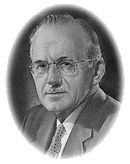
A.W. Tozer, on Having a Personal Revival

How to Have a Personal Revival,
Serious Repentance and Restitution, and
Steps to Spiritual Growth.

by A.W. Tozer

1) Put yourself in the way of the blessing. 

It is a mistake to look for grace to visit us as a kind of benign magic, or to expect God’s help to come as a windfall apart from conditions known and met. There are plainly marked paths that lead straight to the green pastures; let us walk in them.  To desire revival, for instance, and at the same time to neglect prayer and devotion is to wish one way and walk another.

2) Do a thorough job of repenting. 

Do not hurry to get it over with.  Hasty repentance means shallow spiritual experience and lack of certainty in the whole life.  Let godly sorrow do her healing work. Until we allow the consciousness of sin to wound us, we will never develop a fear of evil. It is our wretched habit of tolerating sin that keeps us in our half-dead condition.

3) Make restitution whenever possible. 

If you owe a debt, pay it, or at least have a frank understanding with your creditor about your intention to pay, so your honesty will be above question. If you have quarreled with anyone, go as far as you can in an effort to achieve reconciliation. As fully as possible make that crooked things straight.

*****

Thought 

Repentance and restitution result when we seriously reflect on what God shows us in His Word. What is it of which we need to repent and is there restitution to be made?


Scripture

“Bring forth fruit that is consistent with repentance [let your lives prove your change of heart];”

Matthew 3:8 (Amplified Bible)

Prayer

My tendency, Lord, is not to take seriously my sin that hurts other people and to leave unrepaired the damage I have left in the lives of others. Make me sensitive, Lord!


tozer
Aiden Wilson Tozer was born on April 21, 1897, on a small farm in Western Pennsylvania, the third of six children. And although he would inspire millions with his preaching and writing, he was given very little education during his childhood.

A. W. Tozer was 66 when he died of a heart attack on May 12, 1963. Buried in a small cemetery in Akron, his tombstone simply and appropriately reads, “A Man of God.” He left behind many books that continue to give Christians encouragement and guidance. His writings are as fresh today as when he was alive. His honest and colloquial humor has been known to sweep up congregations in gales of laughter. And his wisdom has left them silent and stunned. For almost 50 years Tozer walked with God, and even though he is gone, he continues to minister to those who are eager to experience God.

Are There Benefits to Being Bipolar?

Bipolar people can be really different.

Originally Published on July 20, 2010 in “Psychology Today”

Let me start by acknowledging what is well known: Manic Depression or Bipolar disorder can be a devastating illness. Affecting at least 1% of the population, it can, untreated, result in suicide, ruined careers and devastated families. Bipolar disorder is often accompanied by alcohol and drug abuse and addiction, criminal and even violent behavior. I acknowledge this because I do not want to make light of the burden this illness places on people’s lives, families, and communities.

On the other hand, the history of the world has been influenced very significantly by people with manic depression (see website www.wholepsychiatry.com for details). They include:

“It seems clear that for at least some people with Bipolar disorder, there is an increased sense of spirituality, creativity, and accomplishment. It may be that having bipolar disorder holds great potential, if one is able to master or effectively channel the energies, which are periodically available, to some higher task. This would of course presume the ability to abstain from harmful drugs and alcohol, to have good character, and at least some supportive relationships and community networks.”

Y
It might be helpful to consider a reconceptualization. Perhaps instead of it being a disorder, we can think of people with bipolarity as having access to unusual potency. This potency will find a way to be outstanding-either in a destructive way, or in a constructive way. If such a choice is presented to the person, perhaps it can open some doors.
——————————————–
 

“And we know that God causes everything to work together for the good of those who love God and are called according to his purpose for them”

Romans 8:28

Source of this article: Psychology Today 

Bryan’s note: A great book, a favorite of mine, that works a lot of this out is Exuberance: The Passion for Life,” by Kay Redfield Jamison.