For People Who Walk in Pain

Luke 5:12. ESV

The man is desperate.  His leprosy has advanced; he is covered with it from ‘head-to-toe.’ He’s an outcast now, completely infected by something he never asked for; he is ‘unclean’ and completely without hope. There is no treatment, the doctors can do nothing. How bad can it get?

The leper knows that without the touch of Jesus, he will never be healed. 

He knows it; he doesn’t need to be convinced by anyone over the hopelessness of his condition. But somehow he has heard that Jesus can do real miracles. Could it be that Jesus can heal his sickness?

The leper comes and falls on his knees before the Lord, with his face in the dirt. This man is completely broken; he has no hope, except for Jesus. What else can he do? He is with any real hope.

Our diseases differ, but our lives have been completely changed by our pain. We all have this in common. 

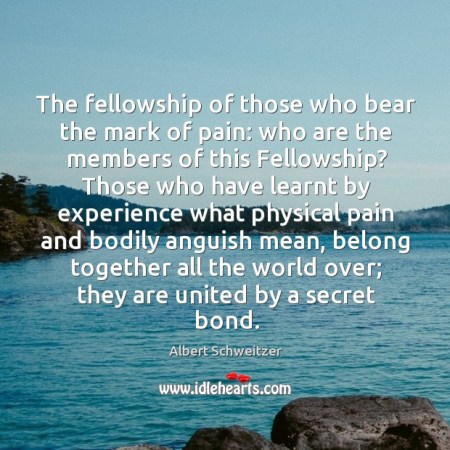
Our pain and darkness vary. Some hurt more, some less. But we’ve all come to the place where we no longer have illusions of somehow being made whole. I sometimes think there should be a secret handshake or a password. We all share a comradeship– we’re all part of the same community. 

We’re a broken club of tired and decidedly unclean misfits.

And we belong to the fellowship of pain.

Lying in the dirt, we’re starting to believe the unbelievable.  Our faith doesn’t activate our healing, as much as it simply guides us to Jesus. We can kneel, and perhaps that’s all we need to do. His presence drives away the fear, the doubt, and the pain. He’s come, and somehow maybe, we begin to hope for mercy.

Only Jesus can carry us through this. Only He can do this.

I have struggled with deep dark depression. I’ve had to take meds.  But when I come into Jesus’ presence, all my melancholy is driven out. He comes and I start to hope again.  Am I a stellar example of perfect discipleship?  I think not. But isn’t about us becoming “angels,” perhaps it’s more about us learning how to kneel, and to allow Jesus to touch our hearts.

You must do this. Repeatedly.

(Over and over and over again.)

“The power of the Church is not a parade of flawless people, but of a flawless Christ who embraces our flaws.”

“The Church is not made up of whole people, rather of the broken people who find wholeness in a Christ who was broken for us.”   
–Mike Yaconelli

r

Rembrandt’s Prodigal Son

Rembrandt-The_return_of_the_prodigal_son
Rembrandt, “The Return of the Prodigal Son,” c. 1661

17 “But when he came to himself, he said, ‘How many of my father’s hired servants have more than enough bread, but I perish here with hunger! 18 I will arise and go to my father, and I will say to him, “Father, I have sinned against heaven and before you. 19 I am no longer worthy to be called your son. Treat me as one of your hired servants.”’ 20 And he arose and came to his father. But while he was still a long way off, his father saw him and felt compassion, and ran and embraced him and kissed him. 21 And the son said to him, ‘Father, I have sinned against heaven and before you. I am no longer worthy to be called your son.’ 22 But the father said to his servants, ‘Bring quickly the best robe, and put it on him, and put a ring on his hand, and shoes on his feet. 23 And bring the fattened calf and kill it, and let us eat and celebrate. 24 For this my son was dead, and is alive again; he was lost, and is found.’ And they began to celebrate.

Luke 15:17-24, ESV

Two hundred and eighty-nine words– these describe the life of every man, woman, and child who has ever lived. These 289 words reveal to us a God who loves far too much, way too easy. Perhaps we sort of expect that he will ‘appropriately’ punish his son– at least put him on probation at least. It only makes sense. But we find that is legalism talking.

“Every saint has a past, and every sinner has a future.” 

Many of us have lived as prodigals, and we have spent our inheritance like ‘drunken sailors.’ We really have nothing at all to show for it. The prodigal, completely destitute, takes the only work he can find. (Imagine a good Jewish boy feeding hogs.)

He is so far gone that he starts inspecting the filthy slop buckets for something to eat.

Many of us will understand his despair. Often there comes to us a crystalline moment of simple awareness. The prodigal, sin-crusted and impoverished, still has a lingering memory of the Father’s house.

The servants there had far more than him right now. Sometimes I wonder if in our captivity, we instinctively want to go home, if only in our minds, to be a servant there.

The Father has dreamed of this precise moment.

The parable says, “He saw him–felt compassion–ran out to him–embraced him–and kissed him.” The Father is a whirlwind of agape love. I’ve read the Parable of the Prodigal Son a hundred times or more. It never loses its punch. I simply want to bring some observations: 

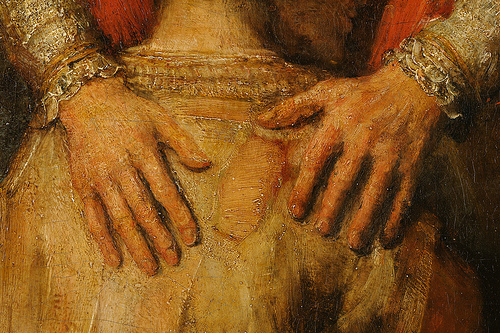
  • We see that his father receives him with a tender gesture. His hands seem to suggest mothering and fathering at once; the left appears larger and more masculine, set on the son’s shoulder, while the right is softer and more receptive in gesture.
  • The son’s head is downy, almost like a newborn’s. We must enter the kingdom like little children. 
  • The Prodigal Son seems to be protected by his father. He snuggles near the Father’s breast. It’s love that holds him there.
  • Consider his sandals. It has taken a long time for him to come home. 
  • Standing at the right is the prodigal son’s older brother, who crosses his hands in stoic judgment; we read in the parable that he objects to the father’s compassion for his brother.
  • We see his mother in the background in the painting, and a seated steward or counselor. One stands in profound joy, the other in sits in stunned perplexity.

But Rembrandt had painted the Prodigal once before, when he was considerably younger. And it is a very good painting. The prodigal is happy and gay; there is absolutely no indication of the consequences of sin.

The Prodigal Son in the Brothel, 1635

He’s a charming young man at the height of his popularity, and we see him at a happy party. He is spending the inheritance of his father.

But Rembrandt chooses at the very end of his life to re-paint it to reflect reality.

This is one of the last paintings he will do, and it is the Prodigal Son–destitute and repenting. I can only imagine; the years have taken a toll and he doesn’t really feel his first painting is enough. He wants to paint what is true.

He now is painting our spiritual condition.

We are given a work that some critics call as the greatest painting ever completed. The painting is now in St. Petersburg, Russia. It is seldom seen by visitors. It is a clear echo of the grace of God for fallen men and women. Like the father in the painting, He’s ready to forgive every sin saturated son and daughter.

The Father’s Prodigal

bry-signat (1)


Words of Hope for a Baby Born Blind

Anophthalmia–the condition of being born with no eye tissue–affects about 30 out of 100,000 babies, leaving them irrevocably blind. This is the letter that a pastor wrote to a Christian couple confronted with this tragic reality.

R

 Dear John and Diane,baby-with-no-eyes

Last night, as I prayed with Noel, you were heavy on my mind. I said, “Lord, O Lord, please let me be a pastor who preaches and leads and loves in a way that makes the impossibilities of life possible for your people by a miracle of sustaining grace. Help me to know the weight and pain of this life and not to be breezy when the mountains have fallen into the sea. Help me to have the aroma of Christ’s sufferings about me. Prevent shallowness and callousness to pain. O Lord make me and my people a burden bearing people.”

O John and Diane, I am so heavy with your child’s sightlessness! God is visiting Bethlehem Church with such pain these days in the birth of broken children. Randy and Ann Erickson with their baby’s broken heart; Jan and Rob Barrett with their baby’s liver outside the body; and your precious little one! Is the Lord saying, “I have a gift for your community.” This is not one or two or three couples’ burden. This is a gift and call to the whole church.

This is a word concerning the brokenness of this fallen age of futility.

This is an invitation for you all to believe that “here we have no lasting city” (Hebrews 13:14). This is an invitation for you to “count every gain as loss for the sake of Christ” (Philippians 3:7). This is a shocking test to see if you will “lose heart” when in fact God’s purpose is to show that his grace is sufficient to renew our inner person every day to deal with the “slight momentary affliction which is preparing for us an eternal weight of glory beyond all comparison, because we look not to the things that are seen but to the things that are unseen; for the things that are seen are transient, but the things that are unseen are eternal” (2 Corinthians 4:17-18).

O Lord, open our eyes to your love in this pain. Open our eyes.

“Then Elisha prayed, and said, ‘O Lord, I pray thee, open his eyes that he may see.’ So the Lord opened the eyes of the young man, and he saw; and behold, the mountain was full of horses and chariots of fire round about Elisha” (2 Kings 6:17).

John and Diane, the mountains surrounding your lives are filled with the horses and chariots of God. Only to the eyes of unbelief does the devil have the upper hand here. God is at work in ways and for years and generations and millions of people that we cannot now imagine. This is ours to believe and to bear, no matter the cost. This is ours for this short life.

It seems to me that this life is a proving ground for the kingdom to come. Some are asked to devote forty or fifty years to caring for a handicapped child instead of breezing through life without pain. Others are asked to be blind all their lives…

But only in this life – ONLY in this life.

I want to be the kind of person who makes that “ONLY” what it really is – very short. Prelude to the infinity of joy, joy, joy. But not yet. Not entirely.

How will we ever cope with the burdens of this life if we believe this is all there is, or even the main act in this drama of reality? O Lord, give us your view of things.

May God fill you with anticipated joy.

“I consider that the sufferings of this present time are not worth comparing with the glory that is to be revealed to us.”

I love you,

Pastor John

Source: http://theworksofgod.com/2009/09/24/helpful-things-pastors-who-love-their-people/

Pastor John Piper site:  http://www.desiringgod.org/

My Enemy is at the Door

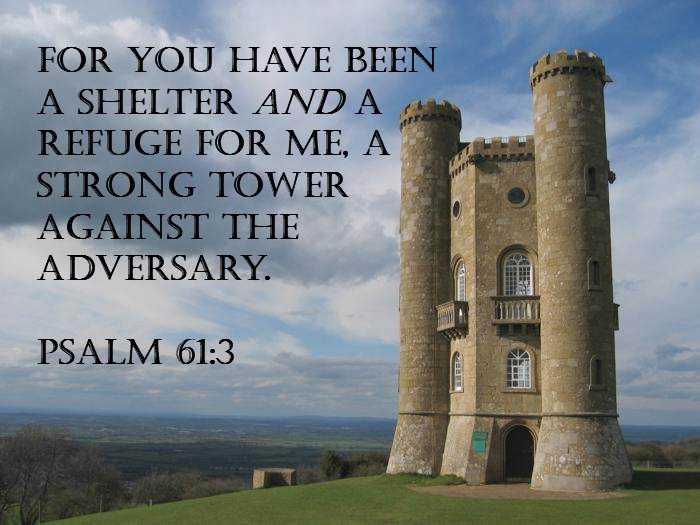
strongtower2

“And he said, “Listen, all Judah and inhabitants of Jerusalem and King Jehoshaphat: Thus says the Lord to you, ‘Do not be afraid and do not be dismayed at this great horde, for the battle is not yours but God’s.”

2 Chronicles 20:15, ESV

flourish10

We certainly don’t face a human army, yet the spiritual battle is just as consuming. Satan and his hordes are working 24/7 to capture our hearts and minds. He wants to enslave our spirits, and to assimilate us into his rebellion against God. For the broken believer, we know where we are weakest. Satanic influence can be fierce. However we are not alone.

Jehoshaphat’s own situation was precarious. Vastly out numbered, his own troops were about to be slaughtered and Jerusalem captured. Jehoshaphat responds by praying. He acknowledges God, and asks for divine help. We find him desperate, and that is how humility grows.

‘Do not be afraid and do not be dismayed at this great horde, for the battle is not yours but God’s.”

When God intervenes, we can only watch (and trust) His deliverance. King Jehoshaphat arranged for his army to be led by singers. There is a confidence here. Praise and worship is the way the enemy is defeated. “The battle belongs to God.” A great victory is won.

Make God your general. Infuse the atmosphere with prayer and praise. Impossible things are about to happen. Victory can be yours if you can only ‘get out of the way.’ This is the wisest and the safest course. (My worst defeats have come when I try my hardest to battle on my own.) When the enemy is pounding at the door, ask Jesus to answer it. He alone will bring you the victory.

P.S. Find a psalm– and then hide yourself in it.