All Joy

James 1:2

“There is no circumstance, no trouble, no testing, that can ever touch me until, first of all, it has gone past God and past Christ, right through to me. If it has come that far, it has come with a great purpose.” 

 Alan Redpath

“All joy,” (verse 2) is a fantastic thought. It stresses a joy that becomes something very powerful and significant. “All joy,” surpasses “some joy” or even “occasional joy.” Instead it’s a joy that remains joy even when tired and weak. It will only shine brighter in the darkness.

Jewels, diamonds, and pearls are typically displayed on a black background.

The black only reveals their brilliance. In the same way darkness should only encourage us to be deliberately brighter than our surroundings. We must understand that we shine only because He makes us shine.

There is a divine incandescence that awaits every believer who feels the need or desire for more of God. When your difficulty is illuminated by grace, it will shine out and proclaim His glory. Perhaps this is what true holiness really is.

The signs surrounding God’s nearness are available to each believer. He is close to those who want Him, and there is nothing will stand in His way. The Lord cherishes and treasures the seeking heart. There is nothing that can detour the believer’s yearning after their Father.

Name your trial, and then tie it to God’s throne.

It’s not yours. Leave it alone and refuse to carry it any further. It’s now the Lord’s concern. Simply watch for the deliverance to come. When God sees your heart, He will lavish Himself out on you.

You were never meant to carry that burden alone.

Worshiping With a Knife

 by the Forward

In Genesis 22, we have the story of Abraham and Isaac on Mt. Moriah.

Abraham has tied up his son on an altar to offer him as a sacrifice in obedience to God’s direction (v. 2). This is faith being tested to the ultimate extreme. And Abraham shows us how faith really works.

“Then on the third day Abraham lifted his eyes and saw the place afar off. And Abraham said to his young men, “Stay here with the donkey; the lad and I will go yonder and worship, and we will come back to you.”

Genesis 22:4-5

This is the first time that  the word “worship” is used in the Bible.

It sets the singular tone for all the scriptures on this subject. I guess what is interesting is there were no musical instruments involved. There was just these needful things:

  • stones,
  • wood,
  • rope,
  • fire,
  • a knife,
  • and Isaac, (the would-be ‘lamb.’)

There was just a handmade altar, and a sharp knife.

In the end, Abraham raises his knife, and then suddenly, (to the relief of us all) he is stopped. His faith has withstood the test, and he has truly ‘worshiped.’

But the Angel of the Lord called to him from heaven and said, “Abraham, Abraham!” So he said, “Here I am.” And He said, “Do not lay your hand on the lad, or do anything to him; for now I know that you fear God, since you have not withheld your son, your only son, from Me.”

Gen. 22:11-12

Principle One: There really can’t be worship without sacrifice.

Recovering this truth concerning worship is critical. It seems we delegate ‘worship’ to a select few who are talented and gifted. We probably don’t do this deliberately, but sometimes we feel it makes a better presentation. We all want to look good, even as Christians.

Principle Two: The first worshiper didn’t use a guitar, but a knife.

This difference keeps the idea of sacrifice in its definition. There isn’t worship without sacrifice. The knife thrust that he was ready to wield wasn’t backed up by drums or piano. Yet Abraham understood worship every step to Moriah with the knife in his belt.

So, brothers and sisters, because of God’s mercies, I encourage you to present your bodies as a living sacrifice that is holy and pleasing to God. This is your appropriate priestly service.”

Romans 12:1

Ultimately, we must realize our sacrifice is the Lamb of God. It’s His blood on God’s altar for our sins. As believers, our faith firmly rests in this spiritual fact.

We of all people have cause to really worship.

And no sacrifice should be too great for Him who gave Himself for us.

Especially Peter

Peter Running to the Empty Tomb, Burnard, c. 1898

And now go and tell his disciples, and especially Peter, that he will go ahead of you to Galilee. You will see him there, just as he told you.”

Mark 16:7, CEV

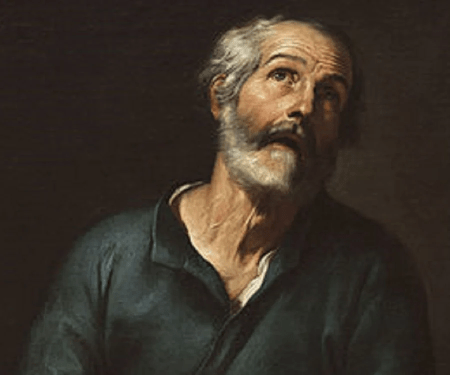
Poor Peter. Despairing over his personal darkness he has become completely undone.  His wound is beyond any human remedy.  No one can help him at this point. We do well to mark the fall of the ‘Rock.’ Peter is now how we understand our Father’s love.

Jesus had called him, the ‘Rock.’  This would become a bestowed nickname of a future transformation.  We use granite and marble when we want something to last for ages.  It is as permanent as we can make it. Peter is definitely a work-in-progress. His character is sand. He really doesn’t measure up.

Visiting a working quarry, you’ll find large machinery.  Men scale the walls with heavy drills.  At just the right spot they begin to bore a hole.  It is hard and intense work, but they are persistent.  The rock is unyielding, but they work relentlessly.

Soon they take the hole to the proper depth.  Explosives are hauled up, and the hole is carefully packed with dynamite.  The word used in the New Testament is the word “dunamis.”  It is translated from Greek into English as “power.”  Our word for “dynamite” is also a translation of that word.

Peter needs the dynamite power of the Holy Spirit. It is explosive. 

“But you will receive dynamite when the Holy Spirit has come upon you; and you shall be My witnesses both in Jerusalem, and in all Judea and Samaria, and even to the remotest part of the earth.”
Acts 1:8

Jesus looks after each disciple before his resurrection.  He kindly gazes at Peter. Especially Peter.  He will need this new power to overcome his weaknesses. The dynamite of the Spirit will explode all over the Upper Room. Shifty Peter us about to become a rock.

His disciples, in just 50 days are going to meet the Holy Spirit. 

Peter was so transformed on Pentecost he would preach and 3,000 would believe and be baptized. He went from cowardly denier to bold preacher. The dunamis of God changed him that day (Acts 2).

As a broken believer, I see the image of Peter morphing into my own face. I have denied Him before others. I am ashamed of what I have done. My depression flares up and my heart goes down in a downward spiral. I must have the Holy Spirit’s authority to be free.

Bryan

Repeat Offenders

“Father, every family has a rascal someone who breaks the rules a juvenile delinquent of untold frustrations and sleepless nights a repeated offender and bearer of sad woe the problem child who needs the most discipline.

Is this why you love me most persistently? When you correct me, is it because I’m the one most contrary?

Or is it that you love me so much?”

 I wrote this thinking about Hebrews 12 and God’s purpose of chastening. I don’t pretend to understand this dynamic completely–all I can say is that my childhood was punctuated by much difficulty. But now, as a father (my two children are now grown), fatherhood has become far easier than my dad had with me.

7 “As you endure this divine discipline, remember that God is treating you as his own children. Who ever heard of a child who is never disciplined by its father? 10 For our earthly fathers disciplined us for a few years, doing the best they knew how.

But God’s discipline is always good for us, so that we might share in his holiness. 11 No discipline is enjoyable while it is happening—it’s painful! But afterward there will be a peaceful harvest of right living for those who are trained in this way.”

Hebrews 12:7, 10-11

I really think we understand our Heavenly Father when we spend quality time with Hebrews 12. We are given insight into His care and into our own issues. It is a good thing He gives us— it enriches our spiritual lives.

It’s never nice to be corrected.

It’s not pleasant. Part of being corrected is being reminded that we’re not as righteous as we think we are. To be corrected strikes us to a reprimand, an admonition that something isn’t right inside of us.

The Father corrects His children–in many ways through a myriad of circumstances. He loves us far too much to allow us to continue in our sin. He’s making us into the image of Christ.

We should welcome His correction. He has a plan for you.

When He disciplines you, it only proves that He is your Father. It’s critical to remember: God’s correction is always for our good. It may be painful yes, but it comes with real hope. It’s not to harm or punish you.

“Father, I’m so sorry that I grieve you as often as I do. I promise to behave. Thank you for being a faithful Father who cares deeply for my soul. Amen.”

 Hannah Whitall Smith.