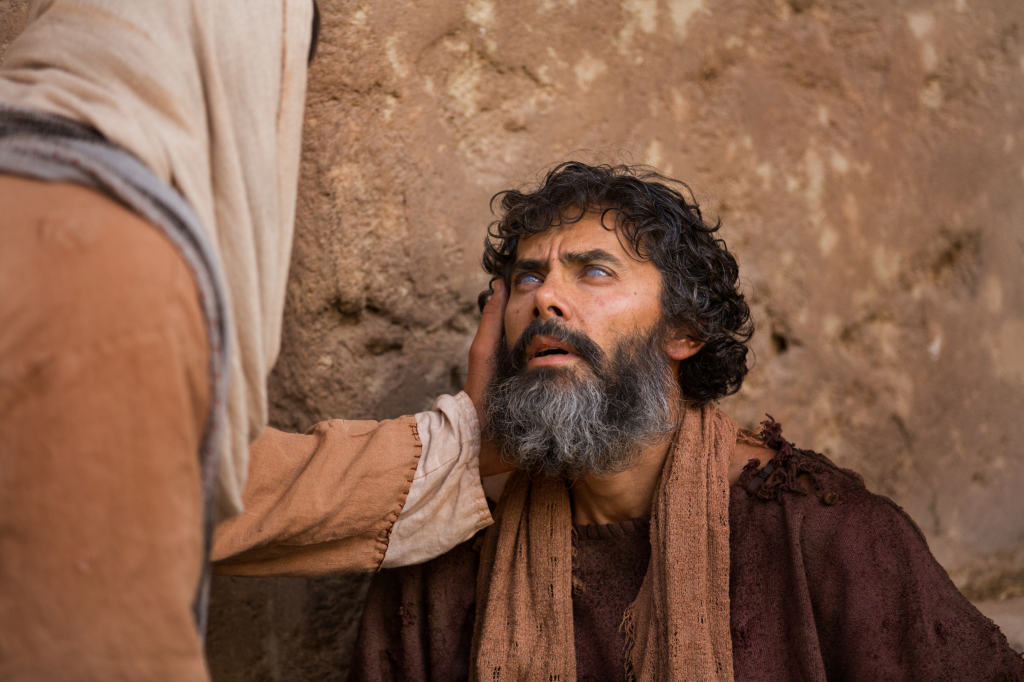
Blind From Birth

John 9:1-7

As he was walking along, he saw a man blind from birth.

“Master,” his disciples asked him, “why was this man born blind? Was it a result of his own sins or those of his parents?”

“Neither,” Jesus answered. “But to demonstrate the power of God. All of us must quickly carry out the tasks assigned us by the one who sent me, for there is little time left before the night falls and all work comes to an end. But while I am still here in the world, I give it my light.”

Then he spat on the ground and made mud from the spittle and smoothed the mud over the blind man’s eyes, and told him, “Go and wash in the Pool of Siloam” (the word Siloam means “Sent”). So the man went where nd washed and came back seeing!

Up to now I’ve tried to approach these posts from the first person viewpoint. Ihoped to understand those who met face-to-face with Jesus. I wanted to grasp what they were seeing through their own eyes. But I intend with this post to revert back to a more traditional approach to this passage.

First, we’re introduced to a man who is blind from birth.

I can’t even imagine what that would be like (just as he probably could imagine having sight). I’ve been told that he probably didn’t have a “dream” life–that requires having seen images (a dog, a tree, a mean person) and this wasn’t available to him. He never saw the color red, or seen a mountain. (He didn’t have the circuitry.)

I suppose we can only imagine what blindness like this would be.

Somehow I’ve come to an idea that this represents fallen men–we’re spiritually blind to the workings and truths of Jesus’ Kingdom. It seems a pretty good explanation of each of us–“blind from birth.”

Secondly, notice the response of the disciples who first met this unfortunate man. They don’t see his needs, rather they want to know the theology behind this. Perhaps that’s how we respond much of the time–we don’t see the needs, we only want to know the reasons. We’re not wise or discerning enough to see what’s going on–in short we’re not equipped to love or show mercy. (We haven’t got the circuitry.)

Perhaps this is how we operate as immature Christians.

We don’t engage the need, but rather we like having great theology over understanding compassion. If we really don’t love needy people, we miss so much. We don’t ever grow up. It’s easy to philosophize–it’s hard to get down and serve and really love others.

It’s funny but Jesus declares Himself to be the light of the world while speaking to the man who is born blind.

Third, we discover the gentle mercy that Jesus has when He meets needy people. Now the Lord does accommodate His followers, but not at the expense of engaging the need of the moment. Jesus is full of compassion–most especially when He meets broken people–and as His followers, we must grasp this.

Good theology is not the primary calling of Jesus’ followers.

As I mature in Christ I’m learning (slowly) that people are His real focus. He has come, not to theologize or philosophize, but to meet needs! Sure the reasons why become clearer, but that really isn’t Jesus’ primary goal. People are, not having impeccable theology.

Classes in systematic theology are good, but soup kitchens are better.

The miracle happens, and Jesus’ love and desire to restore this man is ‘front and center.’ The Lord’s methodology is interesting. Spit and mud, wiped on the blind man’s eyes. In Genesis we discover that God made man out of dirt and dust of the ground. Perhaps what He’s doing here mirrors that work.

And it’s also important to understand that Jesus never performs the exact same healing in the exact same way. For some reason He ‘tailors’ His work to the individuals deepest need. I suppose He doesn’t want us to grab a hold of a formula, as that’s what we want to have.

The story is primarily about a blind man’s healing.

It’s not theology, and it certainly isn’t about what is proper and acceptable. We really must understand this, and we really need to understand the tremendous mercy and power of God to both heal and restore.

Image: MCCC. Text from the “Living Bible,” published by Tyndale House

What Good are the Miracles of Jesus?

His touch makes the difference

But if I do it, even though you do not believe me, believe the miracles, that you may know and understand that the Father is in me, and I in the Father.” 

–John 10:38

The healing’s Jesus boldly attest to his claim to be God.  When we read about them, as recorded in the Gospels, we cannot doubt their real and supernatural flavor.  A normal person cannot give sight to someone who has been blind from birth.  I cannot raise a dead person, it’s simply not even in the basic realm of remote possibility.

Jesus performed hundreds and hundreds of healing’s.

Many of these are not recorded in the Scriptures except through a vague and veiled reference to them.  There were not just healing’s, but he also did miracles over natural laws.  Water gets turned into wine, He walks on the Sea of Galilee, see Him feeding 5000 people with a little boys simple lunch.

You would think that the presentation of each miracle would bring a person to faith.  But that is not the case.  We process them, and then assimilate them to the point where we can more or less nullify them.  “Sure Jesus raised a widow’s son from the dead,” we say–but then we inoculate ourselves against the truth of it.  We deafen ourselves, and by our mental silence nullify the miracle.

We roll right over it. How many miracles have we seen on any given day?

I need, I must re-visit these supernatural events again and again.  They are a tonic to my jaded soul.  These miracles require that I pick them up by their handle and make them my own.  Jesus Christ is waiting for us to accept him as supernatural, because that is what he is. Get used to it.

Does the Lord Jesus still work miracles for you?

“Remember the wonders he has done,
 His miracles, and the judgments he pronounced,”

–Psalm 105:5

Related articles

The Magnificent God: “Getting All In”

miracle
 “If I were you, I would go to God
    and present my case to him.
He does great things too marvelous to understand.
    He performs countless miracles.

Job 5:8-9, New Living Translation

I’m back to reading Job– for the billionth time.  I decided this time, I will muscle through it.  (But I must admit my track record isn’t the greatest.)  I must tell you, the post that follows may not be for you, if your face turns red— stop! Don’t try to read anymore; it’s not for you. Walk away. It’s not worth it.

flourish-simple

These two verses, combined– create a mindset of a bold confidence.  The speaker (not Job the “wonder-guy,” but mere Eliphaz) creates an anticipation of ‘what if?’  His advice, is to turn it over and make it God’s issue.  Let Him deal with it, it is his job.  Lay these issues on his doorstep, ring his door-bell, and run away quick.

But the speaker goes right to the source– revealing a definite purpose.  People like this are uncommon, more or less rare.  But we admire them for it, after all it gives us ‘slackers’ a warm, fuzzy feeling as we gaze on their zeal.  But human solutions will rarely bring out a righteousness of God.  We see them, admire them, want to be like them… but guess what?  It fizzles out into an embarrassed realization as we start to understand; this isn’t going to work after all.

But we must bring our problems to Him.  I will not try to minimize this point.  We are not built to carry such loads.  We weren’t designed to do this.  We approach Him (with some trepidation, if we are reasonably sane) with these ugly and heavy burdens.  But we don’t ring His doorbell and run. Rather we stand to meet Him, face-to-face.

“God does wonders that cannot be understood; 
he does so many miracles they cannot be counted.” 

Verse 9 speaks out of a reflective and knowing heart.  The speaker understands that God works miracles; He has the “ultimate track record.” He does the outrageous; He does things that no one else can do! He is like a magician– wonders happen. The speaker grasps something here.  The God who he seeks is a miracle-working God.  He is so utterly convinced of this fact that he brings it before Job as a ‘plan-of-action.’

And what can we say?  I think there is a lot of ignorance among some who call themselves “believers.”  We catch a fleeting glimpse of His Glory, and suddenly we launch a ministry and a “speaking tour.”  In our very brief encounter with Him we suddenly become either theologians, or talk-show hosts of the religious persuasion (of course, on TV).

There are no crispy clean answers, but as we humbly, and seek Him brokenly– without any aggrandizement or posturing, He will work.  But we must deal with our own urge for “hucksterism” or a feeble manipulation.  It can’t, and won’t work, at least not the way we think it will.

Connecting with Him is not super hard, but it will cost us everything we have. When it is truly real, you will know it by a price that must be paid.

bry-signat-1

cropped-christiangraffiti1 (2)